Housing fire risk assessments explained: BS 9792:2025 for flats and HMOs
Video, 7:41Published 23 October 2026Last reviewed 24 October 2026
Plays from YouTube in privacy-enhanced mode once you press play.
In England, the shared parts of every block of flats and house in multiple occupation must have a fire risk assessment. Since 31 August 2025, the British Standard code of practice for doing that in housing has been BS 9792. In this guide, we'll cover the law, what the standard covers, its nine steps, the four types of assessment, what an assessment is not, competence, how often to review, and residents who need extra help.
The guide below is the video's narration, chapter by chapter, with the diagram from each chapter.
Where the duty comes from

The duty comes from the Fire Safety Order. It applies to the common parts of blocks of flats and houses in multiple occupation. And the Fire Safety Act 2021 made clear that it also covers the structure, the external walls, including cladding and balconies, and the front doors of individual flats.
Since 1 October 2023, the responsible person must record the whole assessment, in full, along with the name of anyone who helped make it. The flats themselves fall outside the Order.
What BS 9792 is
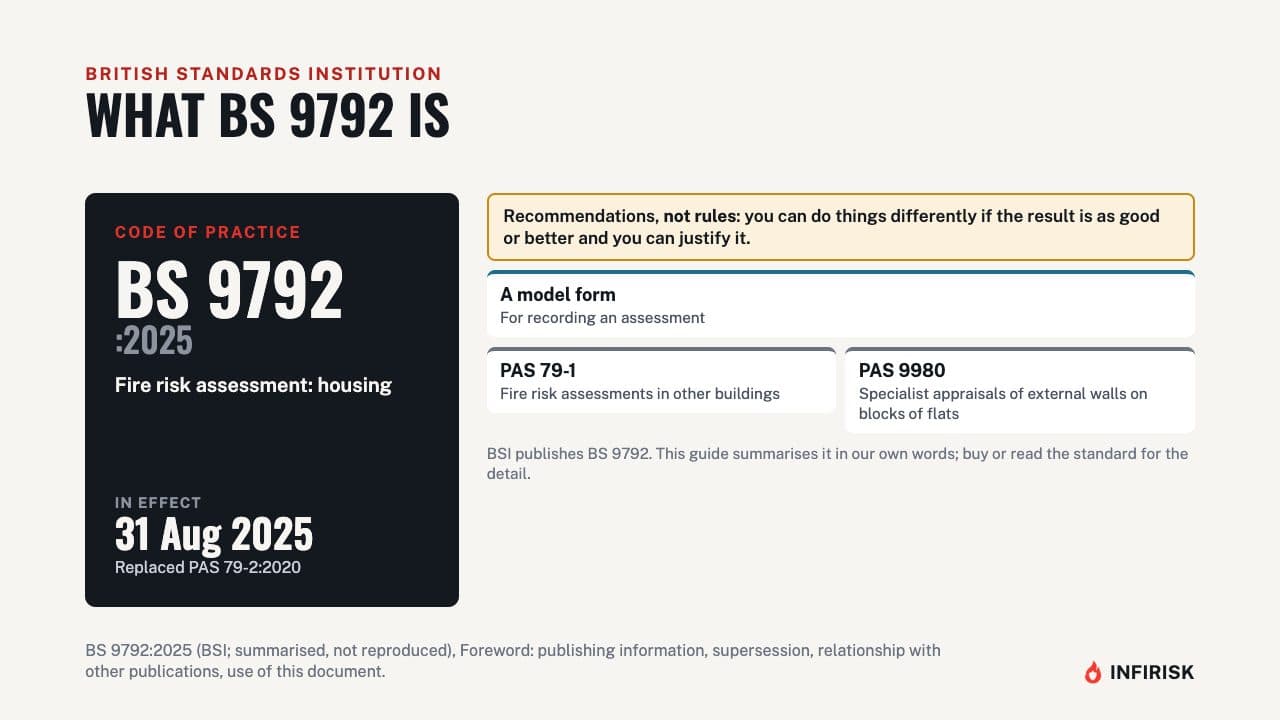
BS 9792 is a code of practice published by BSI. It came into effect on 31 August 2025 and replaced PAS 79-2. It gives recommendations, not rules, so you can do things differently if the result is as good or better and you can justify it.
It also includes a model form for recording an assessment. Fire risk assessments in other buildings are covered by PAS 79-1, and specialist appraisals of external walls on blocks of flats by PAS 9980. This guide summarises the standard in our own words.
What the standard covers
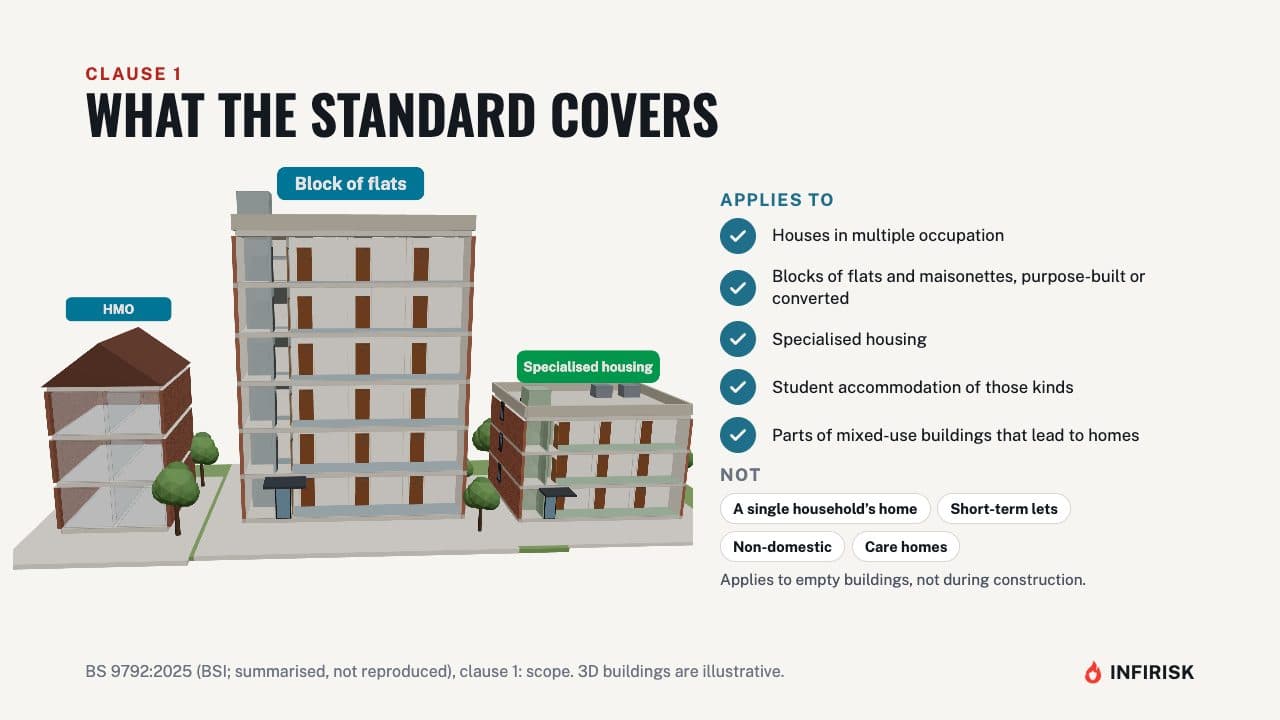
The standard applies to houses in multiple occupation, to blocks of flats and maisonettes, whether purpose-built or converted, to specialised housing, to student accommodation of those kinds, and to the parts of mixed-use buildings that lead to homes. It doesn't apply to a single household's own home, to short-term lets, to non-domestic buildings or to residential care homes. It applies to empty buildings too, but not while they're still under construction.
Nine steps
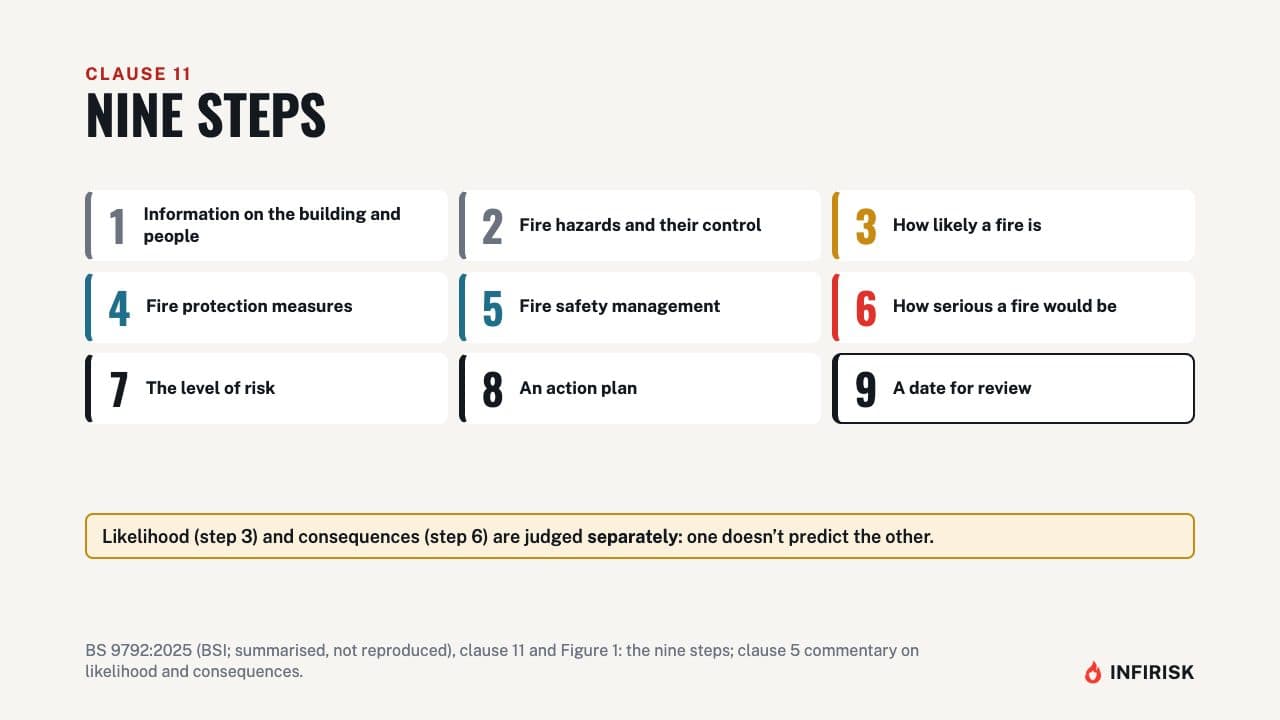
BS 9792 sets out nine steps. Gather information about the building and the people in it. Identify the fire hazards and how they're controlled.
Judge how likely a fire is. Look at the fire protection measures, and at how fire safety is managed. Judge how serious the consequences of a fire would be.
Then decide the level of risk, write an action plan, and set a date for review. Likelihood and consequences are judged separately, because one doesn't predict the other.
Four types of assessment
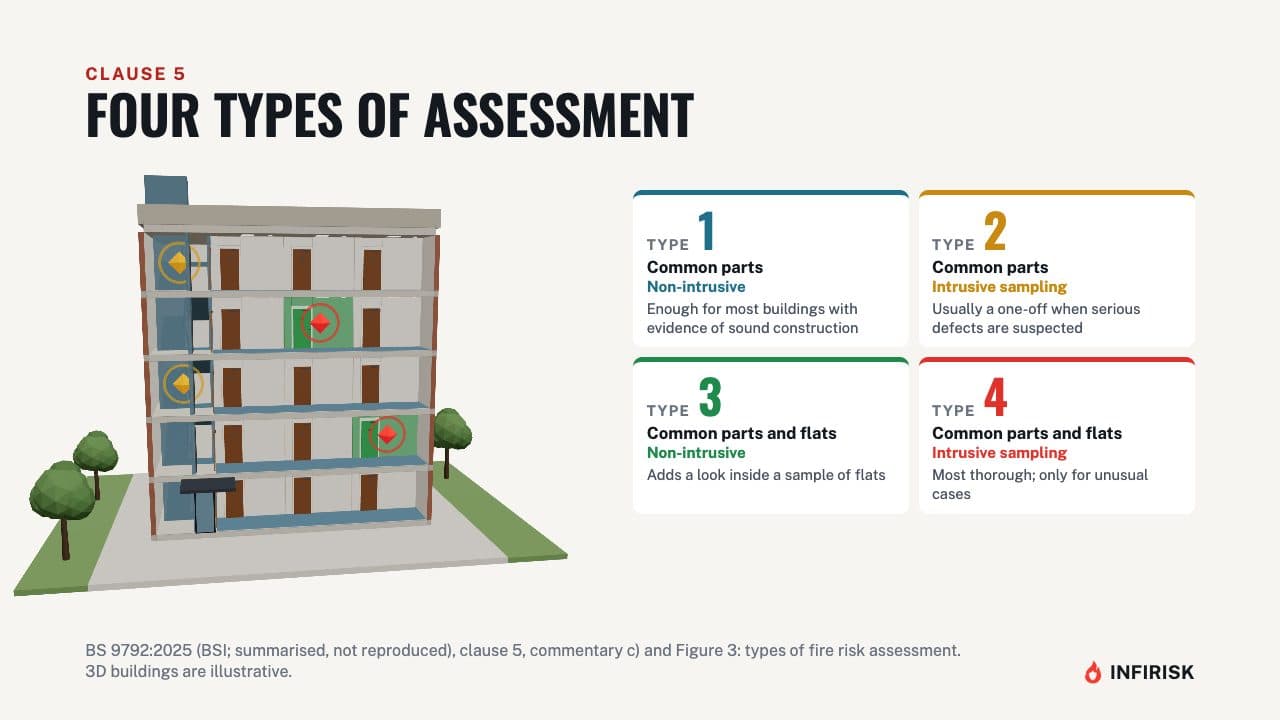
There are four types of assessment. A Type 1 looks at the common parts without opening anything up, and is enough for most buildings where there's evidence the construction is sound. A Type 2 adds intrusive sampling in the common parts, usually a one-off when serious defects are suspected.
A Type 3 adds a non-intrusive look inside a sample of the flats. A Type 4 adds intrusive sampling in the flats as well. It's the most thorough, and only for unusual cases, like a new landlord with no history of past works.
What a Type 1 includes
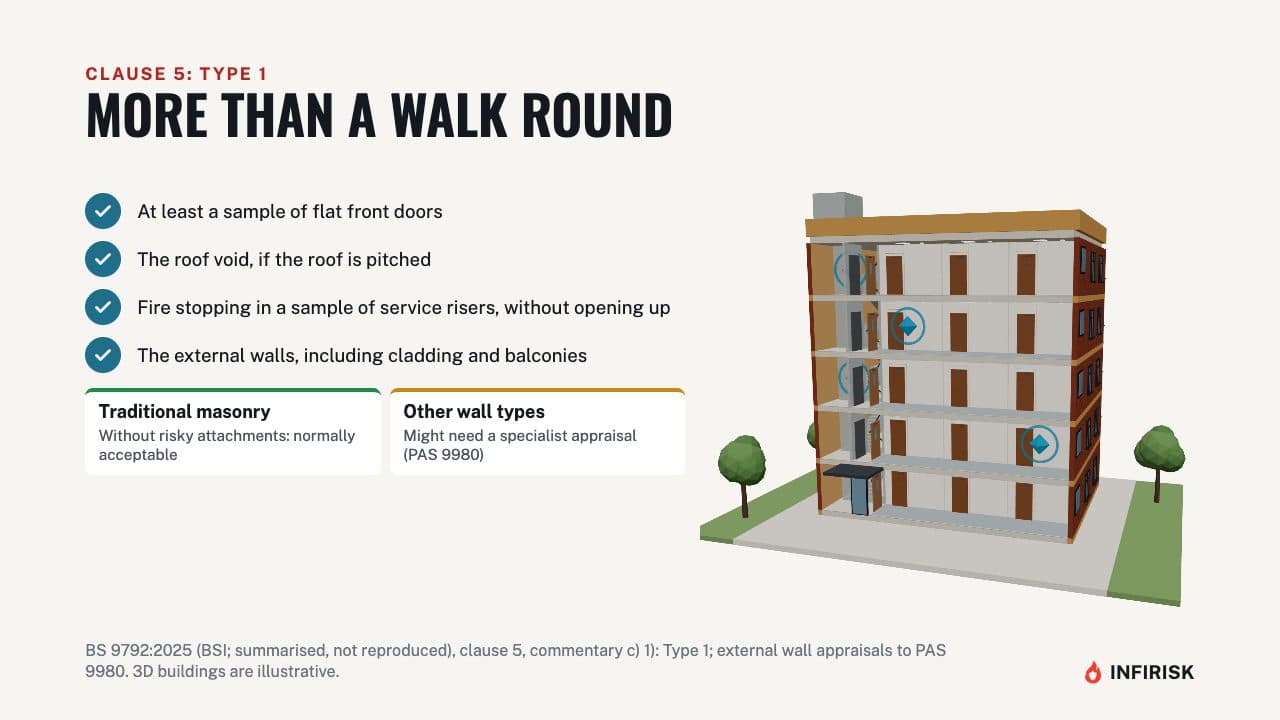
Even a Type 1 goes further than a walk round. It includes at least a sample of flat front doors, and the roof void if the roof is pitched. It also looks at the construction between the flats and the common parts, such as fire stopping in a sample of service risers, as far as can be seen without opening up.
It considers the external walls too. Traditional masonry walls without risky attachments are normally acceptable, but other wall types might need a specialist appraisal.
What an assessment is not
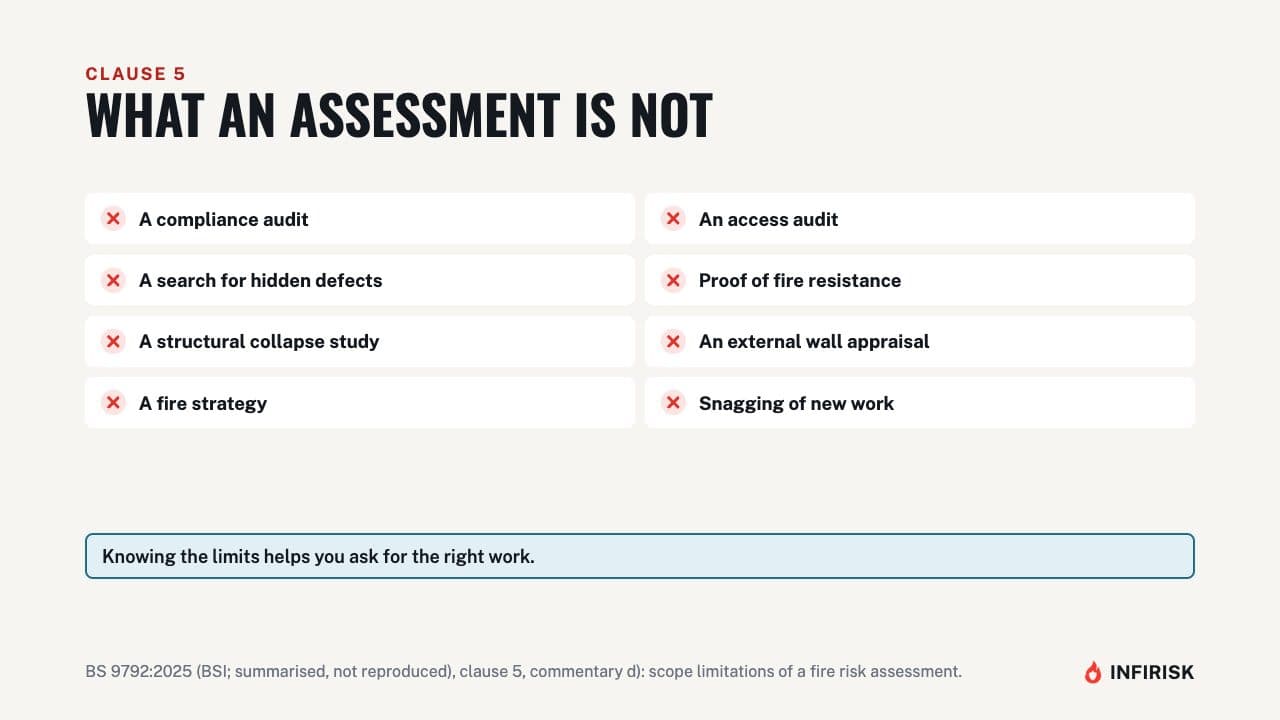
A fire risk assessment is not everything. It isn't a compliance audit, or an access audit for disabled people. It won't find hidden defects in construction, prove the fire resistance of the structure, or work out whether the building could collapse in a fire.
It isn't an external wall appraisal, a fire strategy, or a snagging check on new work. Knowing these limits helps you ask for the right work.
Who should carry it out
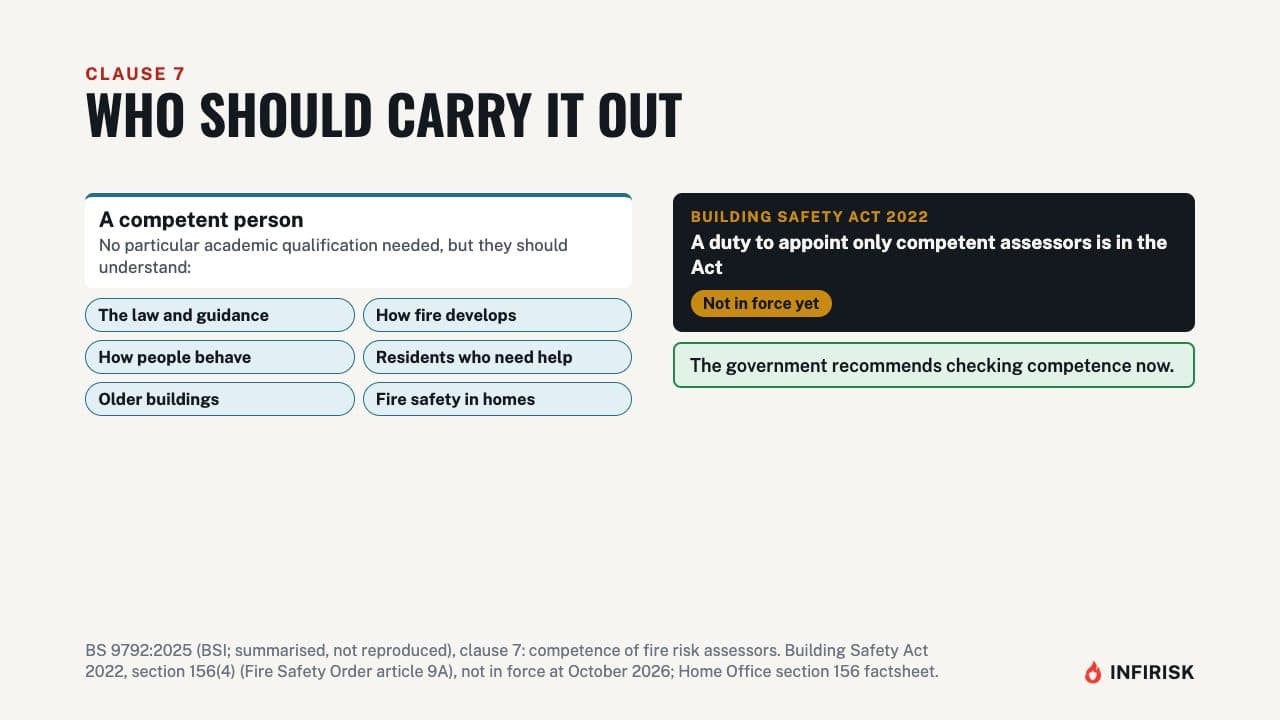
Who should carry it out? BS 9792 says a competent person. They don't need a particular academic qualification, but they should understand the law and the guidance, and how fire develops and how people behave.
They should understand the needs of residents who may need help to escape, older buildings built to earlier standards, and fire safety inside homes. The Building Safety Act includes a duty to appoint only competent assessors, but that part isn't in force yet. The government recommends checking competence now.
How often to review

An assessment should be reviewed after material alterations or a change of use, and after a fire. It should also be reviewed after significant changes to what the assessment relied on or to the fire precautions, when a regulator asks, and at the interval the assessment sets. As a rough guide, the standard suggests a low-risk, low-rise block might have a review every two years and a new assessment every four, and higher-risk blocks a review every year and a new assessment every three.
These are not fixed rules.
Residents who need extra help
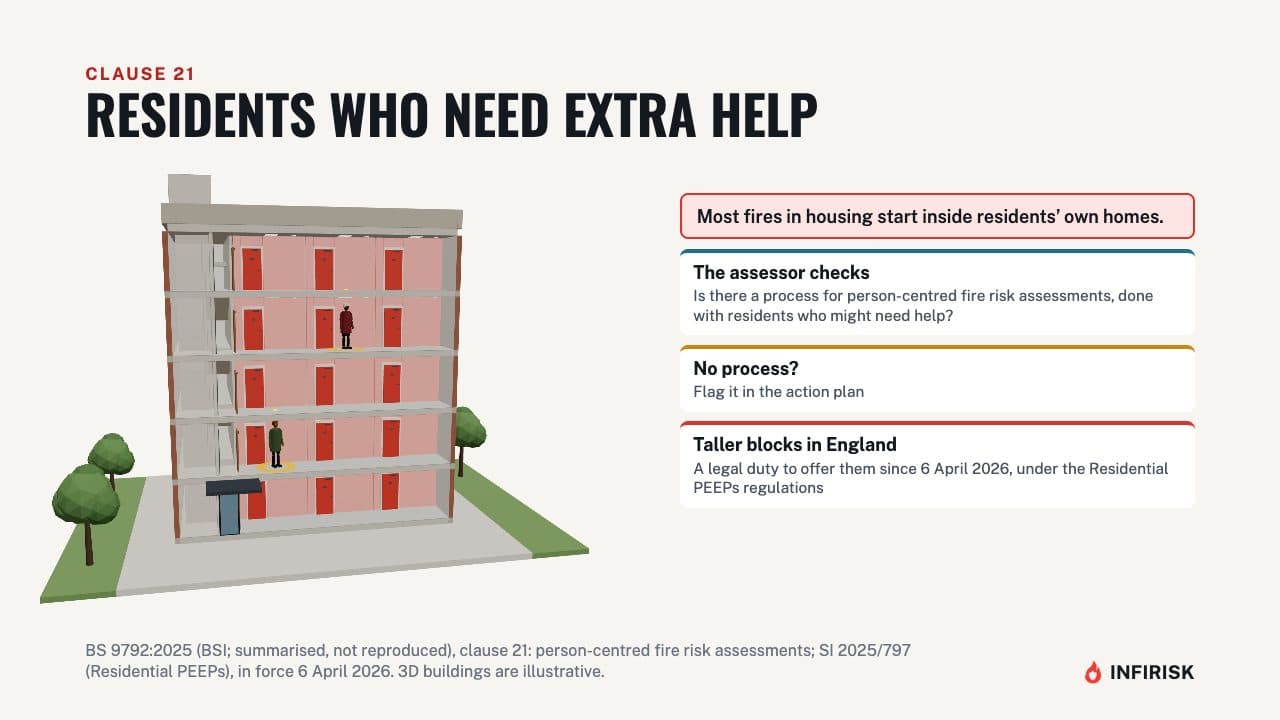
Most fires in housing start inside residents' own homes. So BS 9792 asks the assessor to check whether there's a process for person-centred fire risk assessments, done with residents who might need help, and to flag it in the action plan if there isn't. In England, taller blocks now have a legal duty to offer these assessments, under the Residential PEEPs regulations that came into force on 6 April 2026.
Frequently asked questions
What replaced PAS 79-2?
BS 9792, the code of practice for fire risk assessment in housing, published by BSI. It came into effect on 31 August 2025 and replaced PAS 79-2. It gives recommendations, not rules, and includes a model form for recording an assessment.
What are the four types of fire risk assessment?
A Type 1 looks at the common parts without opening anything up. A Type 2 adds intrusive sampling in the common parts. A Type 3 adds a non-intrusive look inside a sample of flats, and a Type 4 adds intrusive sampling in the flats as well.
Is a Type 1 assessment enough for a block of flats?
It is enough for most buildings where there's evidence the construction is sound. Even a Type 1 includes at least a sample of flat front doors, the roof void if the roof is pitched, and fire stopping in a sample of service risers as far as can be seen, and it considers the external walls.
How often should a housing fire risk assessment be reviewed?
After material alterations, a change of use, a fire, or significant changes, when a regulator asks, and at the interval the assessment sets. As a rough guide, BS 9792 suggests a low-risk, low-rise block might have a review every two years and a new assessment every four, and higher-risk blocks a review every year and a new assessment every three.
Who can carry out a housing fire risk assessment?
BS 9792 says a competent person. No particular academic qualification is needed, but they should understand the law and guidance, how fire develops and how people behave, residents who may need help to escape, and older buildings built to earlier standards.
Sources
Written against
- BS 9792 Fire risk assessment. Housing. Code of practice, BS 9792:2025
- Fire Safety Act 2021, 2021 c. 24
- Check your fire safety responsibilities under section 156 of the Building Safety Act 2022, Current GOV.UK guidance
General guidance for England, not professional or legal advice. Always check the current edition of the guidance, and agree any design with building control or a competent fire safety professional. Contains public sector information licensed under the Open Government Licence v3.0.
More from British Standards Explained
 4:41Video and guide
BS 5839-6 explained for landlords: smoke alarm rules for rented homes in England
The legal minimum for landlords in England, what the BS 5839-6 grades and categories mean, and what to aim for in a rented home.
 9:38Video and guide
Fire alarm categories explained: BS 5839-1 L1 to L5, M, P1 and P2
What each BS 5839-1 fire alarm category covers, what changed in 2025, where call points go, how loud the alarm must be, and how to test and maintain a system.
 9:54Video and guide
Emergency lighting explained: where it's needed, how much light, and testing
What emergency lighting is, when the law requires it, where Approved Document B expects it, the 2025 edition of BS 5266-1, light levels, siting, duration and testing.
- 6 min readINFIRISK guideWritten guide
Fire extinguishers explained: types, colours, how many you need and servicing
What the law requires, the classes of fire, extinguisher types and colours, how many and where, kitchens, electrics and batteries, checks, servicing and training.
Related guides
 6:48Video and guide
Fire risk assessments explained: who needs one, what it covers, and what the law says
The Fire Safety Order in plain English: what a fire risk assessment is, who must have one, what it looks at, what to record, and what happens if it is missing.
- 3 min readINFIRISK guideWritten guide
Awaab's Law and fire hazards: repair deadlines for social homes from November 2026
Which social homes Awaab's Law covers, what counts as a fire hazard, the emergency and significant hazard deadlines, and where the Fire Safety Order takes over.
 5:54Video and guide
E-bike and e-scooter battery fires: buying, charging and the warning signs
Thermal runaway in plain English, what makes a fire more likely, buying and charging safely, the warning signs, and the law for sellers and shared buildings.
 18:09Case study · 1987 · Transport
The King's Cross fire 1987 explained: the trench effect, the flashover and the Fennell investigation
How a lit match under a wooden escalator became the flashover that killed 31 people at King's Cross in 1987, why the trench effect drove it into the ticket hall, and what the Fennell investigation changed.
31 deaths, including 1 firefighter