Fire extinguishers explained: types, colours, how many you need and servicing
Published 23 October 2026Last reviewed 23 October 2026
A portable fire extinguisher can stop a small fire becoming a big one, but only if it's the right type, in the right place, and it works. In this guide, we'll cover what the law requires, the classes of fire, the types of extinguisher and their colours, how many you need and where they go, kitchens, electrics and batteries, checks and servicing, and training.
What the law requires
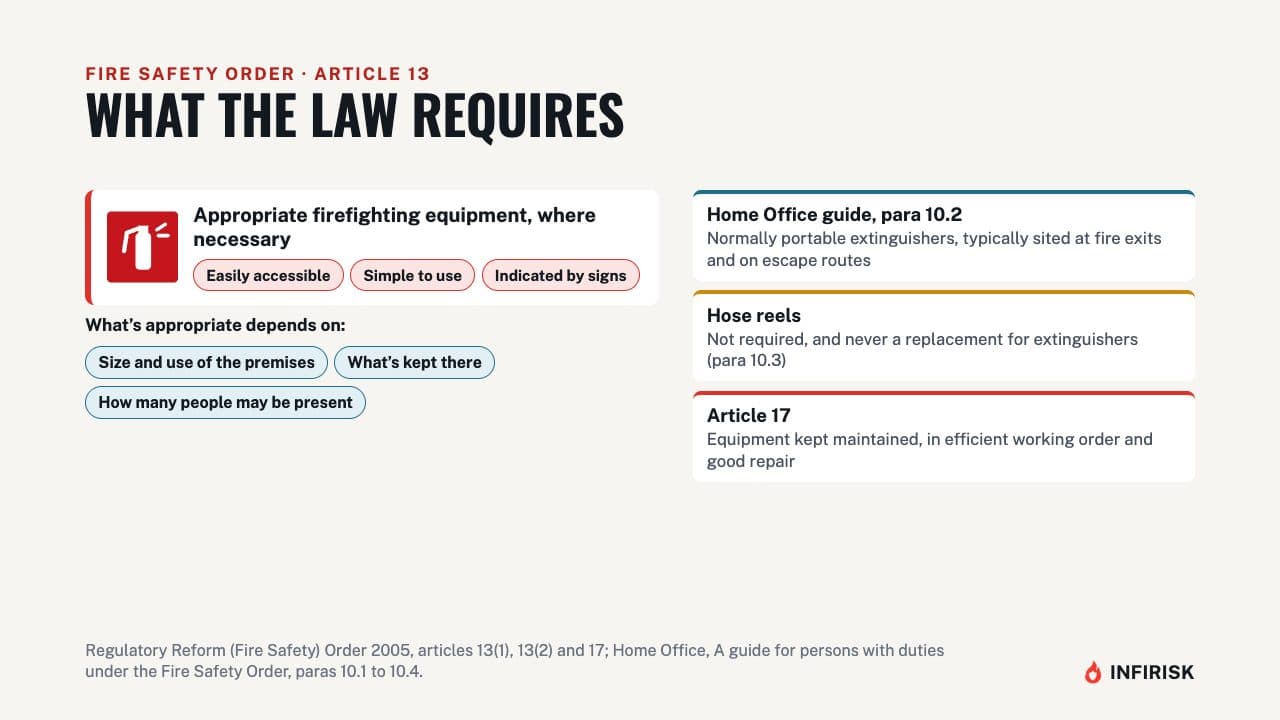
Article 13 of the Fire Safety Order requires the responsible person, where necessary, to provide appropriate firefighting equipment that is easily accessible, simple to use, and indicated by signs. What's appropriate depends on the size and use of the premises, what's kept there, and how many people may be present. The Home Office guide says this will normally mean portable extinguishers, typically sited at fire exits and on escape routes.
Hose reels aren't required, and never replace extinguishers. And article 17 requires the equipment to be maintained.
Three parts of BS 5306
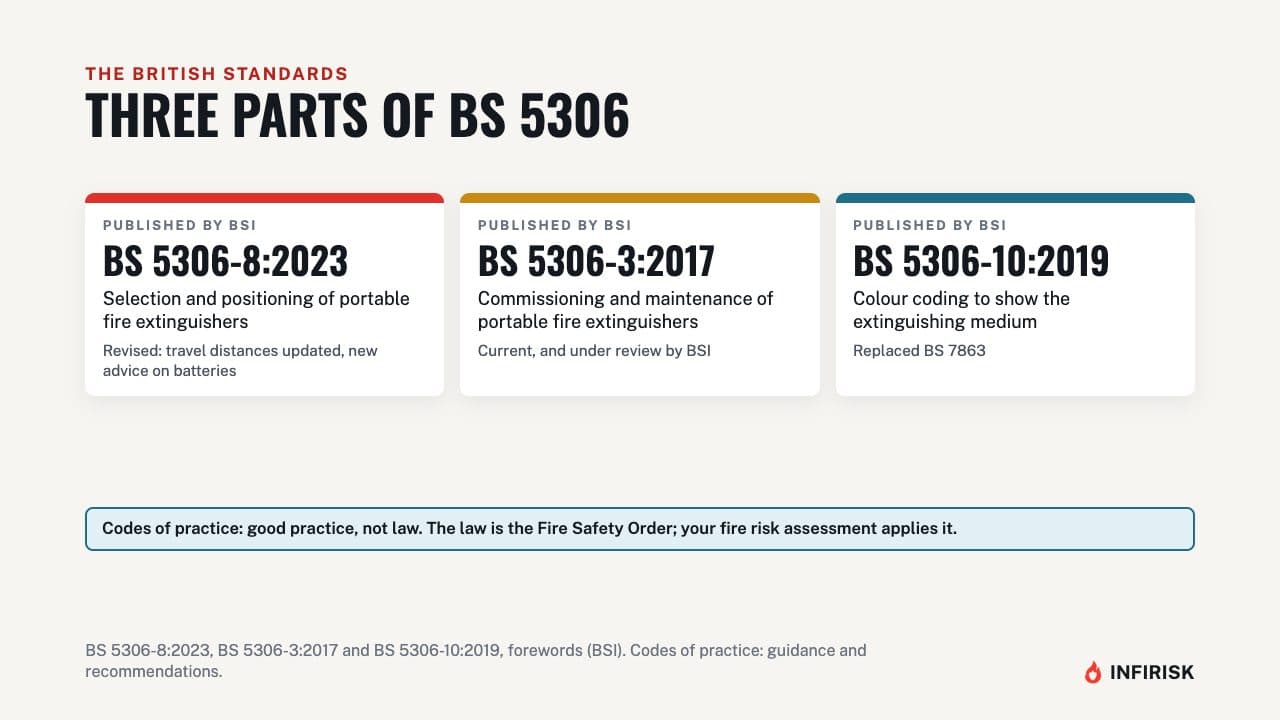
Good practice is set out in three parts of BS 5306, published by BSI. Part 8, the 2023 edition, covers choosing and positioning portable extinguishers. Its revision updated the travel distances and added new advice on batteries.
Part 3, from 2017, covers commissioning and maintenance, and BSI is reviewing it. And part 10 sets the colour codes that show what's inside.
Classes of fire
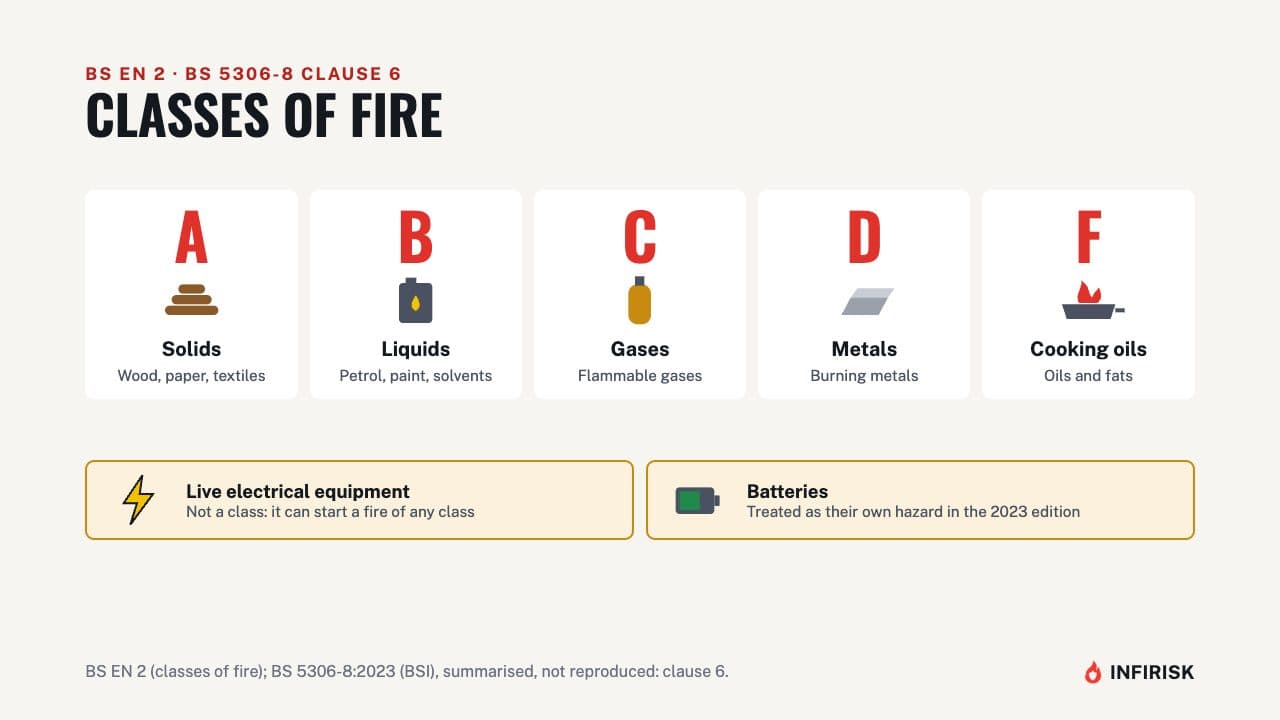
Fires are grouped into classes, defined in BS EN 2. Class A is ordinary solids, like wood, paper and textiles. Class B is flammable liquids, like petrol, paint or solvents.
Class C is flammable gases. Class D is burning metals. And class F is cooking oils and fats.
Electricity isn't a class of its own, because live equipment can start any of them, but BS 5306-8 treats it as a separate hazard, along with batteries.
Types and colour codes
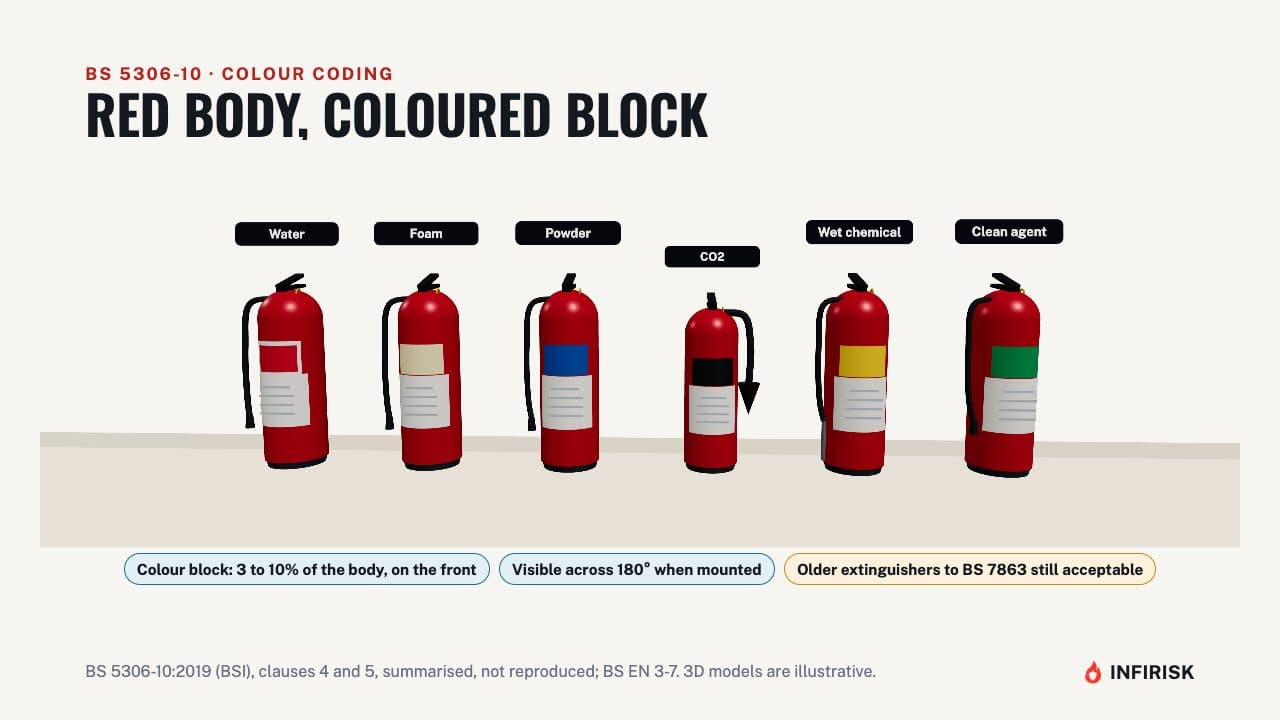
Every extinguisher has a red body, with a block of colour on the front to show what's inside. BS 5306-10 sets the colours. Water is red, with a border so it stands out.
Foam is cream. Powder is blue. Carbon dioxide is black.
Wet chemical is yellow. And clean agent is green. The coloured area covers between 3 and 10 percent of the body, and should be visible across a half circle in front of the extinguisher when it's mounted.
Extinguishers made to the older standard it replaced may still be in service, and are still acceptable.
Which one for which fire
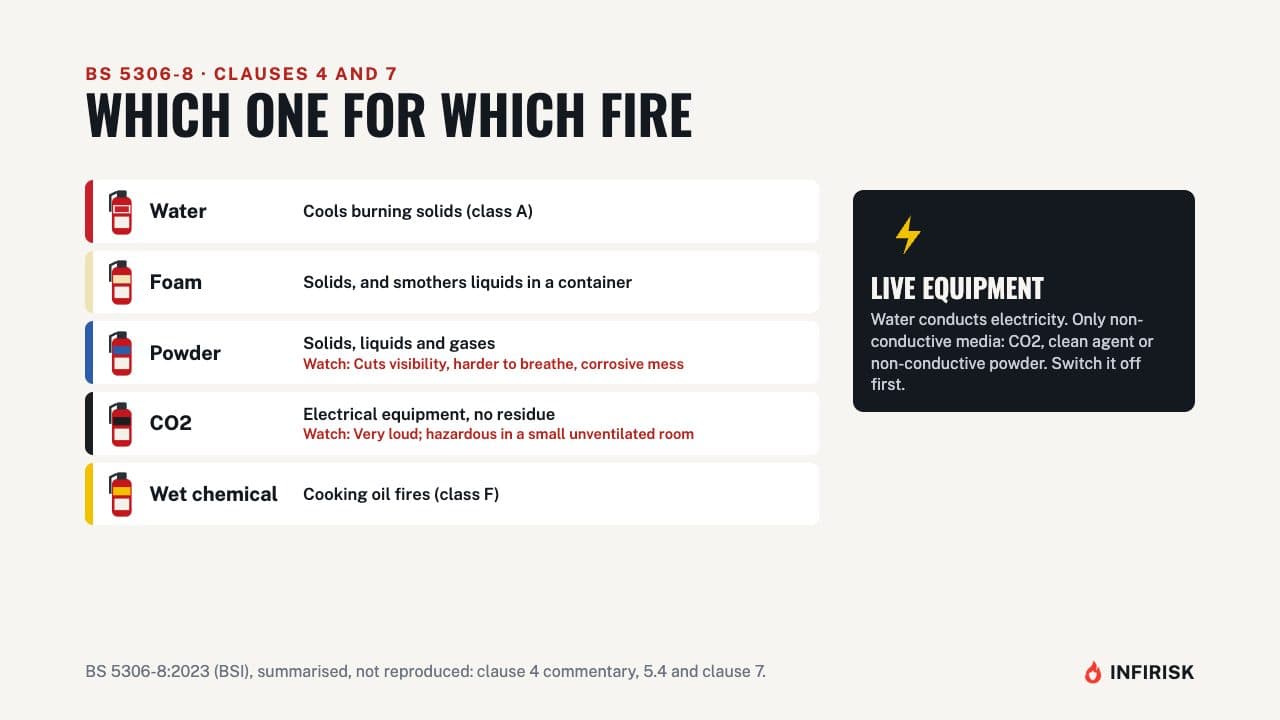
Which one for which fire? Water cools burning solids, and foam does too, while also smothering burning liquids in a container. Powder tackles solids, liquids and gases, but it cuts visibility, can make breathing harder, and leaves a corrosive mess.
Carbon dioxide suits electrical equipment and leaves no residue, but it's very loud, and can be hazardous in a small room without ventilation. Wet chemical is for cooking oil fires. And because water conducts electricity, only non-conductive media, like carbon dioxide, clean agent or non-conductive powder, should go near live equipment, which should be switched off first.
How many you need
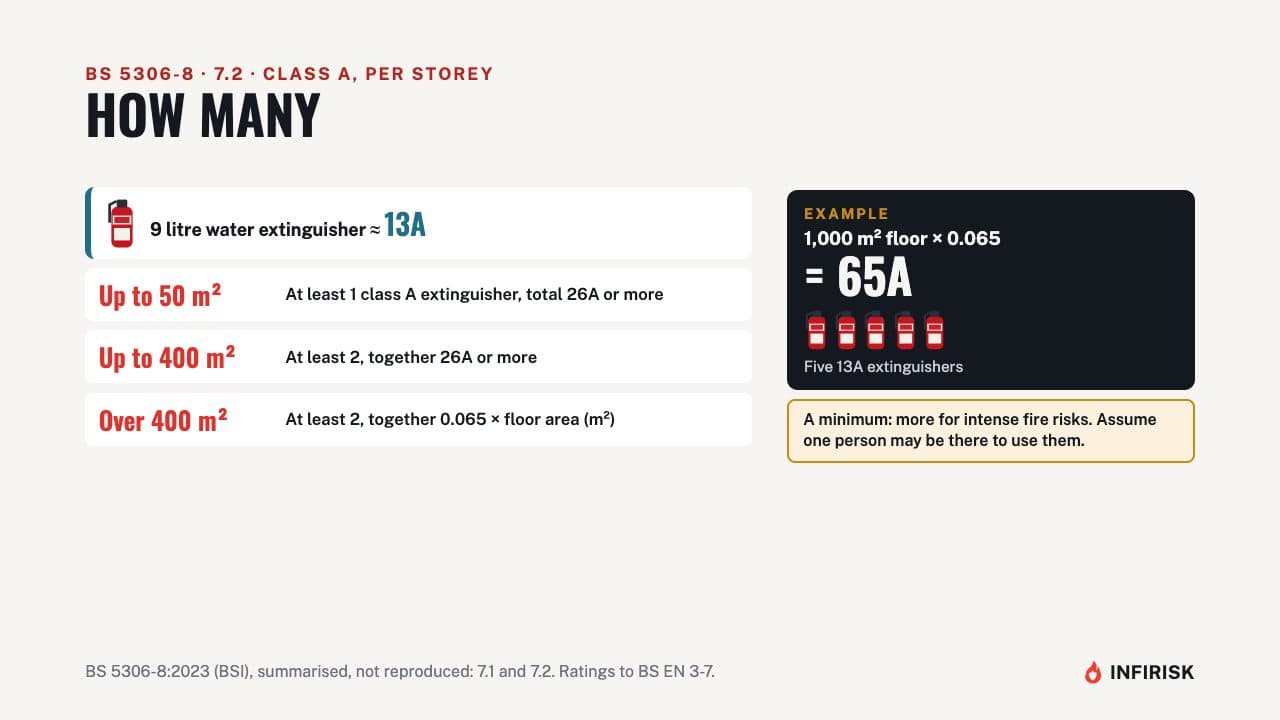
How many? BS 5306-8 sets a minimum for class A fires, storey by storey, using fire ratings. A 9 litre water extinguisher typically achieves a 13A rating.
A storey of up to 50 square metres needs at least one class A extinguisher, with a total rating of at least 26A. Up to 400 square metres, at least two, together rated at least 26A. Above that, at least two, with a combined rating of at least 0.065 times the floor area.
So a 1,000 square metre floor needs at least 65A, which is five 13A extinguishers. That's a minimum: add more where fire could be intense, and plan on the basis that only one person may be there to use them.
Where they go
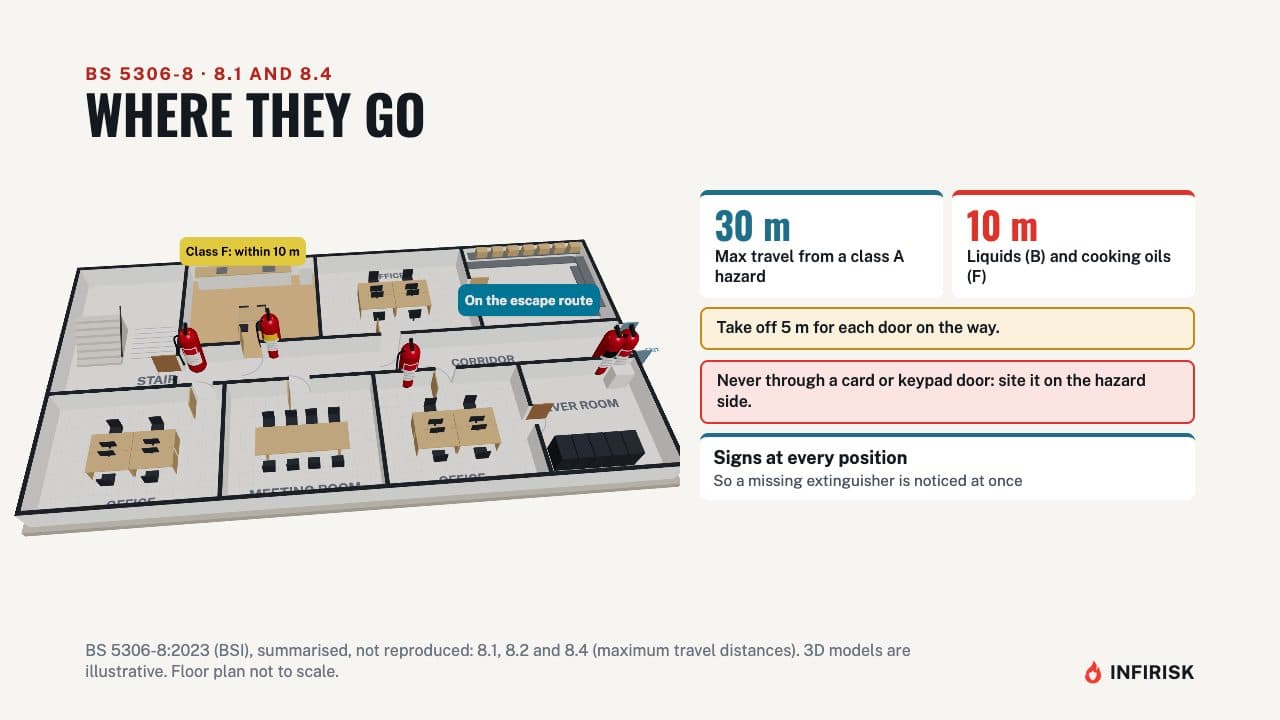
Where should they go? Somewhere obvious, on the route people take to escape: near room exits, in corridors, by stairs and on landings, and in the same place on each similar floor. Nobody should have to travel more than 30 metres from a class A fire hazard to reach an extinguisher.
For flammable liquids and cooking oils, it's 10 metres. Take off 5 metres for every door on the way, and never make someone pass through a door with a card or keypad lock. And mark each position with a sign, so a missing extinguisher is noticed.
Mounting heights
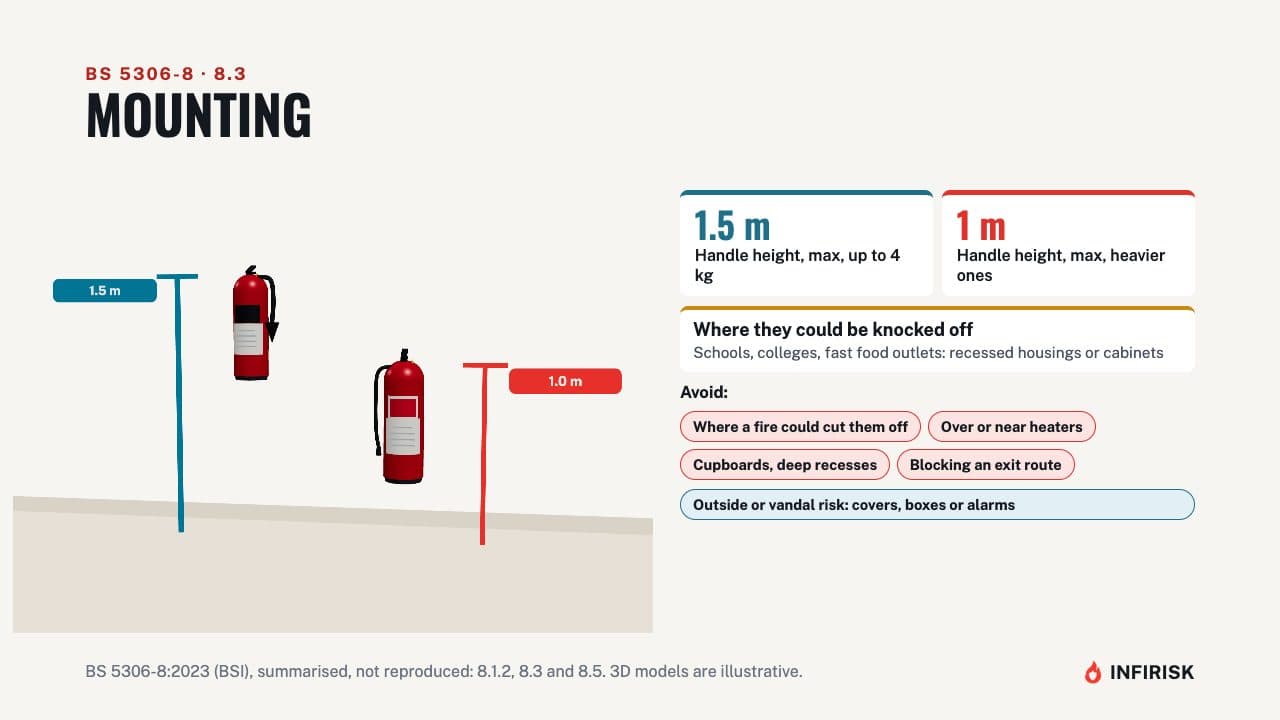
Mount them so they're easy to lift down. An extinguisher of up to 4 kilograms should have its handle no more than 1.5 metres above the floor; heavier ones, no more than 1 metre. In places like schools, colleges and fast food outlets, where they could be knocked off, use recessed housings or cabinets.
Keep them out of places a fire could cut off, away from heaters, out of cupboards and deep recesses, and never where they'd block an exit route. And outside, or where vandalism is likely, protect them with covers, boxes or alarms.
Kitchens and cooking oil
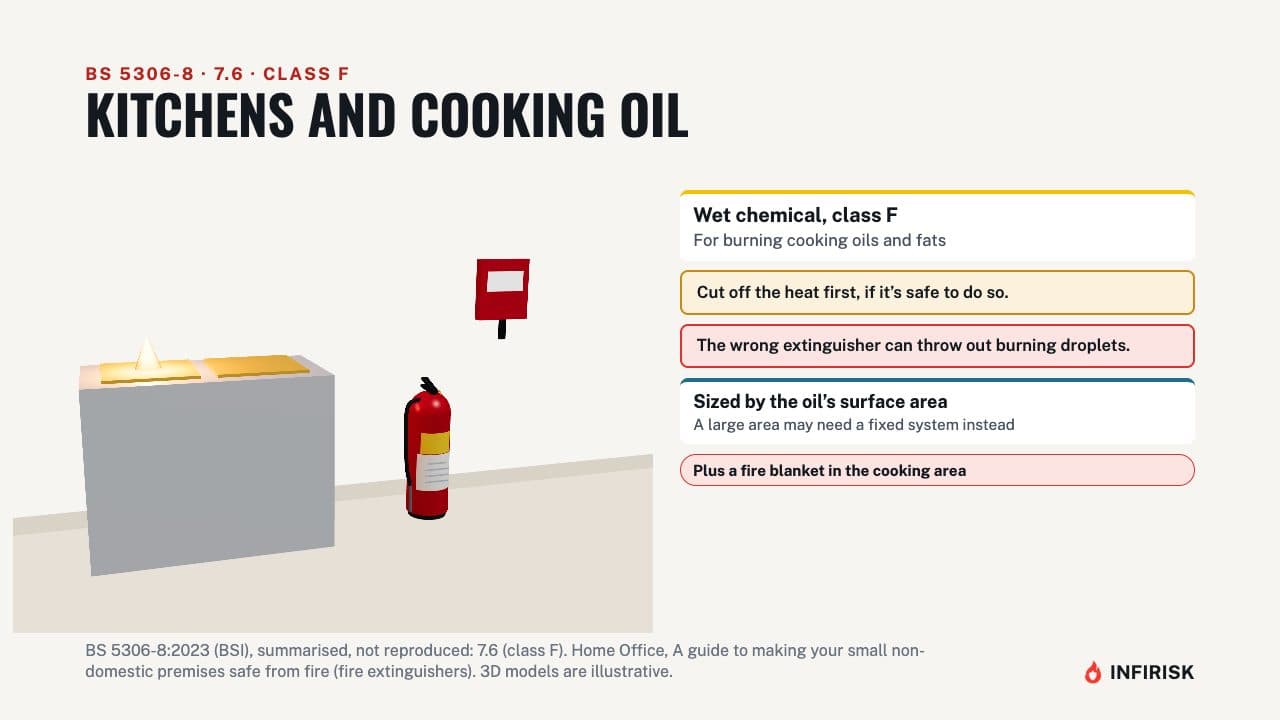
Some hazards need their own extinguisher. In a kitchen with deep fat fryers, a burning oil fire needs a wet chemical, class F extinguisher. Cut off the heat first if it's safe to do so.
Using the wrong extinguisher can throw out burning droplets and make the fire much worse. BS 5306-8 sizes class F extinguishers by the surface area of the oil, and where a large area needs protecting, a fixed system may be better. The Home Office guide for small premises adds a fire blanket in the kitchen or cooking area.
Electrics and batteries
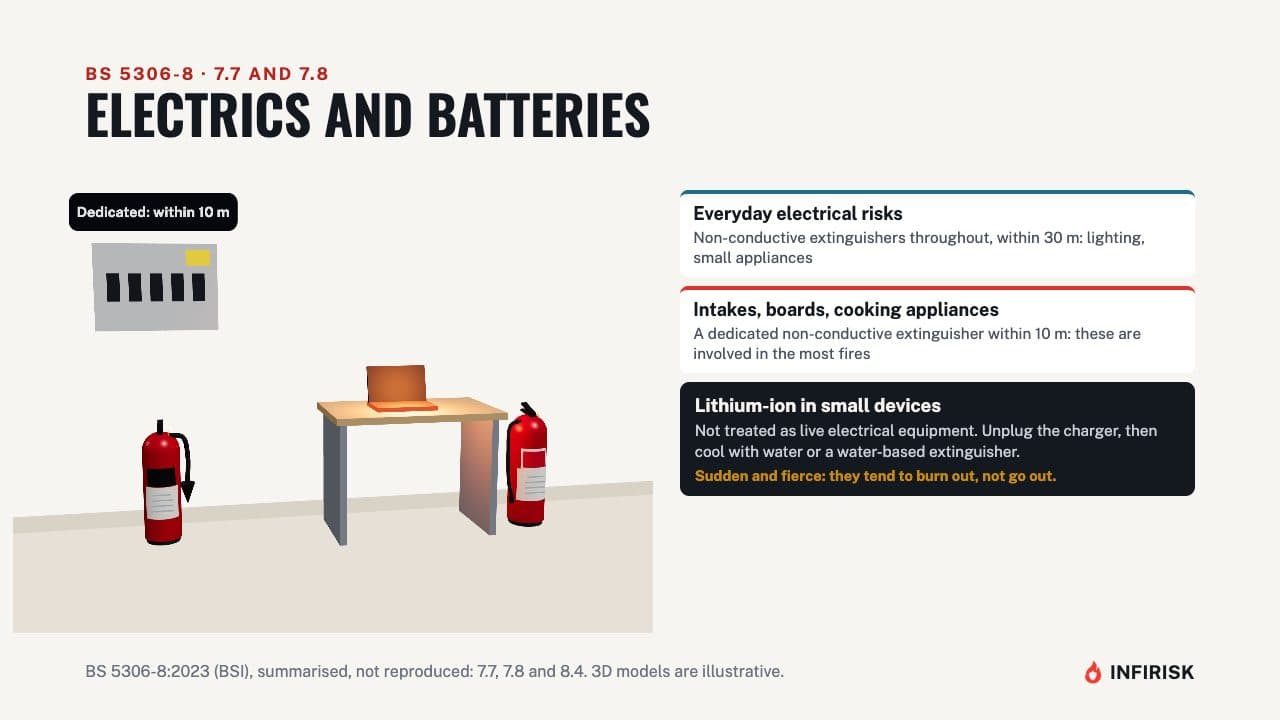
For electrical equipment, provide non-conductive extinguishers throughout for everyday risks, like lighting and small appliances, within 30 metres. Mains intakes, distribution boards and cooking appliances, which are involved in the most fires, get their own dedicated extinguisher within 10 metres. Lithium-ion batteries in small devices, like laptops, phones and e-cigarettes, aren't treated as live electrical equipment.
Unplug the charger, then cool the device with water or a water-based extinguisher. These fires are sudden and fierce, and tend to burn out rather than go out.
Small premises
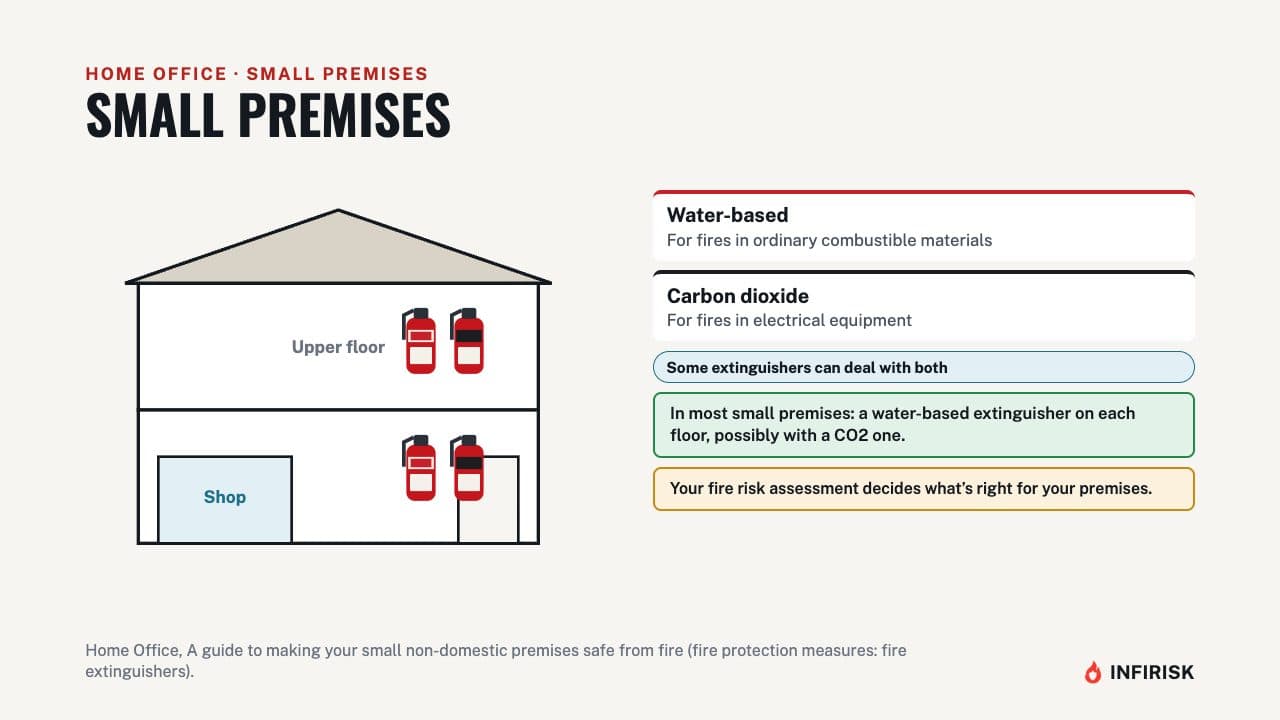
In small premises, the Home Office guide keeps it simple. A water-based extinguisher for fires in ordinary combustible materials, and a carbon dioxide extinguisher for fires in electrical equipment, though some extinguishers can deal with both. In most small premises, a water-based extinguisher on each floor, possibly with a carbon dioxide one, would be considered adequate.
Your fire risk assessment decides what's right for yours.
Monthly checks
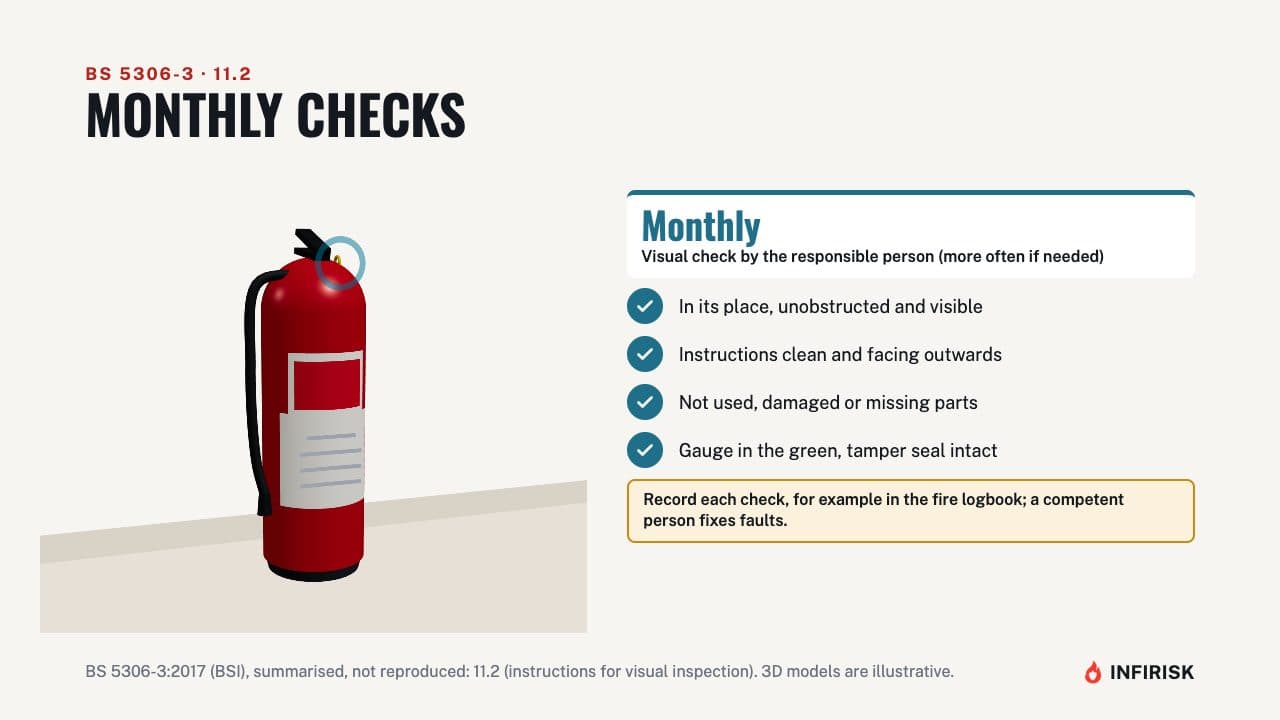
Between services, BS 5306-3 says the responsible person should check every extinguisher at least once a month. Is it in its place, unobstructed and visible? Are the instructions clean and facing outwards?
Has it been used, damaged, or lost a part? Is the pressure gauge in the green, and the tamper seal intact? Record each check, for example in the fire logbook, and get a competent person to deal with anything wrong.
Servicing
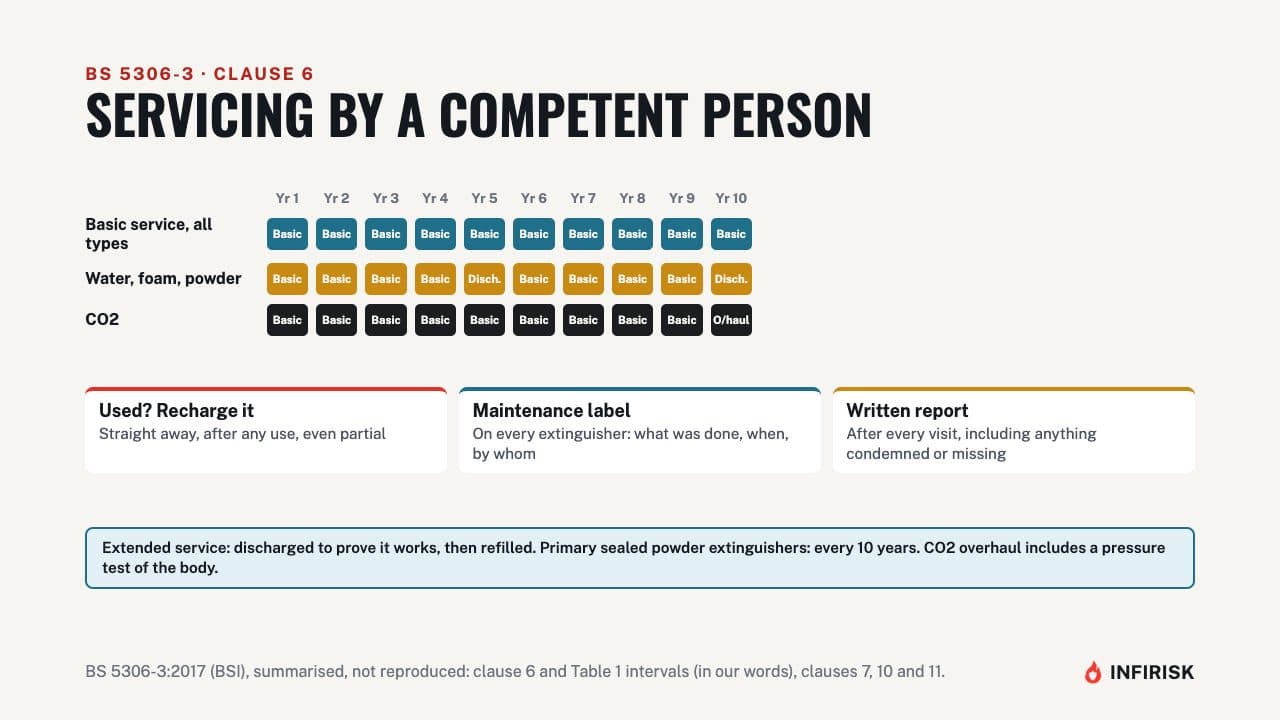
A competent person should give every extinguisher a basic service at least every 12 months, checking it's safe, unused, the right type for the hazard, and will work. Water, foam and powder extinguishers also get an extended service every five years, when they're discharged to prove they work and refilled with fresh contents. Carbon dioxide extinguishers are overhauled every ten years, with a pressure test of the body.
Any extinguisher that's been used is recharged straight away. Each one carries a maintenance label, and after every visit you should get a written report, including anything condemned and anything missing.
Training, and when not to try
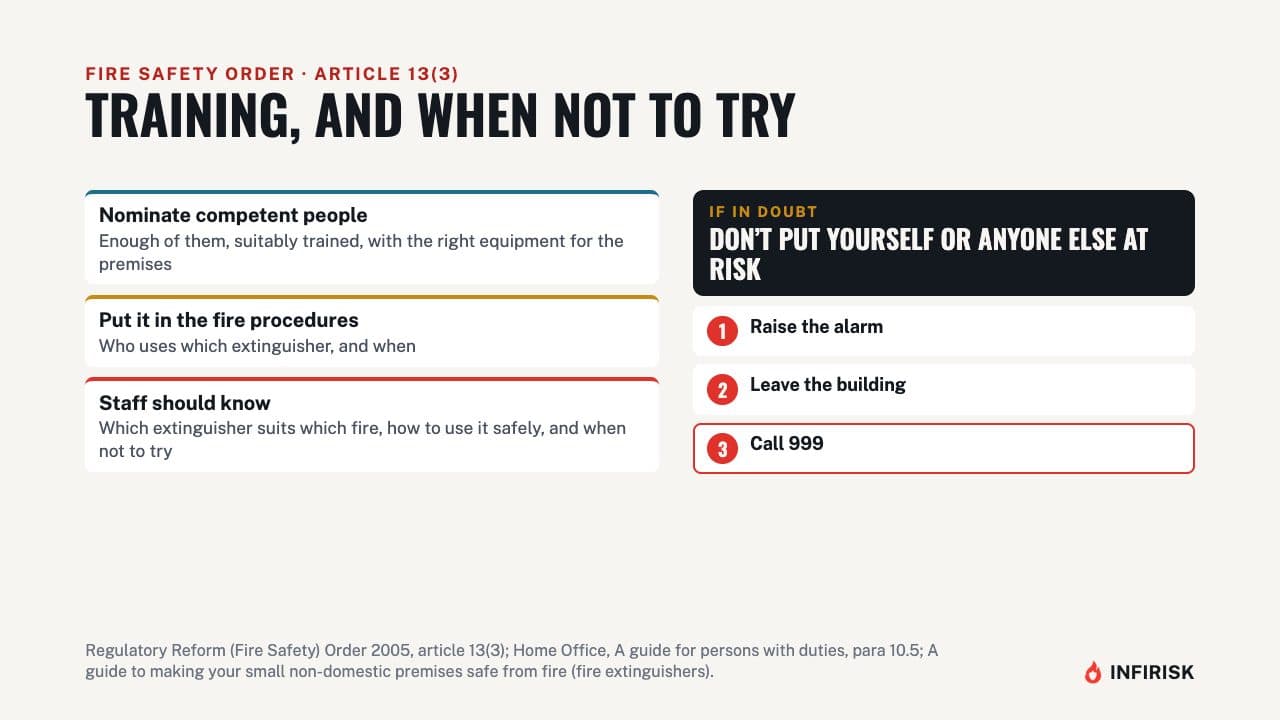
Equipment only helps if people know how to use it. The Fire Safety Order requires the responsible person to nominate enough competent people to use it, with suitable training, and to include it in the fire procedures. Staff should know which extinguisher suits which fire, and when not to try.
The Home Office guide is clear: if in doubt, don't put yourself or anyone else at risk. Raise the alarm, leave the building, and call the fire and rescue service.
Frequently asked questions
What do the colours on a fire extinguisher mean?
Every extinguisher has a red body with a block of colour on the front showing what is inside. Under BS 5306-10, water is red, foam is cream, powder is blue, carbon dioxide is black, wet chemical is yellow and clean agent is green.
How often do fire extinguishers need servicing?
BS 5306-3 recommends a visual check by the responsible person at least monthly and a basic service by a competent person at least every 12 months. Water, foam and powder extinguishers also get a discharge test every five years, and carbon dioxide extinguishers an overhaul every ten.
Which extinguisher should be used on an electrical fire?
Only non-conductive media, like carbon dioxide, clean agent or non-conductive powder, should go near live equipment, and it should be switched off first, because water conducts electricity.
How far should someone have to go to reach a fire extinguisher?
BS 5306-8 says no more than 30 metres from a class A fire hazard, and 10 metres for flammable liquids and cooking oils, taking off 5 metres for every door on the way.
Which fire extinguishers does a small business need?
The Home Office guide for small premises suggests a water-based extinguisher for ordinary combustible materials and a carbon dioxide one for electrical equipment, and says a water-based extinguisher on each floor, possibly with a carbon dioxide one, is adequate in most small premises. Your fire risk assessment decides.
Sources
- The Regulatory Reform (Fire Safety) Order 2005, articles 13 and 17, legislation.gov.uk
- Fire safety: guidance for those with legal duties, GOV.UK
- A guide to making your small non-domestic premises safe from fire, GOV.UK
- BS 5306-8:2023 Selection and positioning of portable fire extinguishers, BSI
- BS 5306-3:2017 Commissioning and maintenance of portable fire extinguishers, BSI
- BS 5306-10:2019 Colour coding of portable fire extinguishers, BSI
Written against
- BS 5306 parts 3, 8 and 10: portable fire extinguishers, BS 5306-8:2023, BS 5306-3:2017, BS 5306-10:2019
- The Regulatory Reform (Fire Safety) Order 2005, SI 2005/1541 as amended (Articles 13 and 17)
- A guide to making your small non-domestic premises safe from fire, 2024
More from Fire Safety Law for Business
 6:48Video and guide
Fire risk assessments explained: who needs one, what it covers, and what the law says
The Fire Safety Order in plain English: what a fire risk assessment is, who must have one, what it looks at, what to record, and what happens if it is missing.
- 3 min readINFIRISK guideWritten guide
Awaab's Law and fire hazards: repair deadlines for social homes from November 2026
Which social homes Awaab's Law covers, what counts as a fire hazard, the emergency and significant hazard deadlines, and where the Fire Safety Order takes over.
 5:54Video and guide
E-bike and e-scooter battery fires: buying, charging and the warning signs
Thermal runaway in plain English, what makes a fire more likely, buying and charging safely, the warning signs, and the law for sellers and shared buildings.
- 4 min readINFIRISK guideWritten guide
The Fire Safety (England) Regulations 2022 explained: every duty for blocks of flats
Which buildings and parts are covered, the three height tiers, and each duty: residents, fire door checks, signs, the information box, plans, external walls and monthly checks.