Fire risk assessments explained: who needs one, what it covers, and what the law says
Video, 6:48Published 22 October 2026Last reviewed 22 October 2026
Plays from YouTube in privacy-enhanced mode once you press play.
If people work in, visit or live above your premises, the law expects you to have a fire risk assessment. In this guide, we'll cover what a fire risk assessment is, which buildings it applies to, who is responsible for it, what it actually looks at, what has to be recorded, how often it's reviewed, and what happens if it's missing.
The guide below is the video's narration, chapter by chapter, with the diagram from each chapter.
What a fire risk assessment is
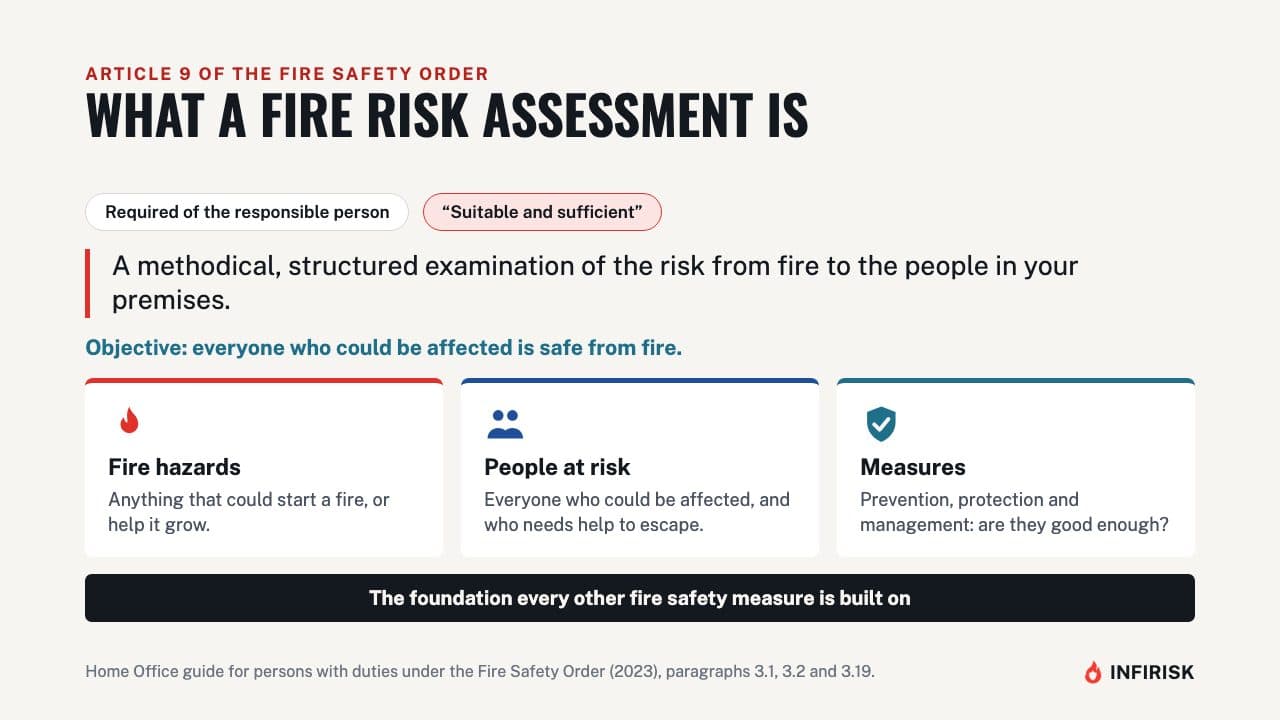
The Regulatory Reform Fire Safety Order 2005 is the main fire safety law for England. It asks the responsible person for premises to carry out a suitable and sufficient fire risk assessment. The government's guidance describes it as a methodical, structured examination of the risk from fire to the people in your premises.
Its objective is simple: to make sure everyone who could be affected is safe from fire. It considers three things. The fire hazards, meaning anything that could start a fire or help it grow.
The people who would be at risk. And whether the measures in place, to prevent fire and to protect people if one starts, are good enough. Everything else in fire safety is built on it.
Which buildings it applies to
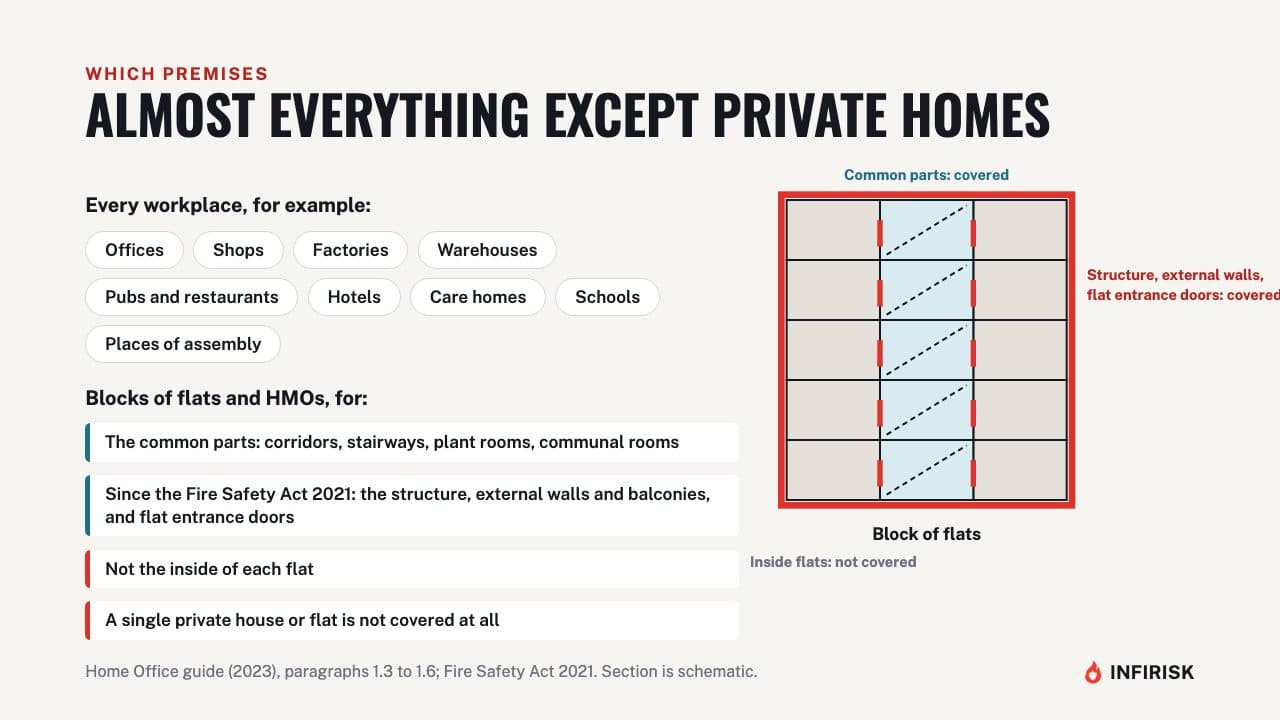
Which buildings does it apply to? Almost all of them, apart from private homes. Every workplace: offices, shops, factories, warehouses, pubs, restaurants, hotels, care homes, schools and places of assembly.
Blocks of flats and houses in multiple occupation too, for the common parts: the corridors, stairways, plant rooms and communal rooms, and, since the Fire Safety Act 2021, the building's structure, its external walls including balconies, and the doors between the flats and the common parts. The only thing outside the Order in a block of flats is the inside of each flat itself. A single private house or flat, lived in by its owner or tenant, is not covered at all.
Who the responsible person is
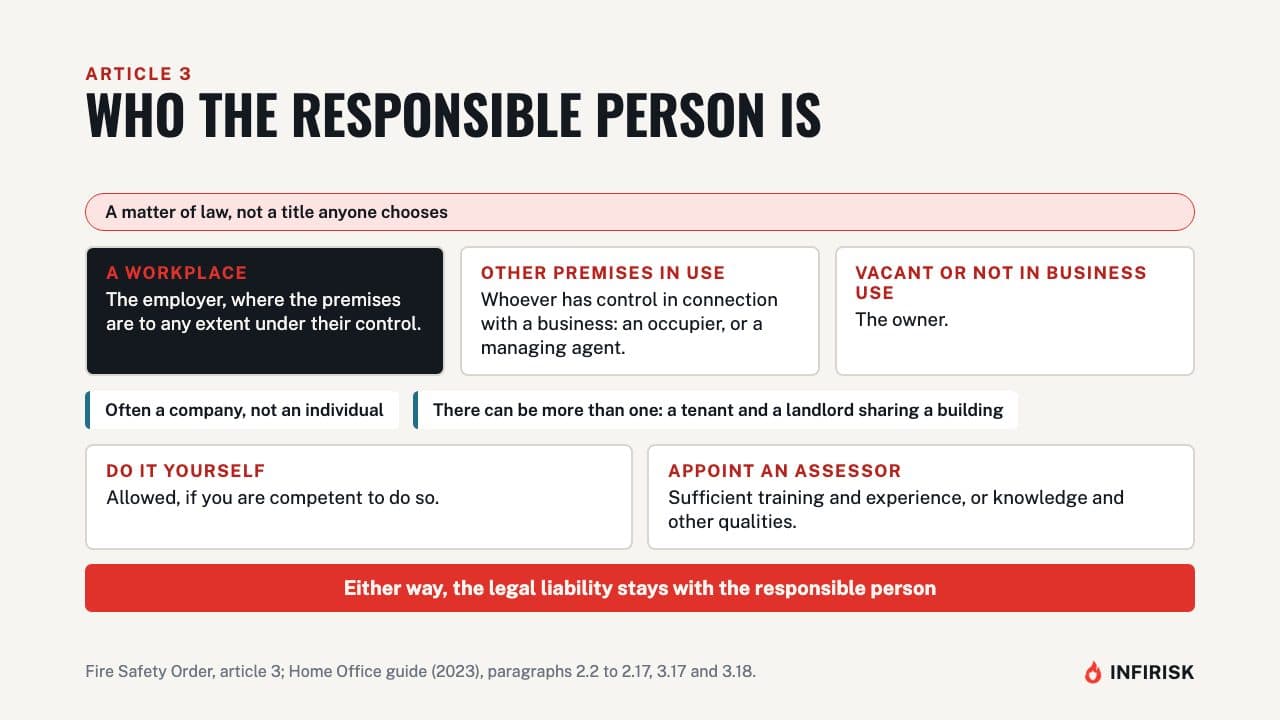
Who is responsible? The Order calls them the responsible person, and it's a matter of law, not a title anyone chooses. In a workplace, it's the employer, where the premises are to any extent under their control.
Otherwise, it's whoever has control of the premises in connection with a business, such as an occupier or a managing agent, and for a vacant building, the owner. Often that's a company rather than an individual, and there can be more than one, for example a tenant and a landlord sharing a building. The responsible person can carry out the assessment themselves if they're competent, or appoint a fire risk assessor.
Either way, the legal liability stays with them, so the guidance says to take care that the assessor has sufficient training and experience, or knowledge and other qualities.
What the assessment looks at
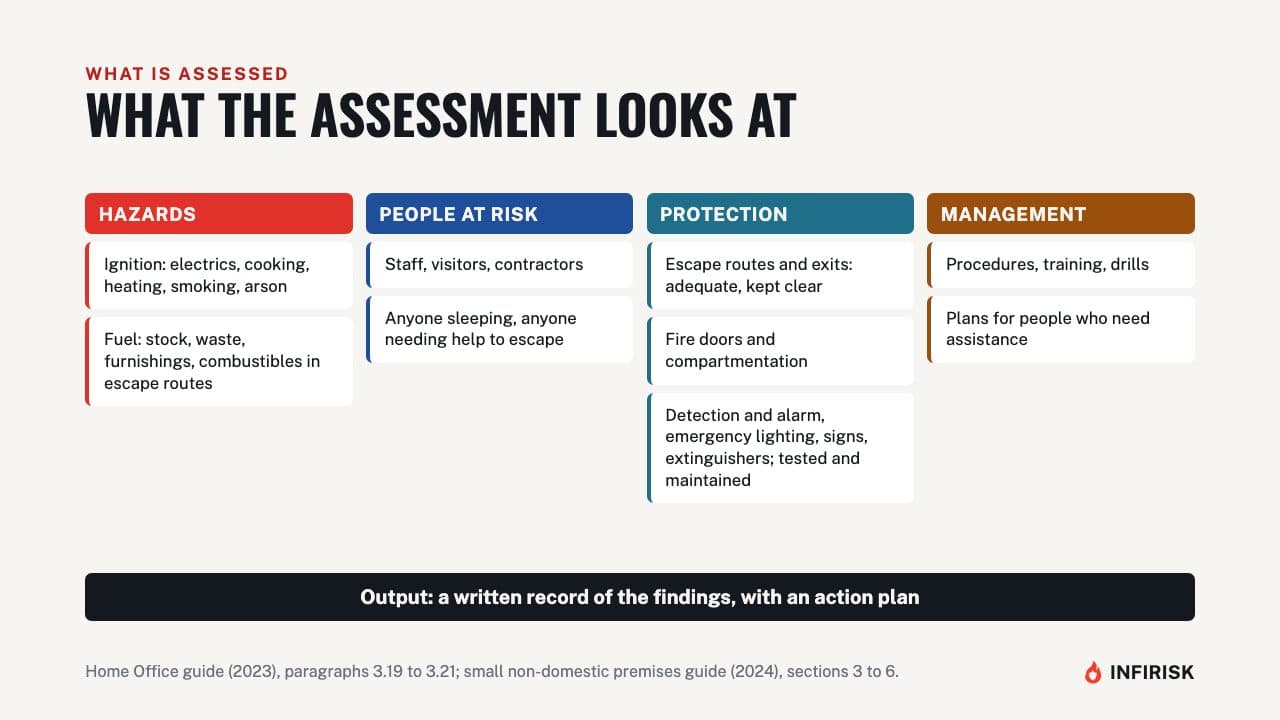
So what does an assessment actually look at? It starts with the hazards: the sources of ignition, such as electrical equipment, cooking, heating, smoking and arson, and the fuel they could meet, such as stored goods, waste, furnishings and combustible materials in escape routes. Then the people at risk: staff, visitors, contractors, anyone who sleeps on the premises, and anyone who would need help to get out.
Then the protection: are the escape routes and exits adequate and kept clear, do fire doors and compartmentation hold fire and smoke back, is there suitable detection and alarm, emergency lighting, signage, and extinguishers, and are they tested and maintained. And finally the management: procedures, training, drills, and plans for people who need assistance. The findings go into a record with an action plan.
What must be recorded (since October 2023)
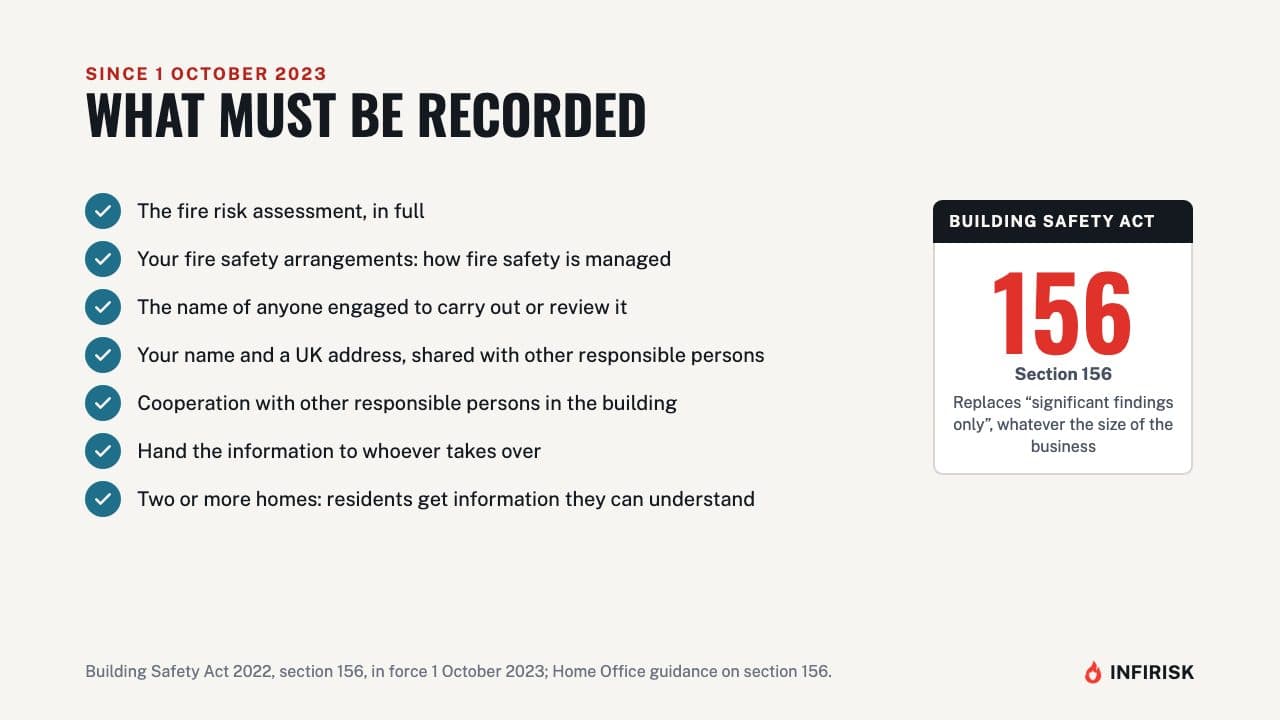
Since 1 October 2023, section 156 of the Building Safety Act has tightened what must be recorded. The responsible person must now record the fire risk assessment in full, not just its significant findings, whatever the size of the business. They must record their fire safety arrangements: how fire safety is managed in the premises.
They must record the name of anyone they engaged to carry out or review the assessment. They must record their own name and a UK address, and share them with any other responsible persons in the building. They must cooperate with those other responsible persons.
And when they hand over, they must pass the fire safety information to whoever takes over. In buildings with two or more homes, residents must also be given fire safety information they can understand.
How often to review it
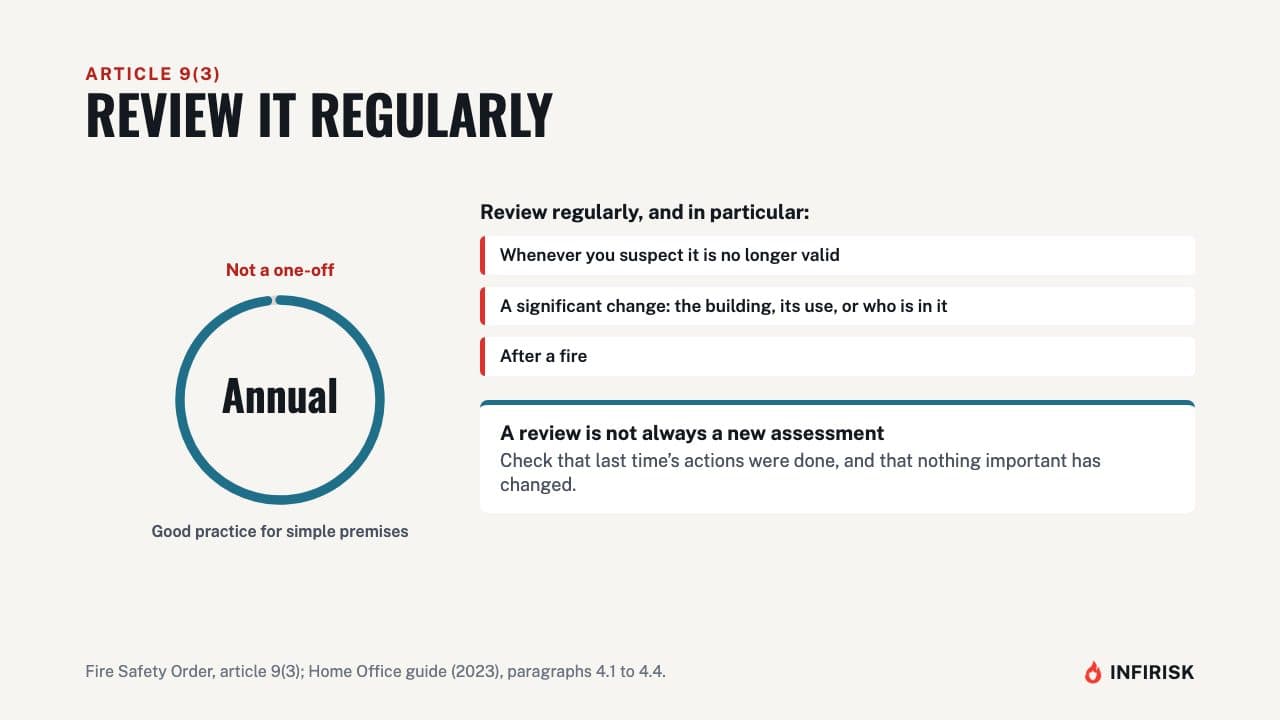
A fire risk assessment isn't a one-off. The Order requires it to be reviewed regularly, and whenever there's reason to think it's no longer valid, or there's been a significant change: to the building, to how it's used, to who is in it, or after a fire. The law doesn't set a fixed interval, but for small and simple premises an annual review is recognised as good practice.
A review doesn't always mean starting again. Often it means checking that the actions from the last assessment were done, and that nothing important has changed.
Enforcement and penalties
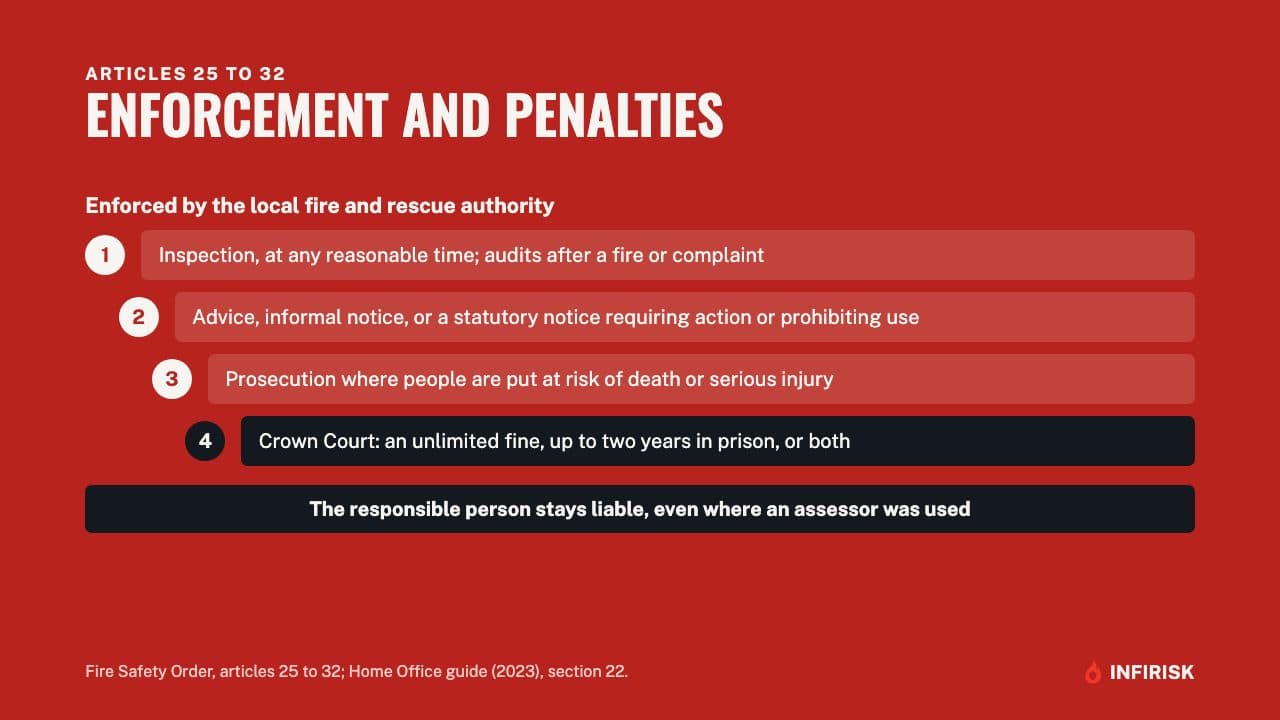
Enforcement normally sits with the local fire and rescue authority, whose inspectors can visit at any reasonable time and will audit after a fire or a complaint. An unsatisfactory inspection can bring advice, an informal notice, or a statutory notice requiring action, or prohibiting use of part of the building. Where a failure places people at risk of death or serious injury, the responsible person can be prosecuted.
On conviction in the Crown Court that means an unlimited fine, up to two years in prison, or both. And liability stays with the responsible person even where an assessor was used.
Frequently asked questions
Is a fire risk assessment a legal requirement?
Yes, for almost every building in England other than private homes. The Regulatory Reform (Fire Safety) Order 2005 requires the responsible person for the premises to carry out a suitable and sufficient fire risk assessment.
Who is the responsible person?
In a workplace it is the employer, where the premises are to any extent under their control. Otherwise it is whoever has control of the premises in connection with a business, such as an occupier or managing agent, and for a vacant building, the owner. There can be more than one responsible person in a building.
Does a block of flats need a fire risk assessment?
Yes, for the common parts such as corridors, stairways and plant rooms, and since the Fire Safety Act 2021 also the structure, the external walls including balconies, and the doors between the flats and the common parts. The inside of each flat is outside the Order.
How often should a fire risk assessment be reviewed?
Regularly, and whenever there is reason to think it is no longer valid or there has been a significant change to the building, its use, its occupants, or after a fire. The law sets no fixed interval; for small and simple premises an annual review is recognised as good practice.
What is the penalty for not having one?
The fire and rescue authority can give advice or serve notices requiring action or prohibiting use. Where a failure places people at risk of death or serious injury, the responsible person can be prosecuted; on conviction in the Crown Court that means an unlimited fine, up to two years in prison, or both.
Sources
- The Regulatory Reform (Fire Safety) Order 2005, legislation.gov.uk
- A guide for persons with duties under the Fire Safety Order (Home Office, 2023), GOV.UK
- Check your fire safety responsibilities under Section 156 of the Building Safety Act 2022, GOV.UK
- Making your small non-domestic premises safe from fire (2024), GOV.UK
Written against
- The Regulatory Reform (Fire Safety) Order 2005, SI 2005/1541 as amended (Articles 3, 9 and 11)
- A guide for persons with duties under the Fire Safety Order, 2023
- A guide to making your small non-domestic premises safe from fire, 2024
General guidance for England, not professional or legal advice. Always check the current edition of the guidance, and agree any design with building control or a competent fire safety professional. Contains public sector information licensed under the Open Government Licence v3.0.
More from Fire Safety Law for Business
- 3 min readINFIRISK guideWritten guide
Awaab's Law and fire hazards: repair deadlines for social homes from November 2026
Which social homes Awaab's Law covers, what counts as a fire hazard, the emergency and significant hazard deadlines, and where the Fire Safety Order takes over.
 5:54Video and guide
E-bike and e-scooter battery fires: buying, charging and the warning signs
Thermal runaway in plain English, what makes a fire more likely, buying and charging safely, the warning signs, and the law for sellers and shared buildings.
- 6 min readINFIRISK guideWritten guide
Fire extinguishers explained: types, colours, how many you need and servicing
What the law requires, the classes of fire, extinguisher types and colours, how many and where, kitchens, electrics and batteries, checks, servicing and training.
- 4 min readINFIRISK guideWritten guide
The Fire Safety (England) Regulations 2022 explained: every duty for blocks of flats
Which buildings and parts are covered, the three height tiers, and each duty: residents, fire door checks, signs, the information box, plans, external walls and monthly checks.
Related guides
 7:41Video and guide
Housing fire risk assessments explained: BS 9792:2025 for flats and HMOs
The code of practice that replaced PAS 79-2: what it covers, its nine steps, the four types of assessment, competence, and how often to review an assessment.
 18:09Case study · 1987 · Transport
The King's Cross fire 1987 explained: the trench effect, the flashover and the Fennell investigation
How a lit match under a wooden escalator became the flashover that killed 31 people at King's Cross in 1987, why the trench effect drove it into the ticket hall, and what the Fennell investigation changed.
31 deaths, including 1 firefighter
- 2 min readINFIRISK guideWritten guide
How Much Does a Fire Risk Assessment Cost?
Typical UK prices by building and assessment type, what drives the fee, and how to buy the right scope.
- 2 min readINFIRISK guideWritten guide
Do I Need a Fire Risk Assessment?
Whether the law requires an assessment for your premises, who the responsible person is, and review timing.