The King's Cross fire 1987 explained: the trench effect, the flashover and the Fennell investigation
Video, 18:09Published 24 October 2026Last reviewed 24 October 2026
Plays from YouTube in privacy-enhanced mode once you press play.
On the evening of the 18th of November 1987, a small fire under a wooden escalator at King's Cross Underground station grew, in about 15 minutes, into a flashover that killed 31 people. The investigation that followed asked three questions. How did the fire start? Why was there a flashover? And why did 31 people die? In this guide, we'll follow the build-up, the night itself, the response, and what changed afterwards.
The guide below is the video's narration, chapter by chapter, with the diagram from each chapter.
King's Cross in 1987
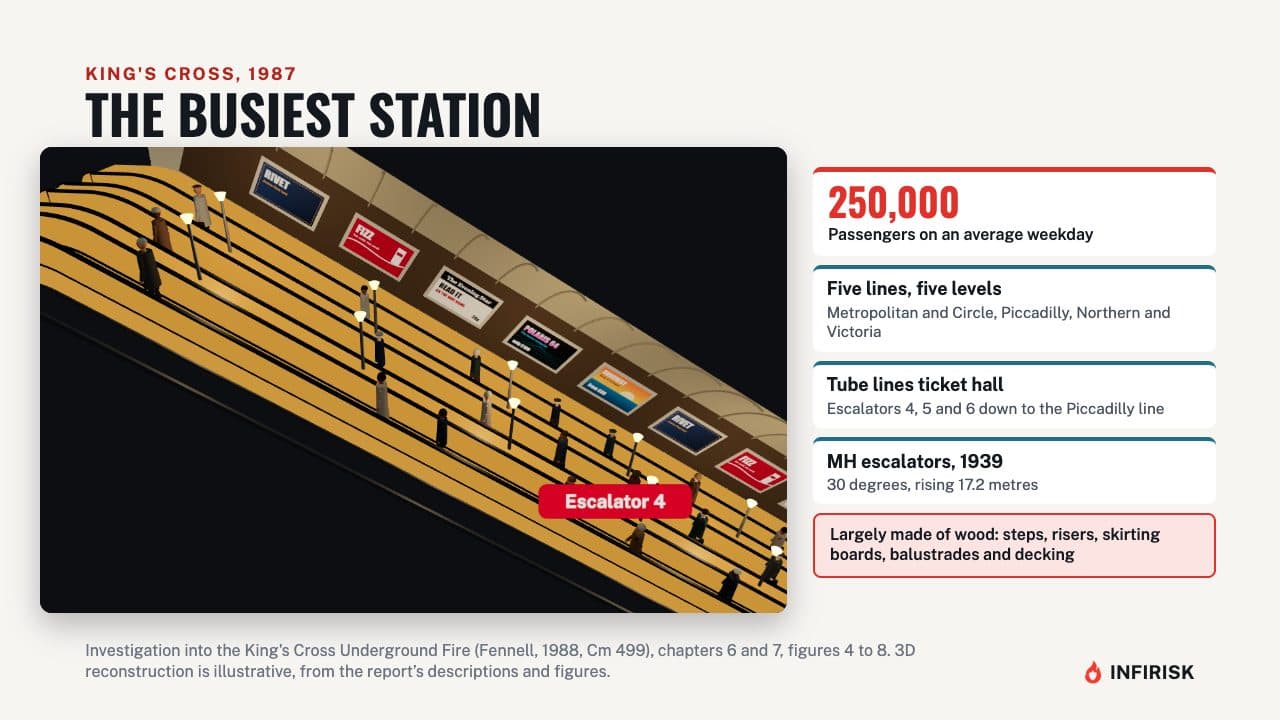
In 1987, King's Cross was the busiest station on the Underground, used by over 250,000 passengers on an average weekday. Five lines met there, on five different levels, joined by a labyrinth of passages, stairs and escalators. At its centre was the tube lines ticket hall.
From it, three escalators, numbered four, five and six, ran down to the Piccadilly line. They were installed in 1939, rising 17.2 metres at an angle of 30 degrees. And they were largely made of wood: wooden steps and risers, plywood skirting boards, and plywood balustrades and decking, finished in varnish.
Decades of escalator fires
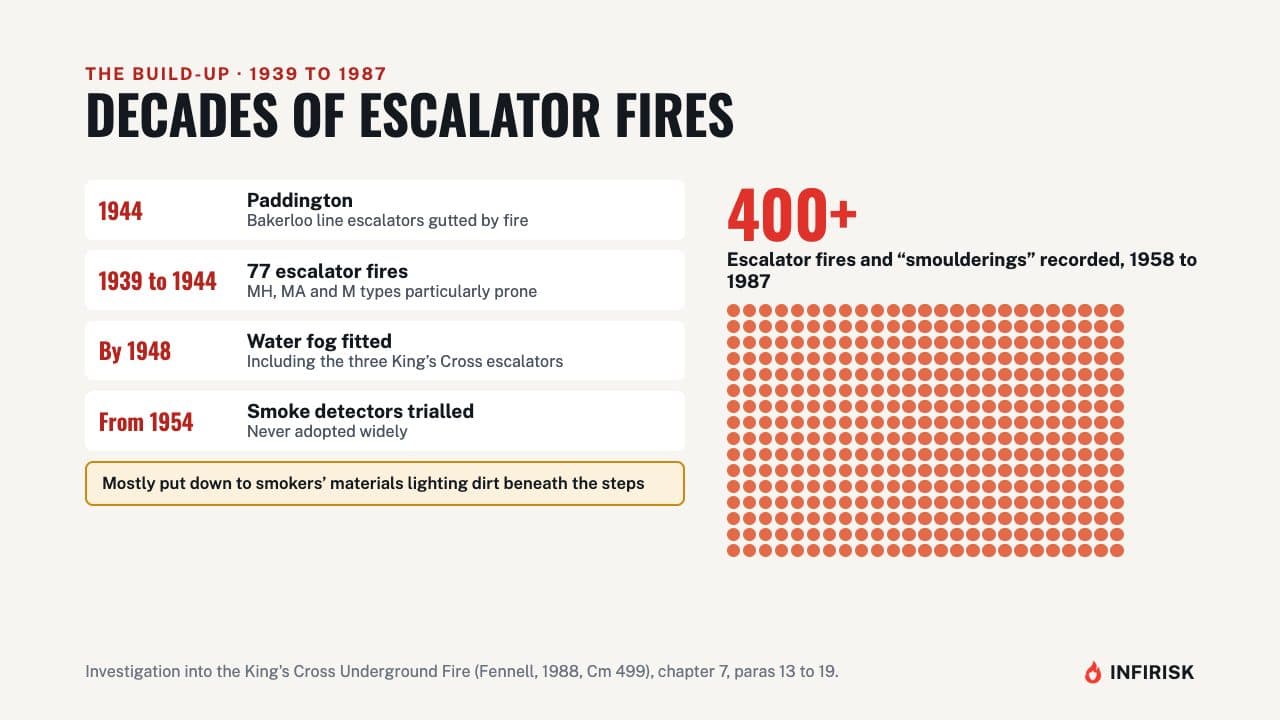
Escalator fires on the Underground went back decades. On Christmas Eve 1944, the Bakerloo line escalators at Paddington were completely gutted by fire. A review at the time counted 77 escalator fires between 1939 and 1944, and found the wooden M type escalators, including the MH type later used at King's Cross, particularly prone to them.
Most were put down to smokers' materials lighting dirt beneath the steps. After Paddington, cleaning was increased, and by 1948 water fog sprinklers had been fitted beneath more escalators, including the three at King's Cross. Automatic detection was considered as early as 1948, and smoke detectors were trialled from 1954, but they were never adopted widely.
Between 1958 and 1987, London Underground recorded over 400 fires and so-called smoulderings on its escalators.
The warnings came closer
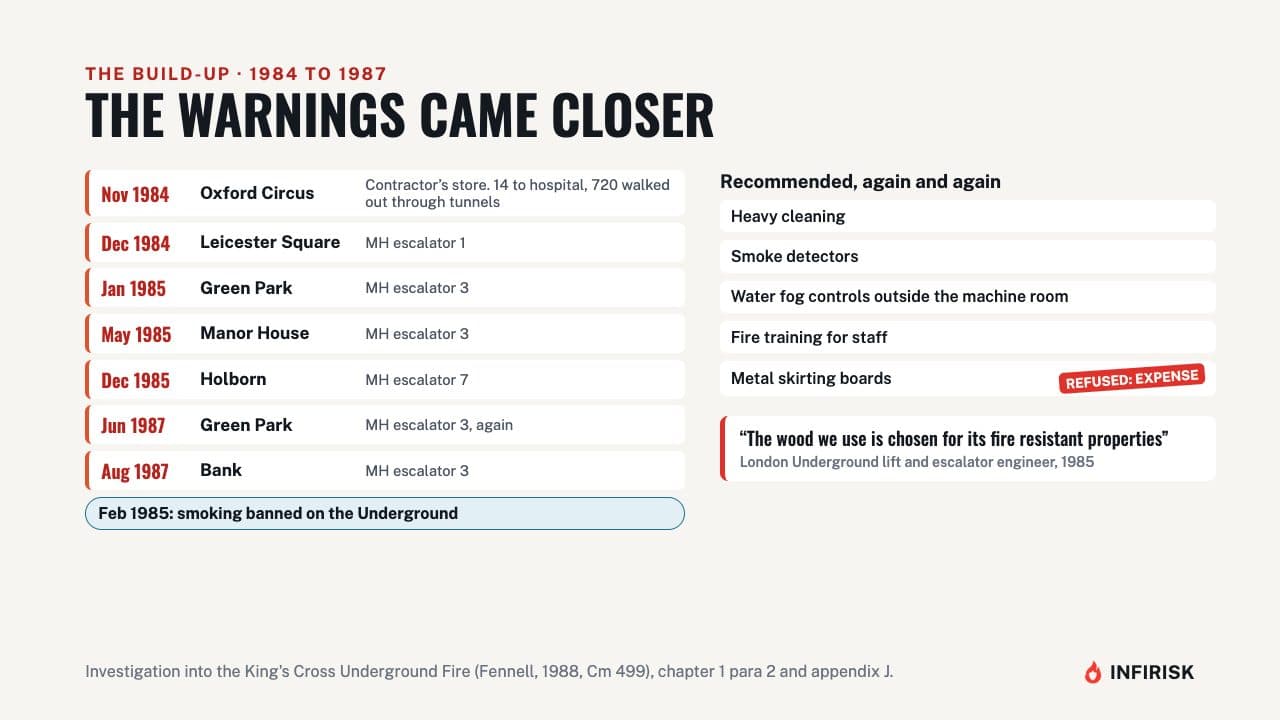
In the three years before King's Cross, the warnings came closer together. In November 1984, a fire in a contractor's store at Oxford Circus filled the station with smoke. Fourteen people went to hospital, and 720 passengers had to walk through the tunnels to escape.
Smoking was banned on the Underground in February 1985. Then came serious fires on wooden MH escalators at Leicester Square, Green Park, Manor House, Holborn, Green Park again, and Bank. Their internal inquiries kept recommending the same things: heavy cleaning, smoke detectors, water fog controls outside the machine room, fire training for staff, and metal in place of wooden skirting boards.
Replacing the wood was refused on grounds of expense, with one engineer noting that the wood was chosen for its fire resistant properties.
Fires called smoulderings
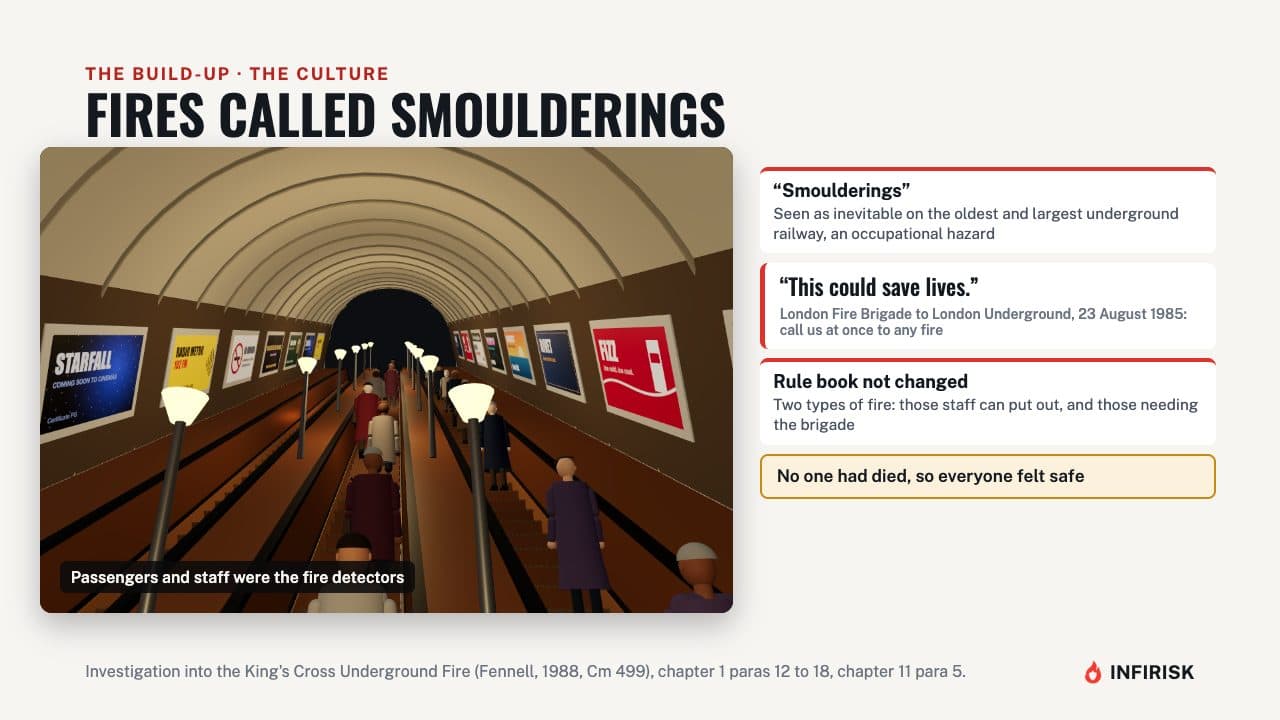
Inside London Underground, these fires had a name: smoulderings. Fennell found that management believed fires were inevitable on the oldest and most extensive underground railway in the world, and treated them as an occupational hazard. With passengers and staff acting as fire detectors, they believed there would always be time to get people out.
The fire brigade disagreed. After a fire at Baker Street in August 1985, its senior officers wrote asking to be called at once to any fire on the Underground, warning that it could save lives. The rule book was not changed.
It still divided fires into those staff could put out with their own equipment, and those that needed the brigade. And because no one had ever died in an escalator fire, everyone was lulled into a false sense of security.
A seed bed for fire
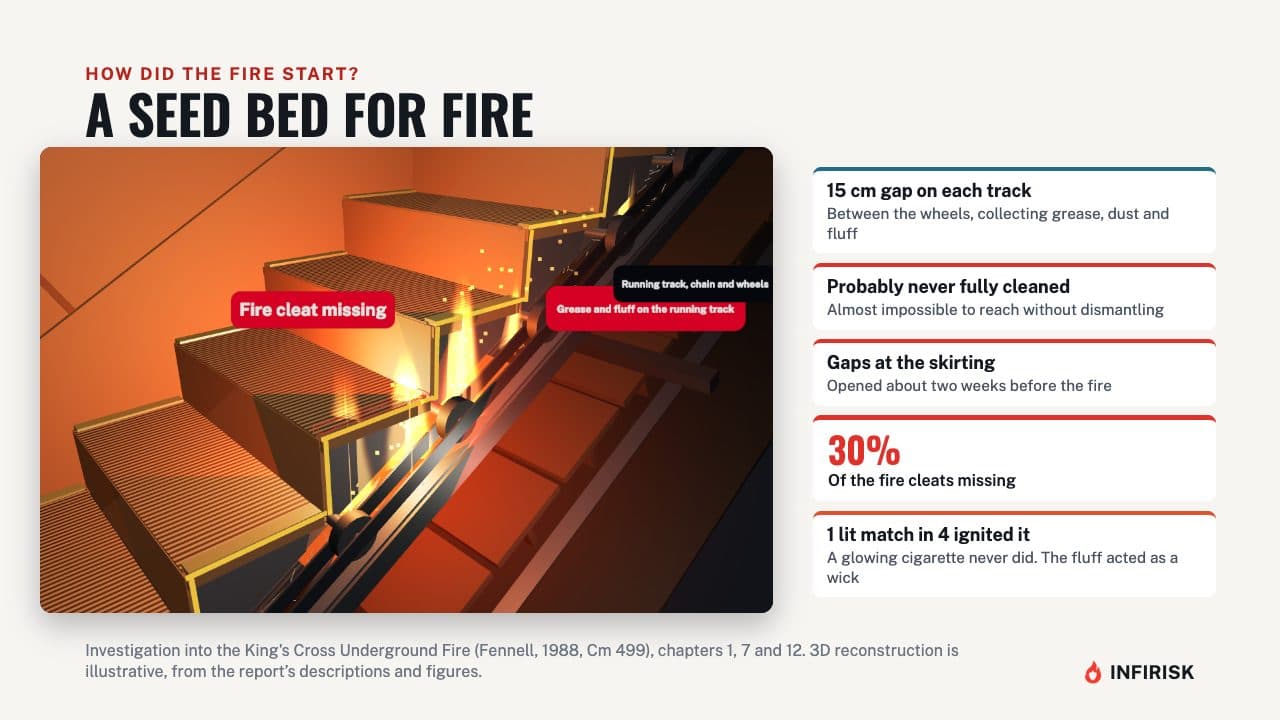
Escalator four had a hidden problem. Under each side of the steps ran a running track, where a gap of about 15 centimetres between the wheels collected grease, dust and fluff. The tracks were almost impossible to reach without dismantling the escalator, and at King's Cross they had probably never been cleaned completely.
About two weeks before the fire, gaps had opened between the steps and the skirting board, and 30 per cent of the metal fire cleats, meant to stop matches falling through, were missing. Tests later showed that one lit match in four, dropped onto that greasy, fluffy mixture, set it alight. A glowing cigarette never did.
The fluff worked like a candle wick.
19:25 The fire starts
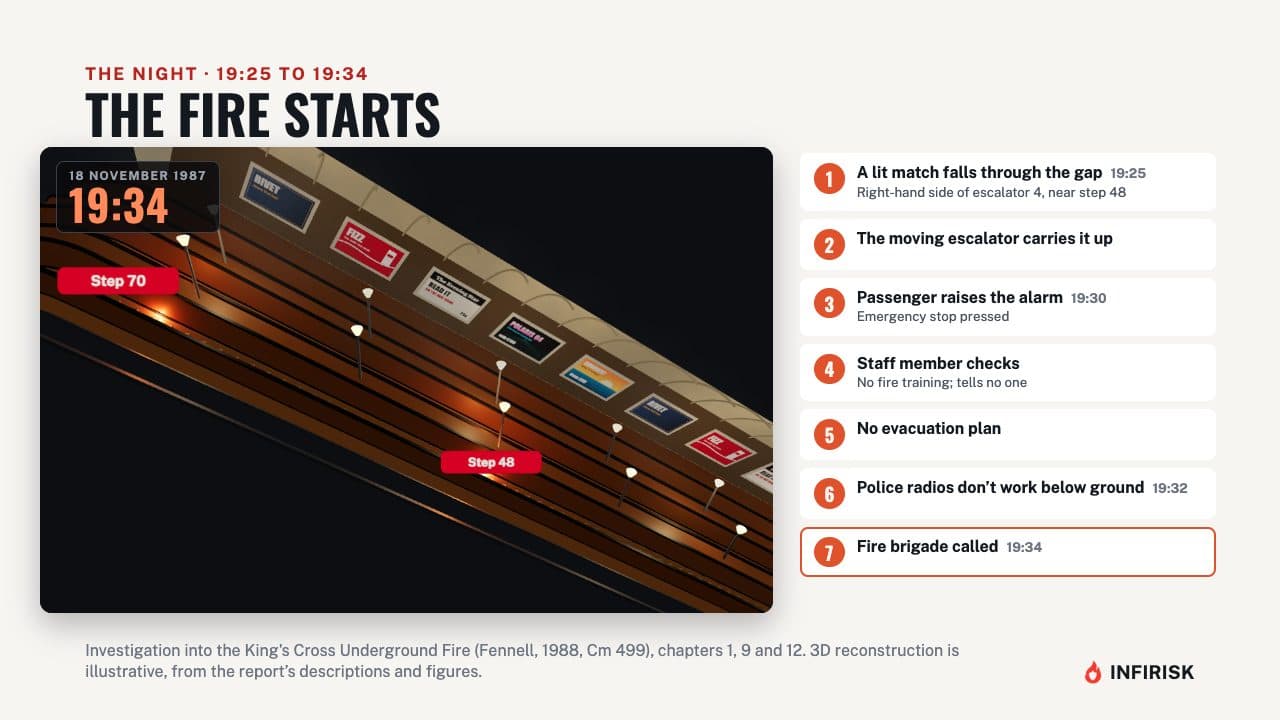
At about 19:25, a lit match, probably dropped by a passenger leaving the station, fell through the gap on the right-hand side of escalator four, near step 48. It landed in the grease on the running track, and the grease began to burn. Because the escalator was still running, the fire was carried further up.
At about 19:30, a passenger saw smoke and a glow beneath the steps, pressed the emergency stop, and raised the alarm. A member of staff went to look, but he had no fire training, and he told neither the station manager nor the line controller. London Underground had no evacuation plan.
Two police officers in the ticket hall went to help. Their radios didn't work below ground, so one ran up to the street to call for help. The fire brigade was called at 19:34.
19:36 Ten minutes
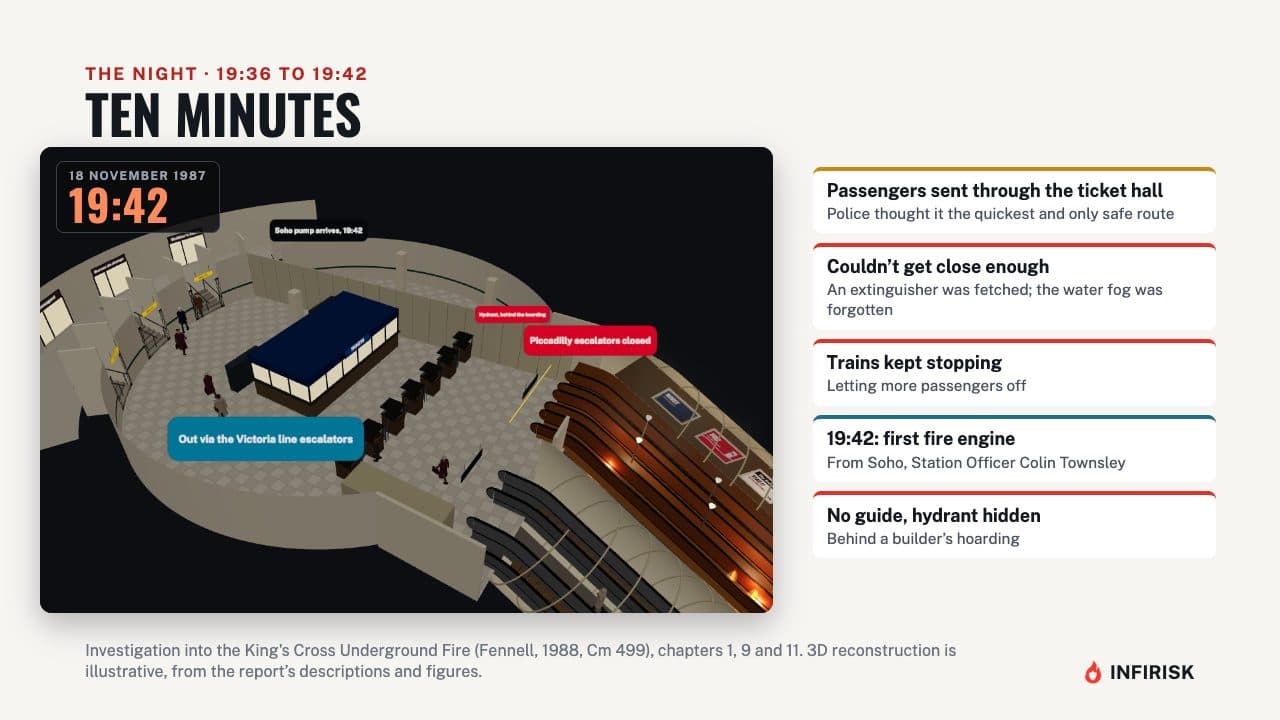
For the next ten minutes, the fire grew, and the station carried on around it. The police closed the Piccadilly line escalators and sent passengers out another way: up the Victoria line escalators, and through the tube lines ticket hall. They didn't know the station's layout, and believed it was the quickest and only safe route.
Under the escalators, an inspector saw the flames, but couldn't get close enough to use an extinguisher. He forgot the water fog equipment, sprinklers fitted beneath the escalator in the 1940s, and it was never turned on. Trains kept stopping and letting passengers off.
At 19:42, the first fire engine arrived, from Soho, with Station Officer Colin Townsley in charge. No one from London Underground met the crews, and the fire hydrant in the ticket hall was hidden behind a builder's hoarding.
19:45 Flashover
Station Officer Townsley went to look. The fire was burning about halfway down escalator four, described as about the size of a large cardboard box, with flames licking up the handrail. He sent for firefighters in breathing apparatus and a water jet, and ordered the message: make pumps four, persons reported.
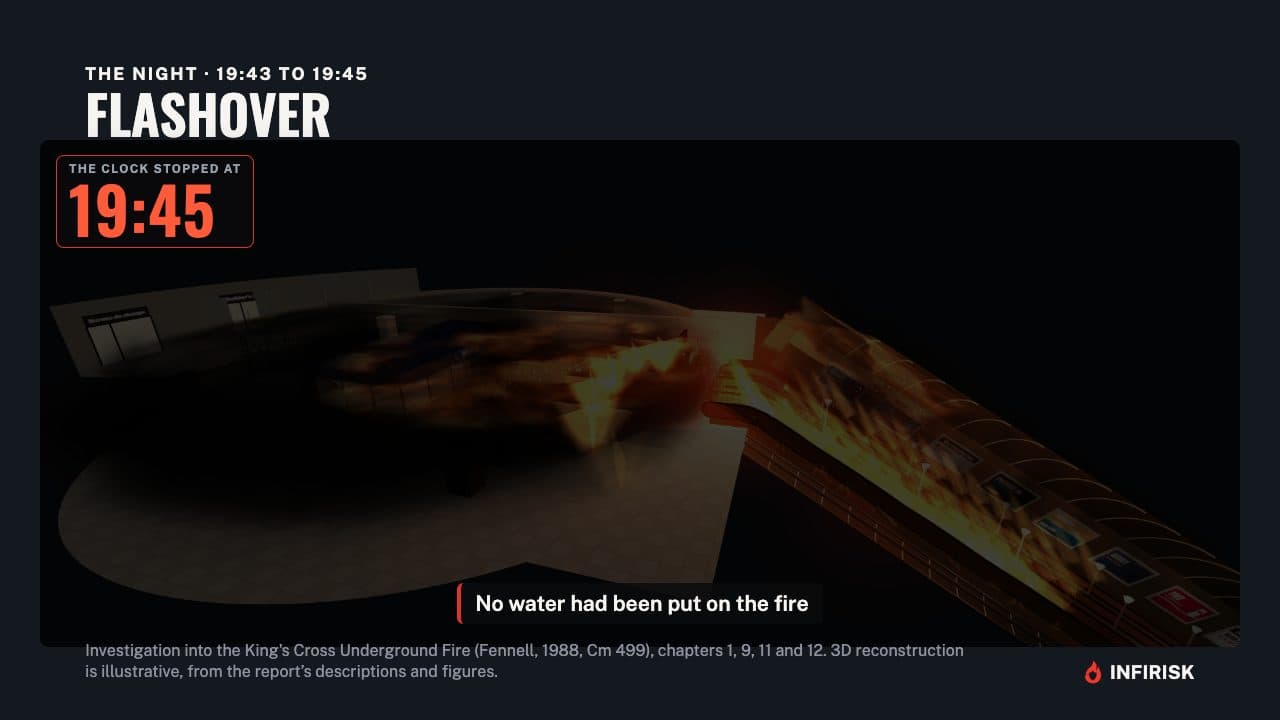
By 19:43, the fire had spread across both balustrades and the steps between them. Then, at about 19:45, it changed completely. In seconds, a jet of flame shot up the escalator trench and into the ticket hall.
It hit the ceiling and rolled across it, and the hall filled with intense heat and thick black smoke. A digital clock at the top of the escalators stopped in the heat. It read 19:45.
From the first alarm to the flashover, not one drop of water had been put on the fire.
The trench effect
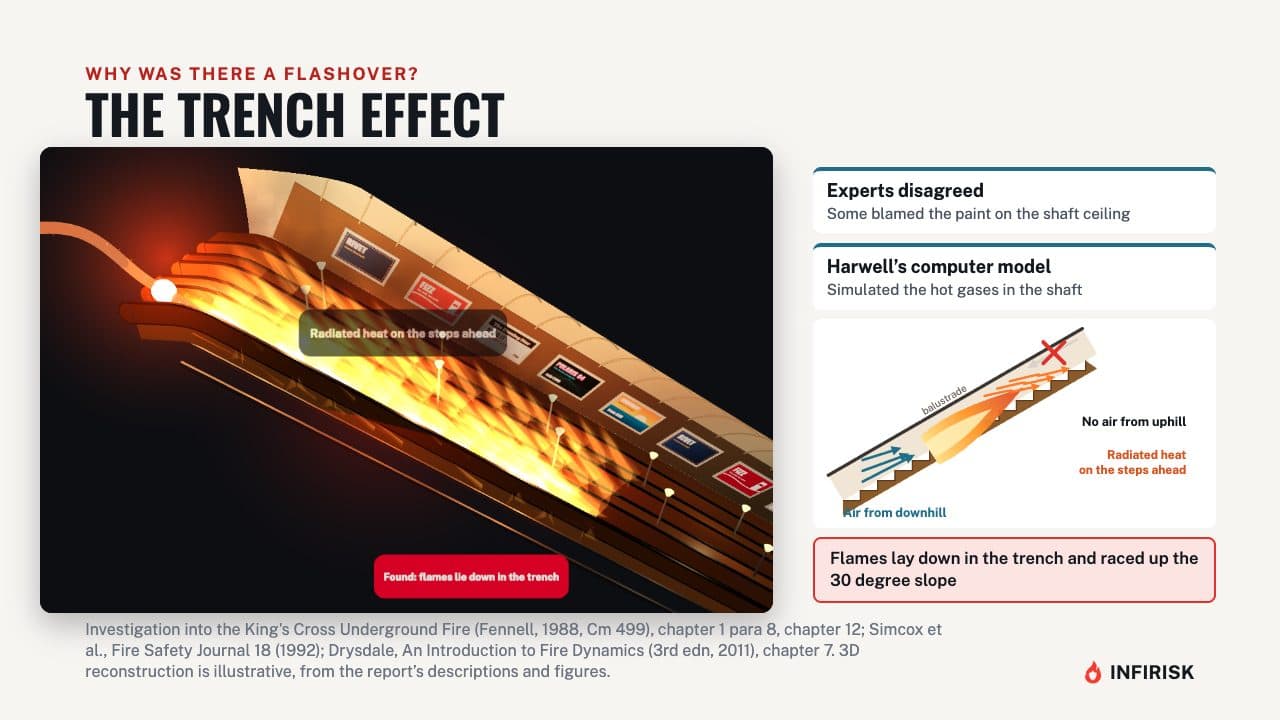
Why did a modest escalator fire suddenly become a fireball? At the investigation, the experts disagreed. Some blamed the paint on the shaft's ceiling, where up to 20 coats had built up.
The breakthrough came from a computer. Scientists at Harwell modelled the flow of hot gases in the escalator shaft, and found something nobody expected. Once both balustrades and the steps between them were burning, air could no longer reach the uphill side of the flames.
So instead of rising towards the ceiling, the flames lay down in the trench formed by the steps and balustrades. Lying flat over the steps ahead, they radiated heat onto wood that was not yet burning. That wood gave off flammable gases and caught almost at once, so the burning length grew, the flames grew longer, and the fire raced up the 30 degree slope, faster and faster.
The science of the slope
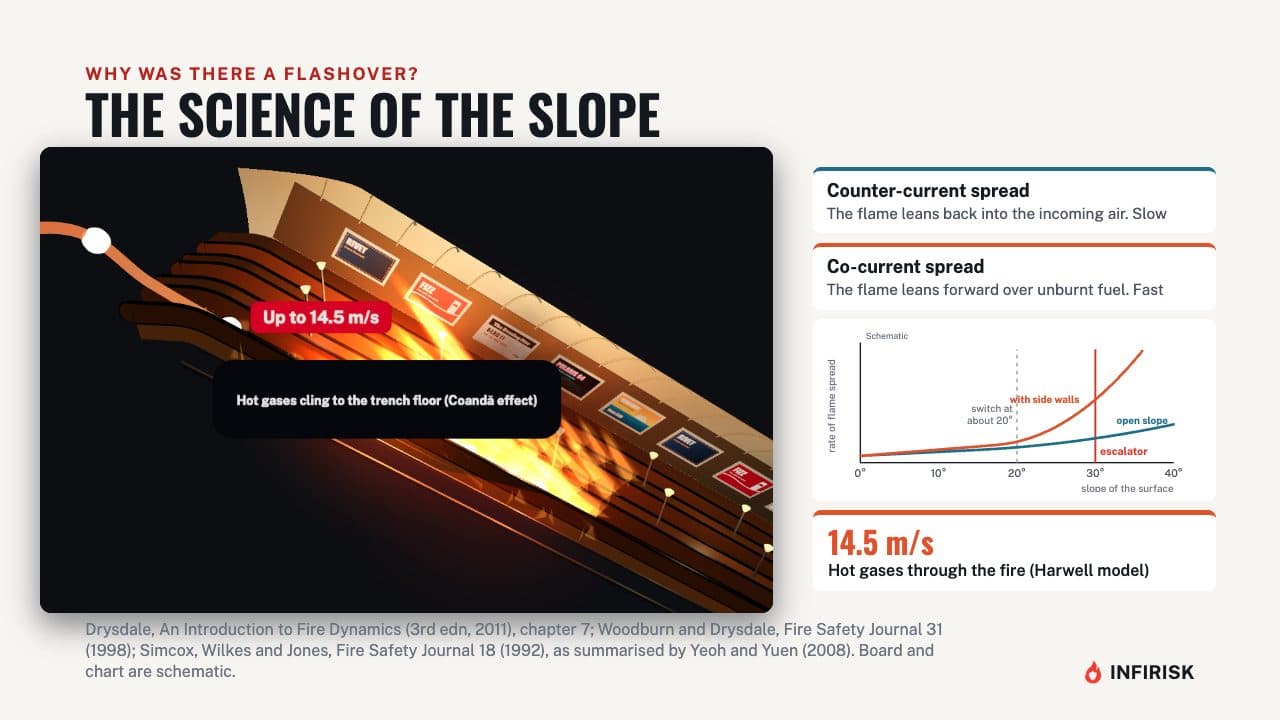
For the technically minded, here is why 30 degrees mattered. On a flat surface, a flame creeps against the air drawn in to feed it. Fire scientists call that counter-current spread, and it is slow.
Tilt the surface past a critical angle and the flame leans forward over the fuel ahead. That is co-current spread, and it is fast. Side walls make it far worse, because no air can be drawn in from the sides.
In laboratory trenches the switch came at about 20 degrees. The escalator was at 30. Harwell's computer model found the hot gases clinging to the floor of the trench, rushing up it at up to 14 and a half metres a second.
Every metre of wood that caught heated the next metre faster.
Two streams
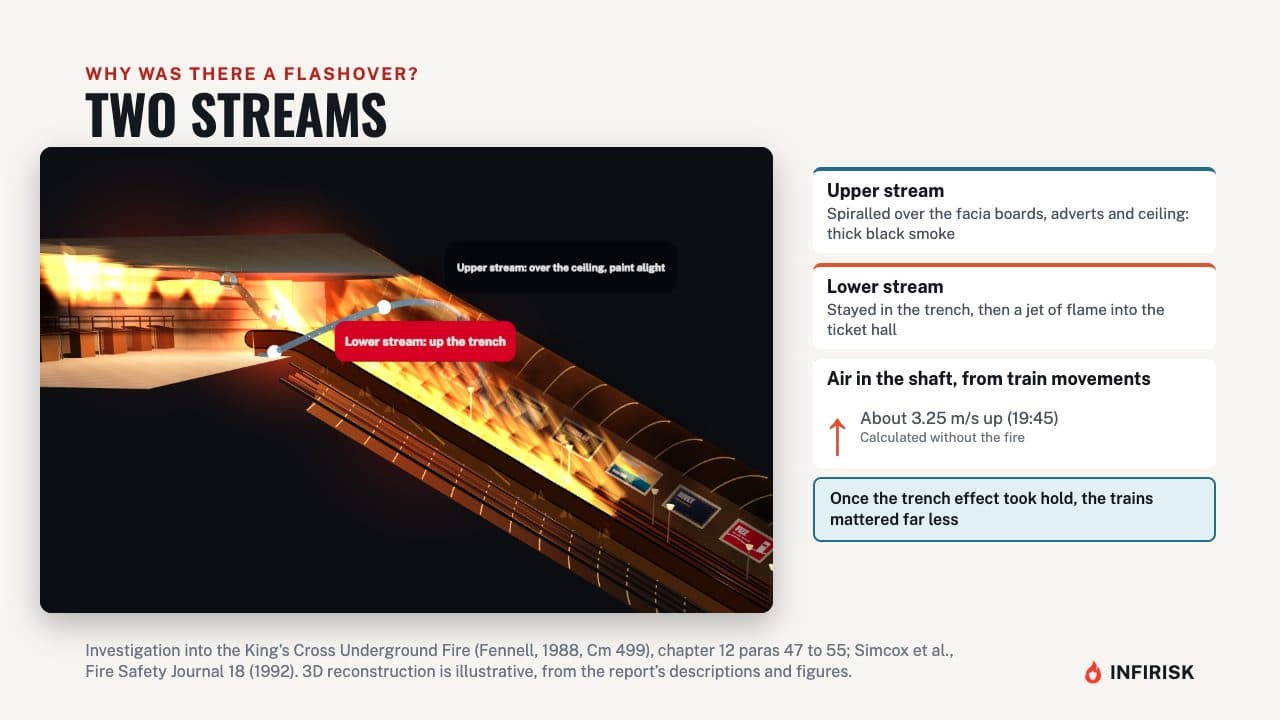
Higher up the shaft, the flow split in two. One stream rose out of the trench and spiralled up over the facia boards, advertisements and ceiling. It set the old paint alight, and made the thick black smoke that swept into the ticket hall and round the passages.
The other stream stayed in the trench and kept accelerating, until a jet of flame erupted into the ticket hall, hit the ceiling and was carried across it. Because those flames came from burning wood, they made little smoke of their own. Train movements may have played a part.
The air in the shaft was calculated to have switched from flowing down at about 1.75 metres a second to flowing up at about 3.25, just as the fire lay down. But once the trench effect took hold, the trains mattered far less.
Proving it
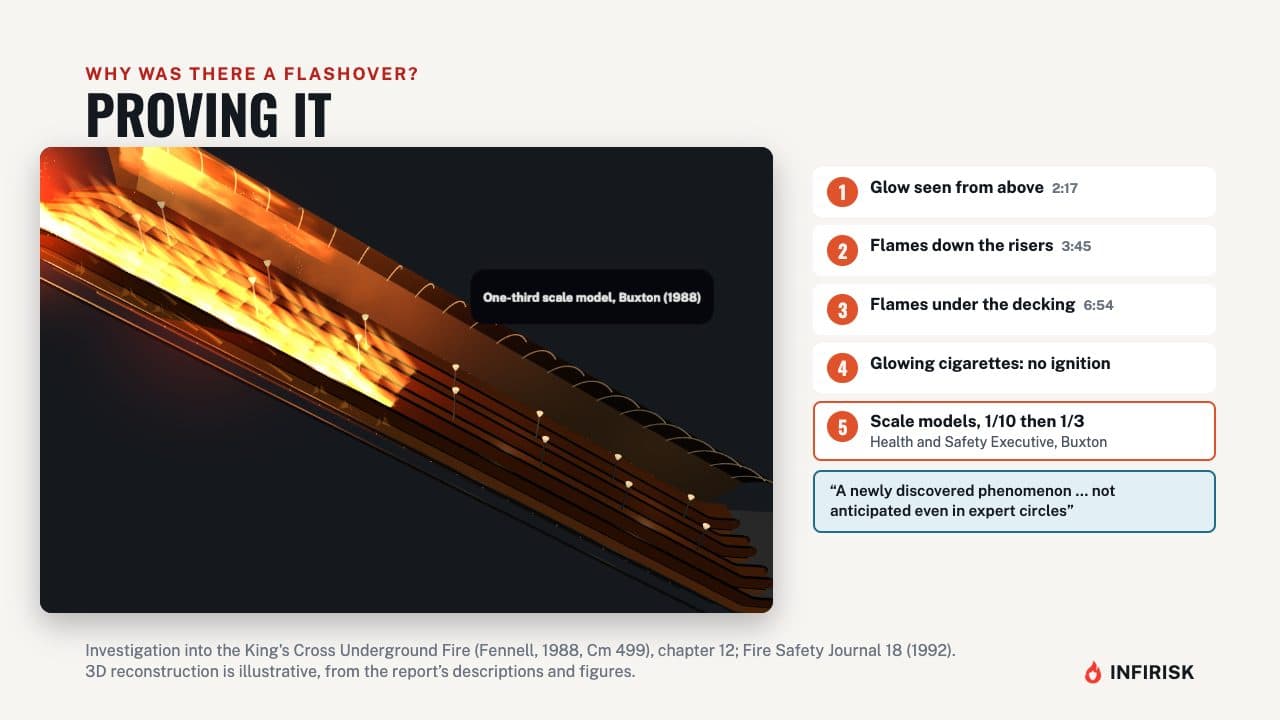
The theory was tested. In January 1988, investigators dropped a lit match into an undamaged section of escalator four, with its grease still in place. A glow could be seen from above after 2 minutes 17 seconds, flames down the side of the risers after 3 minutes 45, and flames touching the underside of the decking after about 7 minutes.
Glowing cigarettes dropped the same way never lit it. Then the Health and Safety Executive at Buxton built scale models of the shaft and ticket hall, first at one tenth and then at one third of full size. Fire on the model escalator lay down in the trench, raced up it, and erupted into the model ticket hall, just as the computer had predicted.
It became known as the trench effect, in the words of one adviser, a newly discovered phenomenon, not anticipated even in expert circles.
Thirty-one lives
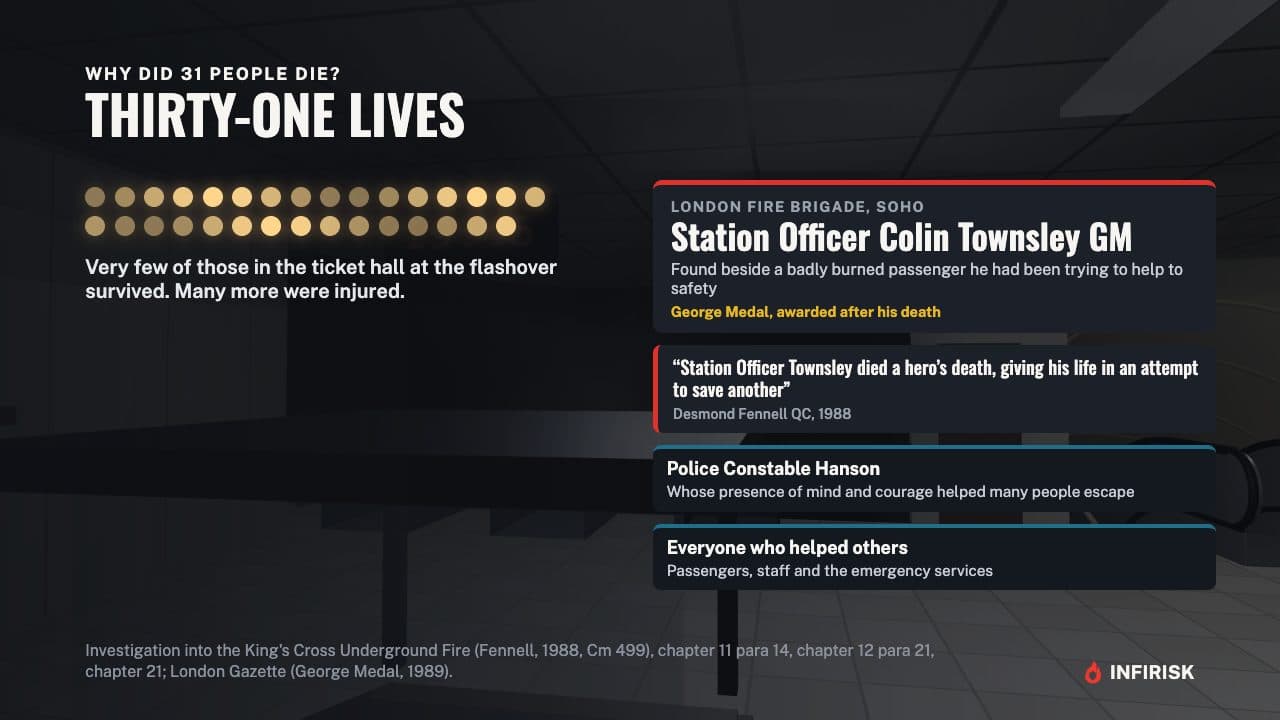
The flashover killed 31 people, and injured many more. Very few of those in the ticket hall at that moment survived. Among the dead was Station Officer Colin Townsley, in charge of the first fire engine from Soho.
He was found at the foot of the steps to the Pancras Road entrance, beside a badly burned passenger he had been trying to help to safety. Fennell wrote that he died a hero's death, giving his life in an attempt to save another, and he was awarded the George Medal after his death. Fennell also praised Police Constable Hanson, whose presence of mind and courage must have helped many people to escape.
And he saluted everyone, passengers, staff and the emergency services, who helped others that night.
Two worlds: the response
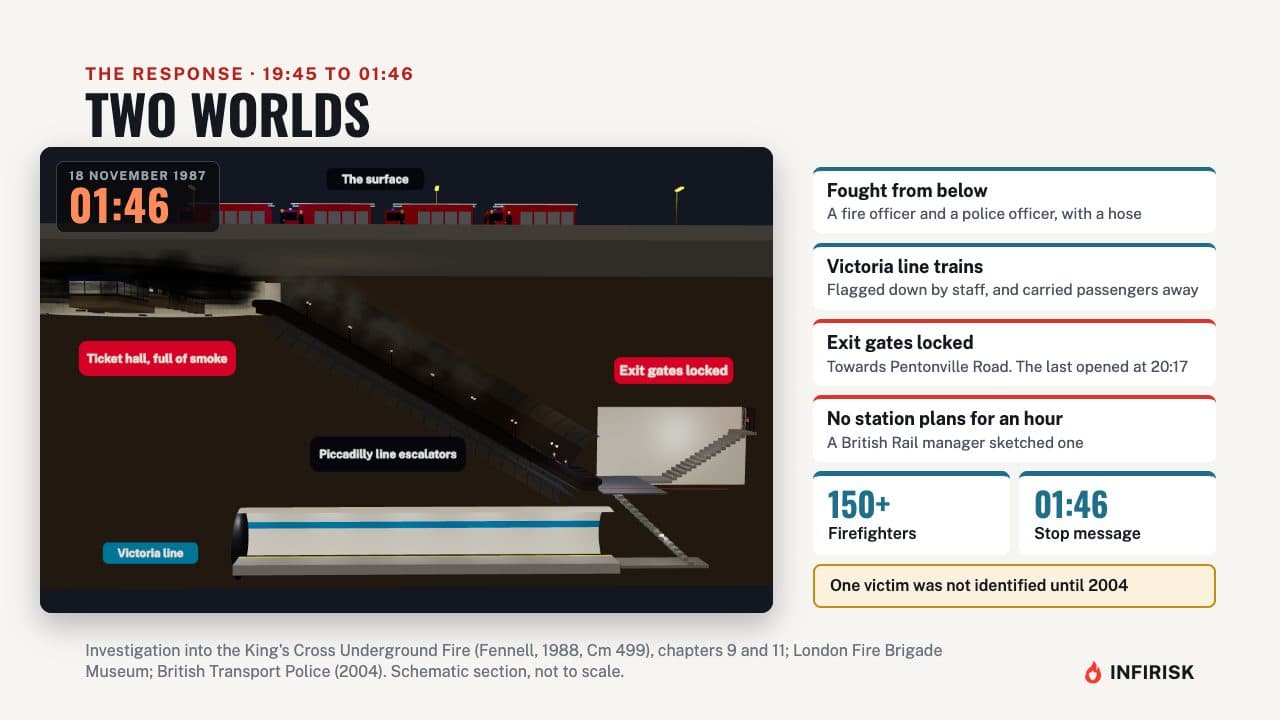
The flashover split the station in two. Crews on the surface believed those below were trapped or dead, while those below had no idea what was happening above. Below ground, a fire officer and a police officer fought the fire with a hose from the bottom of the escalators.
Staff flagged down Victoria line trains that had been told not to stop, and the trains carried passengers away. An injured passenger was carried to the emergency exit towards Pentonville Road, only to find its gates locked. The last of them was not opened until 20:17.
On the surface, the fire brigade had no plans of the station until about an hour after the flashover, and asked a British Rail manager to sketch one. Over 150 firefighters attended. The fire was surrounded at 21:48, and the stop message came at 01:46.
One victim was not identified until 2004.
What Fennell found
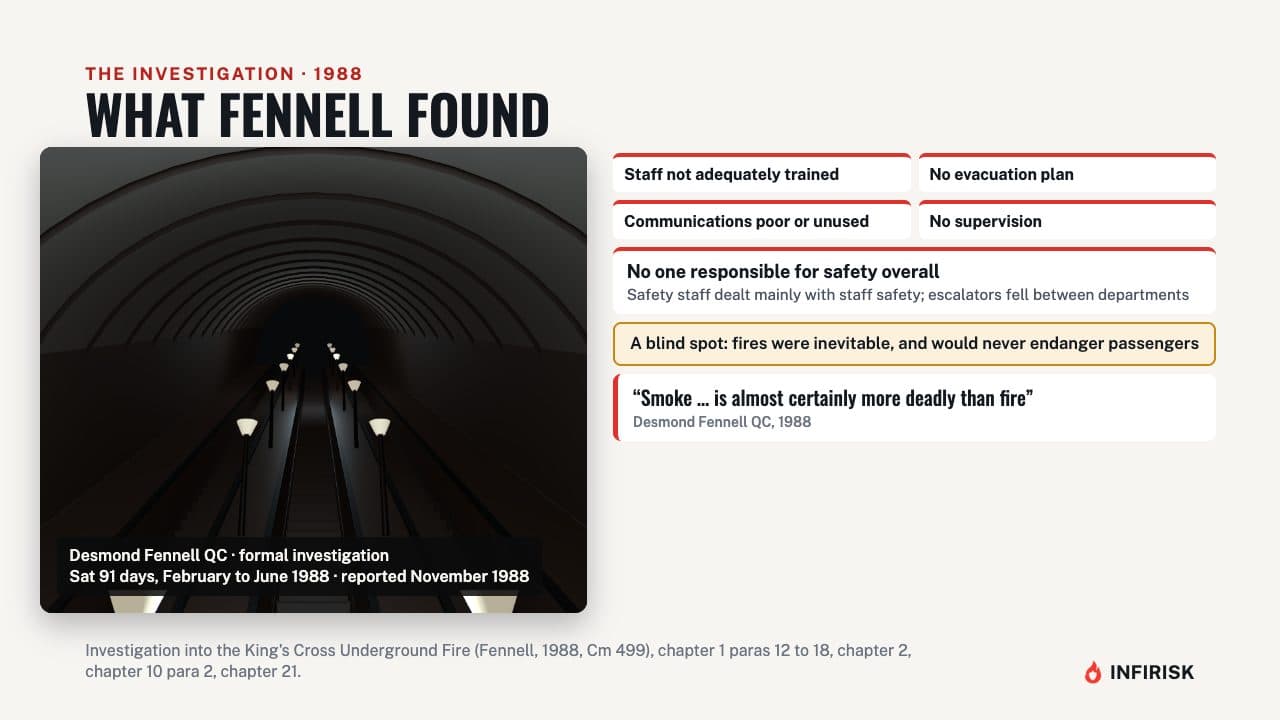
Five days after the fire, the government appointed Desmond Fennell QC to hold a formal investigation. It sat for 91 days in 1988, and reported that November. Fennell found that the staff had not been adequately trained, there was no plan for evacuating the station, communications equipment was poor or not used, and there was no supervision.
No one person at London Underground was responsible for safety overall. Each director thought safety in his division meant mainly the safety of staff, and the escalators fell between departments. The company had a blind spot: it believed fires were inevitable, and that a fire on a wooden escalator would never endanger passengers.
Fennell said that ignored the unpredictability of fire, and the danger from smoke, which he called almost certainly more deadly than fire.
Prevention, not precaution
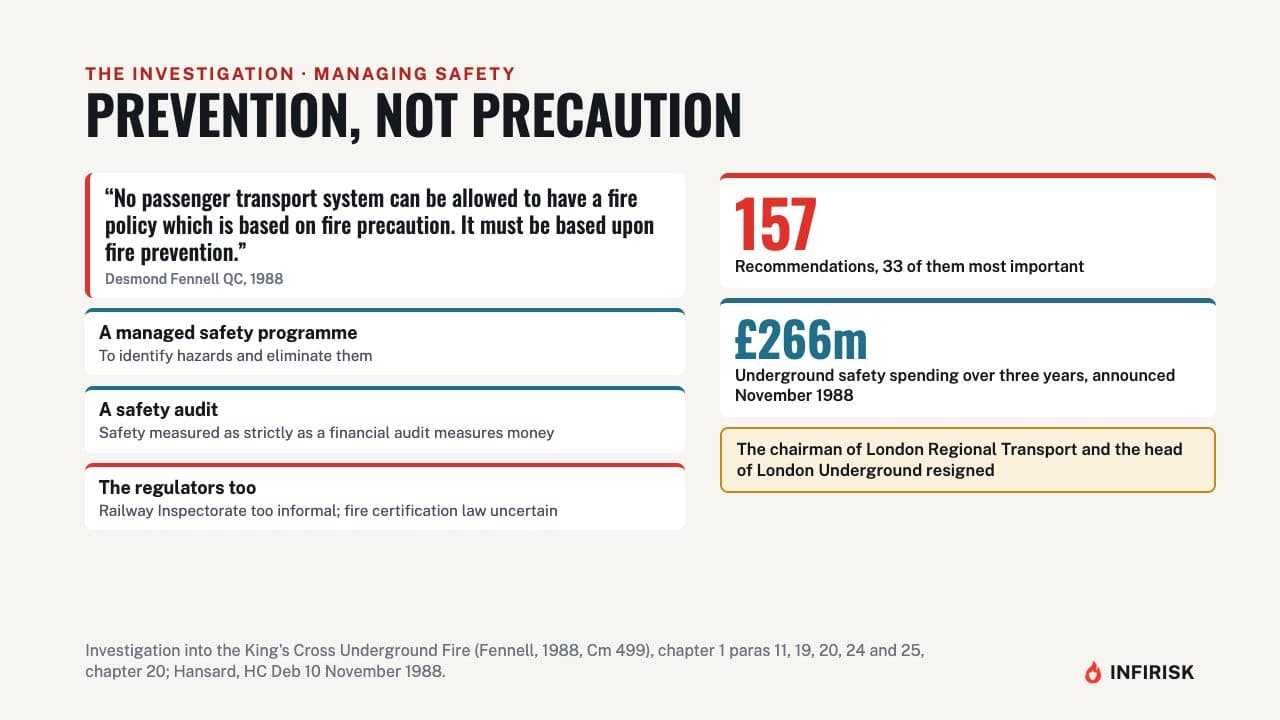
His central message was about managing safety. No passenger transport system, he wrote, can have a fire policy based on fire precaution. It must be based on fire prevention.
He called for a managed safety programme to find and remove hazards, and a safety audit, so that safety could be measured as strictly as a financial audit measures money. He found the Railway Inspectorate's relationship with London Underground too informal, and the law on fire certification for underground stations uncertain. He made 157 recommendations, 33 of them most important.
The government announced 266 million pounds of Underground safety spending over three years, and the chairman of London Regional Transport and the head of London Underground both resigned.
Wood out, detection in
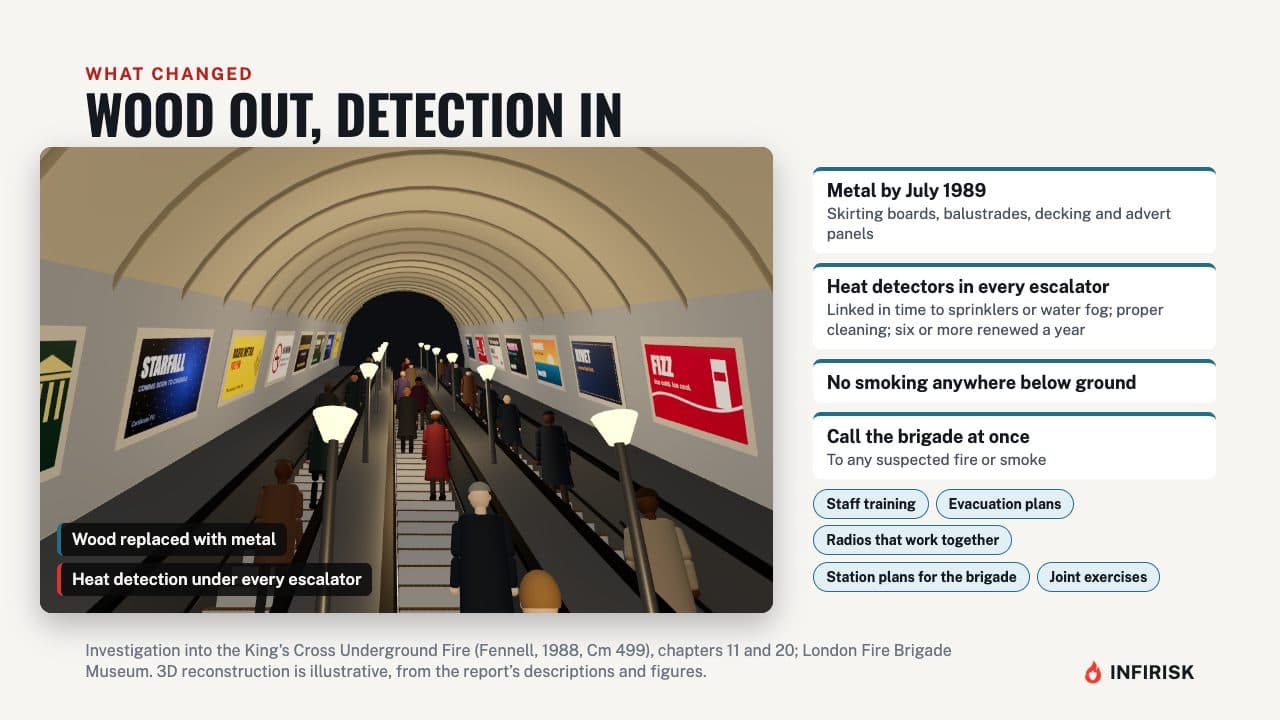
Change followed quickly. Fennell required the wooden skirting boards, balustrades, decking and advertisement panels on every escalator to be replaced with metal by July 1989. He called for heat detectors in every escalator, linked in time to sprinklers or water fog, for proper cleaning, and for six or more escalators to be renewed every year.
The smoking ban was extended to every part of a station below ground. London Underground's instructions now required staff to call the fire brigade at once to any suspected fire or smoke. Fennell also called for staff training and evacuation plans, police radios that worked with the fire brigade's, station plans kept where the brigade could reach them, and joint exercises between the emergency services.
Rules for underground stations
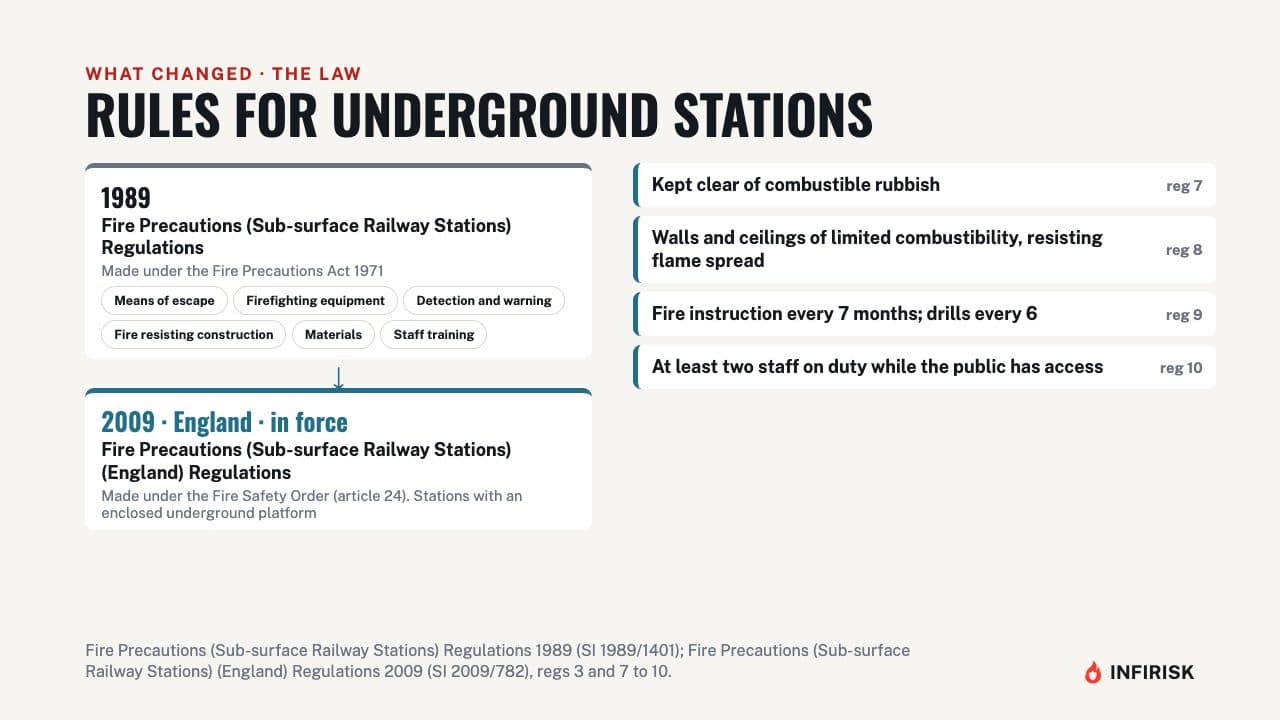
The law changed too. The Fire Precautions (Sub-surface Railway Stations) Regulations 1989, made under the Fire Precautions Act, gave underground stations their own fire safety rules, covering escape, firefighting equipment, detection and warning, fire resisting construction, materials, and staff training. In England, they were replaced in 2009 by regulations made under the Fire Safety Order, which still apply.
Stations with an enclosed underground platform must be kept clear of combustible rubbish. Walls and ceilings in public areas must be of limited combustibility, with surfaces that resist the spread of flame. Staff need basic fire instruction at least every seven months, with fire drills every six months.
And at least two staff must be on duty whenever the public has access.
Lessons today
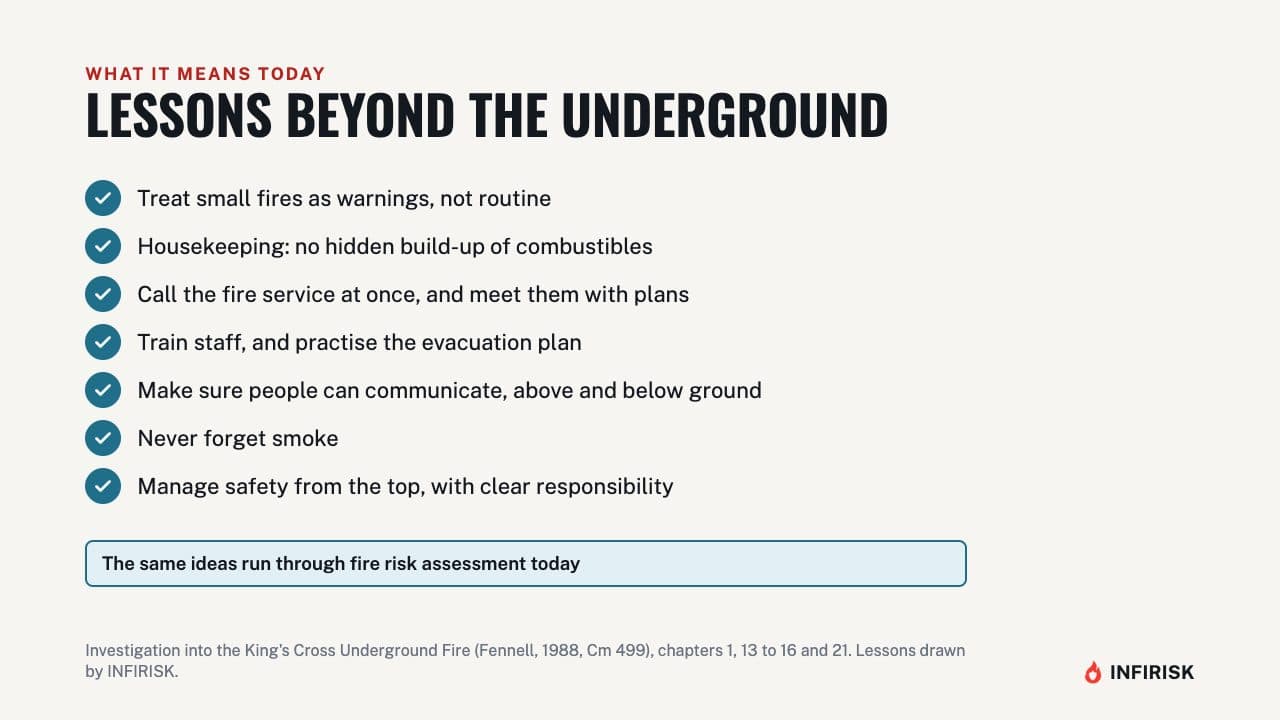
The lessons reach far beyond the Underground. Small fires are warnings, not routine: every escalator fire that went out without harm made the next one feel safer. Housekeeping matters: this fire started in dirt that had built up for years where nobody could see it.
Call the fire service straight away, and meet them with someone who knows the building and has its plans. Train staff, and have an evacuation plan that has been practised. Make sure people can communicate, above and below ground.
Never forget smoke: within seconds it filled the ticket hall, and very few people caught there at the flashover survived. And manage safety from the top, with clear responsibility, and measure it as carefully as money. The same ideas run through fire risk assessment today.
What the inquiry found
- The fire developed slowly for about fifteen minutes, then erupted into the ticket hall as a flashover driven by the trench effect, a phenomenon not then understood.
- The escalator was built of wood and the running tracks had not been cleaned of grease and debris.
- London Underground had no plan for evacuating the station in a fire and staff had little fire training; no member of staff called the fire brigade, which was summoned by a police officer from the street at 19:34 because police radios did not work below ground.
- Smoking had been banned on the Underground in 1985 but the ban was not enforced.
What this fire changed
- The Fire Precautions (Sub-surface Railway Stations) Regulations 1989, remade for England in 2009: Imposed specific fire precautions on sub-surface stations, including the removal of wooden escalators; still in force in their 2009 form.
Frequently asked questions
What caused the King's Cross fire?
At about 19:25 on 18 November 1987, a lit match, probably dropped by a passenger leaving the station, fell through the gap beside the steps of escalator four. It landed in years of grease and fluff on the running track, which began to burn, and the moving escalator carried the fire further up.
What is the trench effect?
Once both balustrades and the steps between them were burning, air could no longer reach the uphill side of the flames, so they lay down in the trench instead of rising. Lying flat over the steps ahead, they heated wood that was not yet burning, and the fire raced up the 30 degree slope faster and faster. Scientists at Harwell found it by modelling the hot gases in the shaft.
Why did the fire suddenly become a flashover at 19:45?
The trench effect drove a jet of flame up the escalator shaft and into the ticket hall, where it hit the ceiling and rolled across it, filling the hall with intense heat and thick black smoke. From the first alarm to the flashover, no water had been put on the fire.
How many people died in the King's Cross fire?
31 people died, including Station Officer Colin Townsley of the London Fire Brigade.
What changed after the King's Cross fire?
Fennell made 157 recommendations. Wooden escalator parts were replaced with metal, smoking was banned below ground, and staff had to call the fire brigade at once to any suspected fire. He also called for heat detectors in every escalator, linked in time to sprinklers or water fog. The Fire Precautions (Sub-surface Railway Stations) Regulations 1989 gave underground stations their own fire safety rules, replaced in England in 2009 by regulations that still apply.
Sources
- Investigation into the King's Cross Underground Fire (Desmond Fennell OBE QC, Department of Transport, 1988, Cm 499), Railways Archive
- King's Cross Fire (Fennell Report), House of Commons statement, 10 November 1988, Hansard
- Fire Precautions (Sub-surface Railway Stations) Regulations 1989 (SI 1989/1401), legislation.gov.uk
- Fire Precautions (Sub-surface Railway Stations) (England) Regulations 2009 (SI 2009/782), legislation.gov.uk
- Fire Safety Journal, volume 18 issue 1 (1992): The King's Cross Underground Fire
- Simcox, Wilkes and Jones (1992), Computer simulation of the flows of hot gases from the fire at King's Cross Underground station, Fire Safety Journal 18, 49 to 73
- The King's Cross fire, 1987, London Fire Brigade Museum
Written against
General guidance for England, not professional or legal advice. Always check the current edition of the guidance, and agree any design with building control or a competent fire safety professional. Contains public sector information licensed under the Open Government Licence v3.0.
Related guides
 6:48Video and guide
Fire risk assessments explained: who needs one, what it covers, and what the law says
The Fire Safety Order in plain English: what a fire risk assessment is, who must have one, what it looks at, what to record, and what happens if it is missing.
 5:25Video and guide
Second staircases in blocks of flats: the 18m rule in Approved Document B (2026)
The 2026 amendment to Approved Document B: when a second common stair is needed, how 18 metres is measured, the transitional arrangements, and evacuation lifts.
 5:02Video and guide
Travel distances in Approved Document B (Table 2.1) explained
How far is too far to escape a fire? The Table 2.1 limits for buildings other than dwellings, how they are measured, and how dead ends are checked.
 5:46Video and guide
Loft conversions and fire safety: escape routes, fire doors and alarms
Why a loft room changes the fire safety rules for the whole house, and what Approved Document B asks for: protected stairway, doors, windows and alarms.