E-bike and e-scooter battery fires: buying, charging and the warning signs
Video, 5:54Published 23 October 2026Last reviewed 24 October 2026
Plays from YouTube in privacy-enhanced mode once you press play.
E-bikes and e-scooters are used safely by millions of people every day. But the large lithium-ion batteries inside them can start fires that grow fast and are very hard to put out. In this guide, we'll cover why these batteries fail, what makes a fire more likely, how to buy and charge safely, the warning signs, and what the law expects from sellers and building managers.
The guide below is the video's narration, chapter by chapter, with the diagram from each chapter.
Why it matters
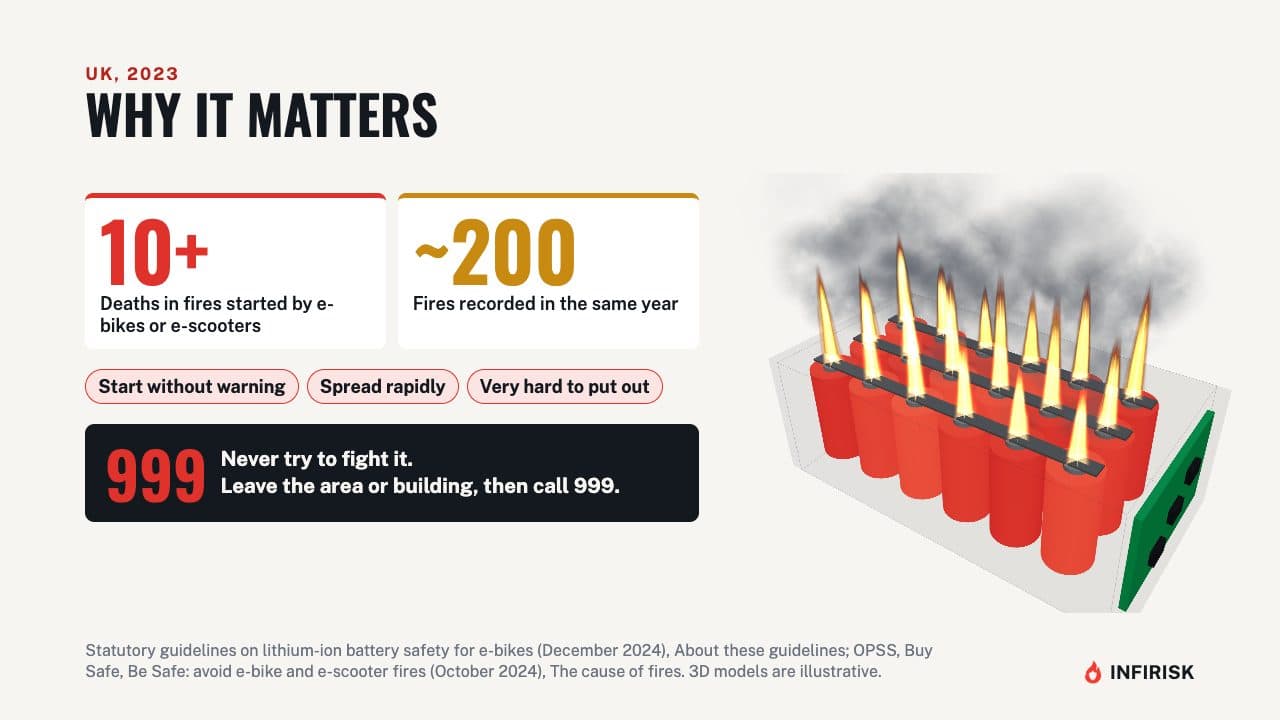
The government's statutory guidelines on e-bike batteries record at least 10 deaths in fires started by e-bikes or e-scooters in the UK in 2023, and almost 200 fires. Government advice is clear: these fires can start without warning, spread rapidly, and are very hard to extinguish. Never try to fight one yourself.
Leave the area or the building as quickly as possible, and call 999.
Thermal runaway

The danger is called thermal runaway. If a cell inside the battery gets hot enough, chemical reactions start to produce heat faster than it can escape. Gas builds up, the cell casing ruptures, and flammable, potentially toxic gases are released that can ignite, causing a fire or an explosion.
The heat spreads to the cells next to it, so one failing cell can set off the whole pack.
What makes a fire more likely
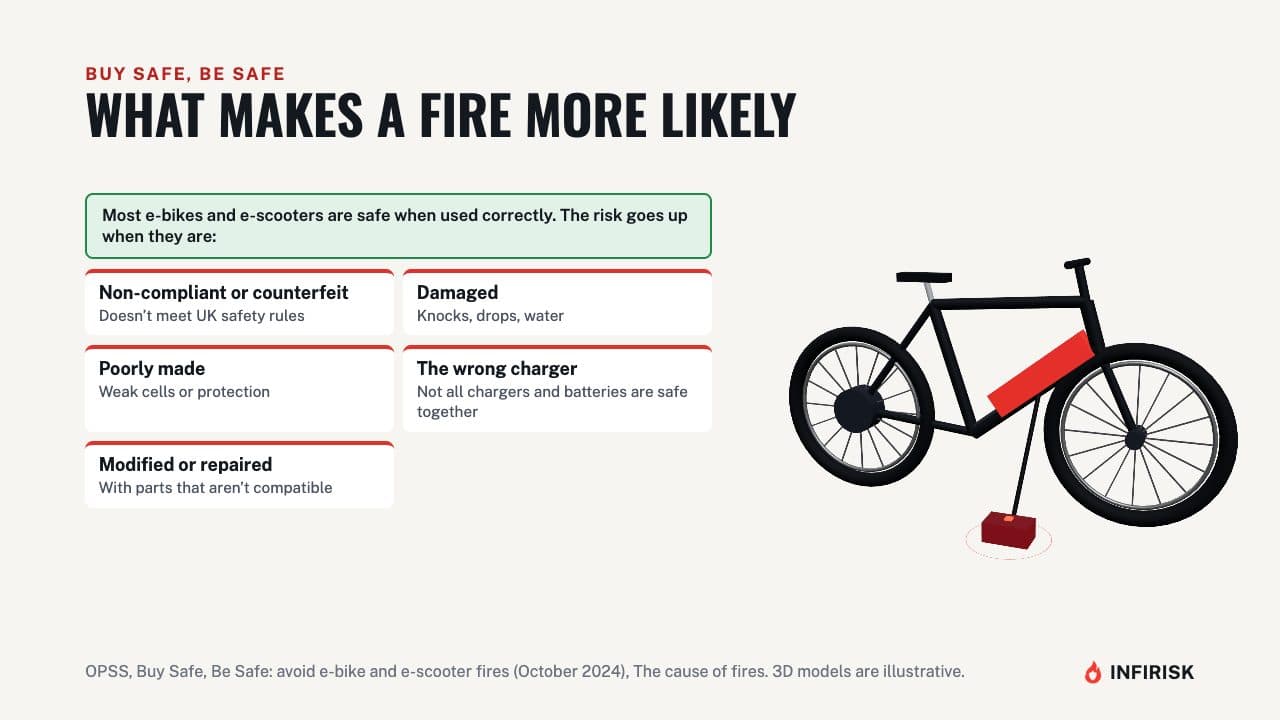
Most e-bikes and e-scooters are safe when used correctly. The risk of fire goes up when a product is non-compliant or counterfeit, damaged, or poorly made. It also goes up when a battery is charged with the wrong charger.
And it goes up when the bike or scooter is modified or repaired with parts that aren't compatible, such as a different charger, motor or battery.
Buying safely
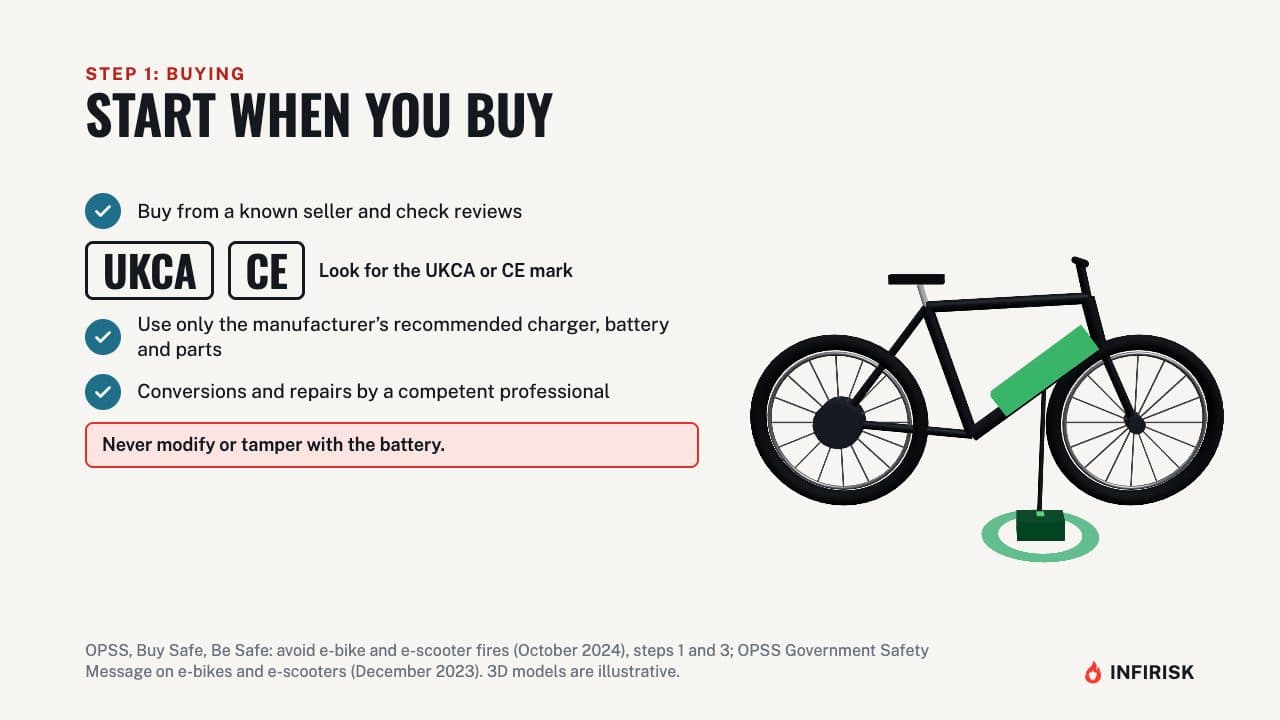
Start when you buy. Choose a known seller and check reviews: products sold to UK consumers must meet UK safety law, and good sellers explain how theirs does. Look for the UKCA or CE mark.
Only use chargers, batteries and replacement parts that the manufacturer recommends. If you want to convert a pedal bike into an e-bike, have a competent professional do it, and have repairs done professionally too. Never modify or tamper with the battery.
Charging safely

Charge safely. Follow the manufacturer's instructions, and charge in a safe place that doesn't block escape routes or exits. So never in the hallway or by the front door, and not in a bedroom.
In a flat like this, the hallway is the way out: every room opens onto it, and the front door is at the end. Most of these fires happen while the battery is charging, and they can develop within a few seconds. A fire here could cut everyone off from the front door, and fill the way out with smoke.
So charge away from the way out, on a hard, flat surface, with a smoke alarm where you charge. Don't cover the charger or battery. Charge while you are awake and at home, not overnight or while you're out, and unplug once the battery is full.
Warning signs
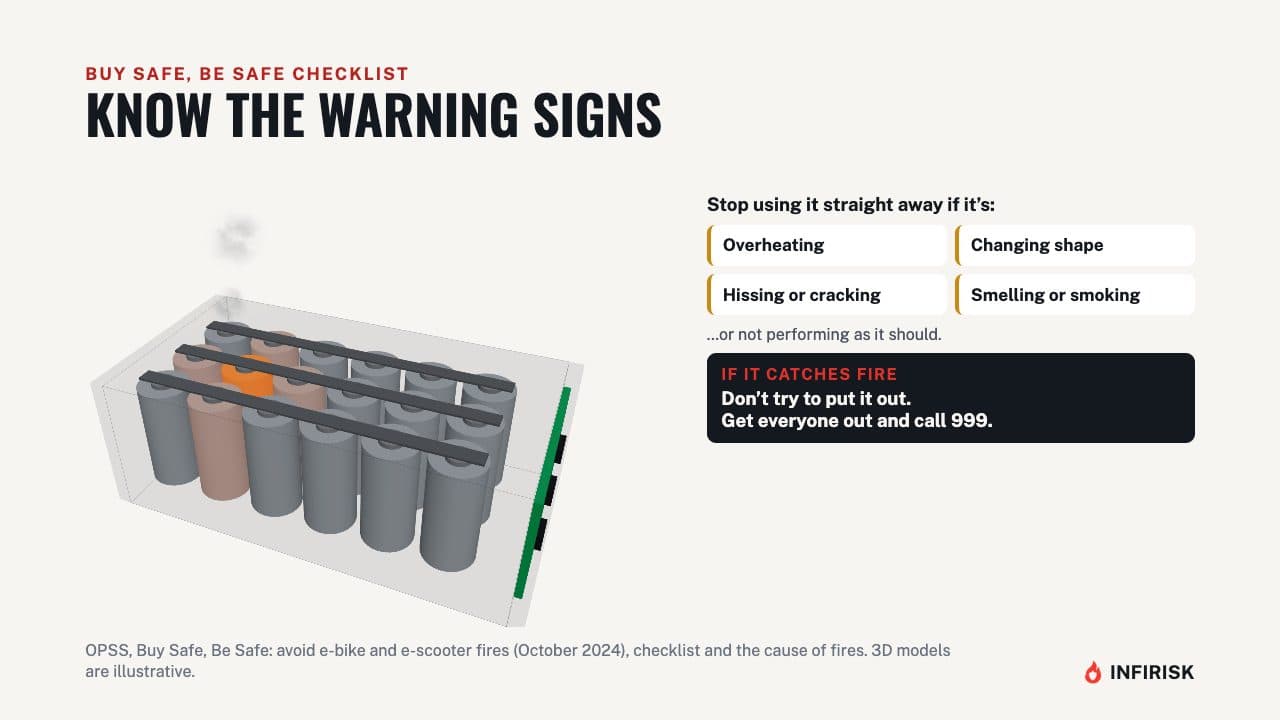
Know the warning signs. Stop using a battery or charger straight away if it is overheating, changing shape, hissing or cracking, smelling, smoking, or not performing as it should. If a battery catches fire, don't try to put it out.
Get everyone out, and call 999.
What the law expects
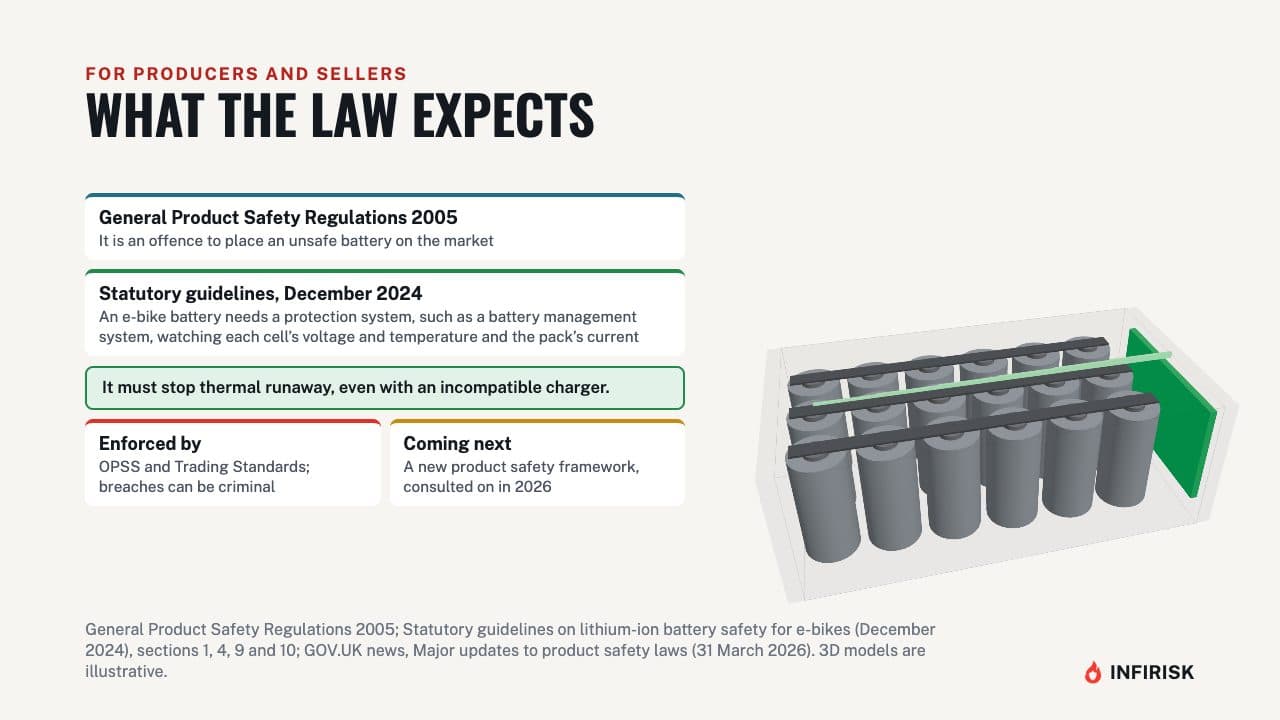
For businesses, the law is the General Product Safety Regulations 2005. Since December 2024, statutory guidelines say an e-bike battery must have a protection system, such as a battery management system. It watches each cell's voltage and temperature and the pack's current, and stops thermal runaway, even with an incompatible charger.
Producers and sellers must take the guidelines into account. The Office for Product Safety and Standards and Trading Standards enforce the rules, and breaches can be criminal. A new product safety framework was consulted on in 2026.
Blocks of flats and shared buildings
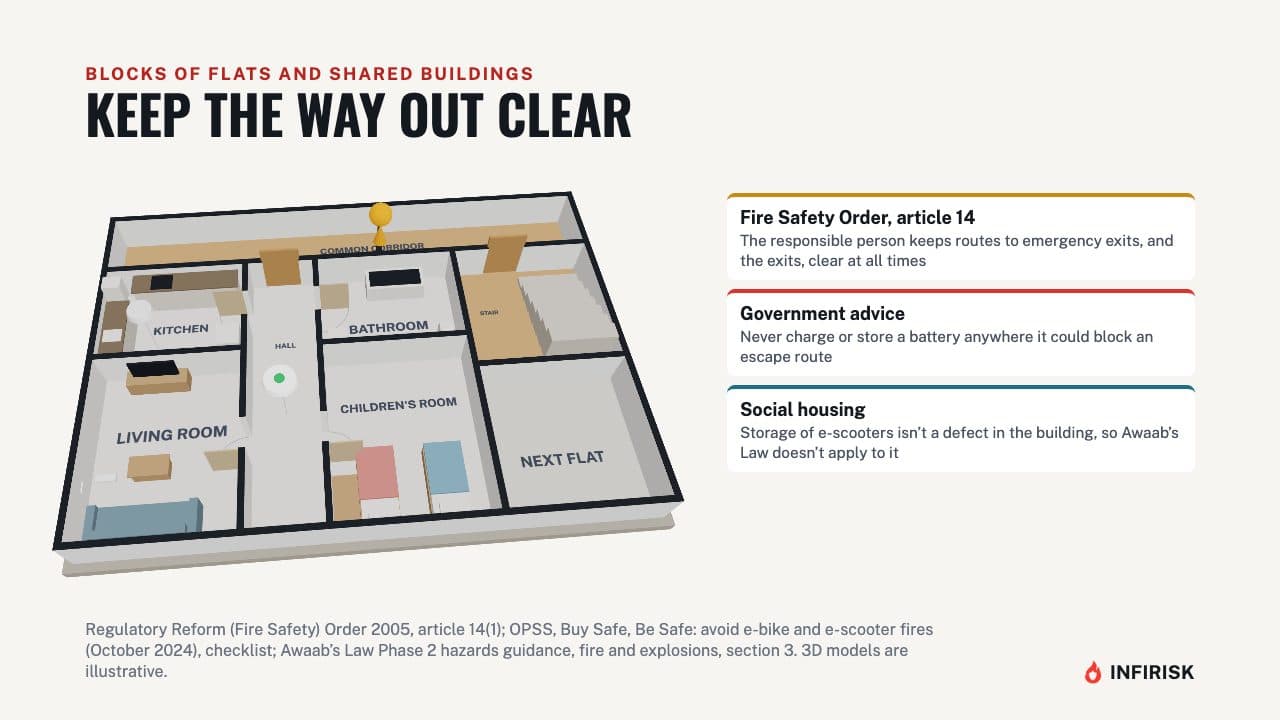
In blocks of flats and other shared buildings, article 14 of the Fire Safety Order requires the responsible person to keep routes to emergency exits, and the exits themselves, clear at all times. Government advice says never charge or store a battery in a hallway, or anywhere it could block an escape route. In social housing, the government's Awaab's Law guidance treats an e-scooter kept in a flat as outside Awaab's Law, because it isn't a defect in the building.
Frequently asked questions
Is it safe to charge an e-bike overnight?
Government advice is to charge while you are awake and at home, not overnight or while you're out, and to unplug once the battery is full. Charge in a safe place that doesn't block escape routes or exits, so never in the hallway.
What are the warning signs of a failing e-bike battery?
Stop using a battery or charger straight away if it is overheating, changing shape, hissing or cracking, smelling, smoking, or not performing as it should. If a battery catches fire, do not try to put it out: get everyone out and call 999.
Can I use a different charger for my e-bike?
Only use chargers, batteries and replacement parts that the manufacturer recommends. The risk of fire goes up when a battery is charged with the wrong charger, or when the bike is modified or repaired with parts that are not compatible.
Can e-bikes be kept in the corridor of a block of flats?
Article 14 of the Fire Safety Order requires the responsible person to keep routes to emergency exits, and the exits themselves, clear at all times. Government advice is never to charge or store a battery in a hallway, or anywhere it could block an escape route.
What is thermal runaway?
If a cell gets hot enough, chemical reactions produce heat faster than it can escape. Gas builds up, the casing ruptures and flammable, potentially toxic gases are released that can ignite. The heat spreads to the next cells, so one failing cell can set off the whole pack.
Sources
Written against
- Statutory guidelines on lithium-ion battery safety for e-bikes, Current GOV.UK guidance
- The Regulatory Reform (Fire Safety) Order 2005, SI 2005/1541 as amended (Article 14)
General guidance for England, not professional or legal advice. Always check the current edition of the guidance, and agree any design with building control or a competent fire safety professional. Contains public sector information licensed under the Open Government Licence v3.0.
More from Landlord Fire Safety
 4:41Video and guide
BS 5839-6 explained for landlords: smoke alarm rules for rented homes in England
The legal minimum for landlords in England, what the BS 5839-6 grades and categories mean, and what to aim for in a rented home.
- 3 min readINFIRISK guideWritten guide
Awaab's Law and fire hazards: repair deadlines for social homes from November 2026
Which social homes Awaab's Law covers, what counts as a fire hazard, the emergency and significant hazard deadlines, and where the Fire Safety Order takes over.
 7:41Video and guide
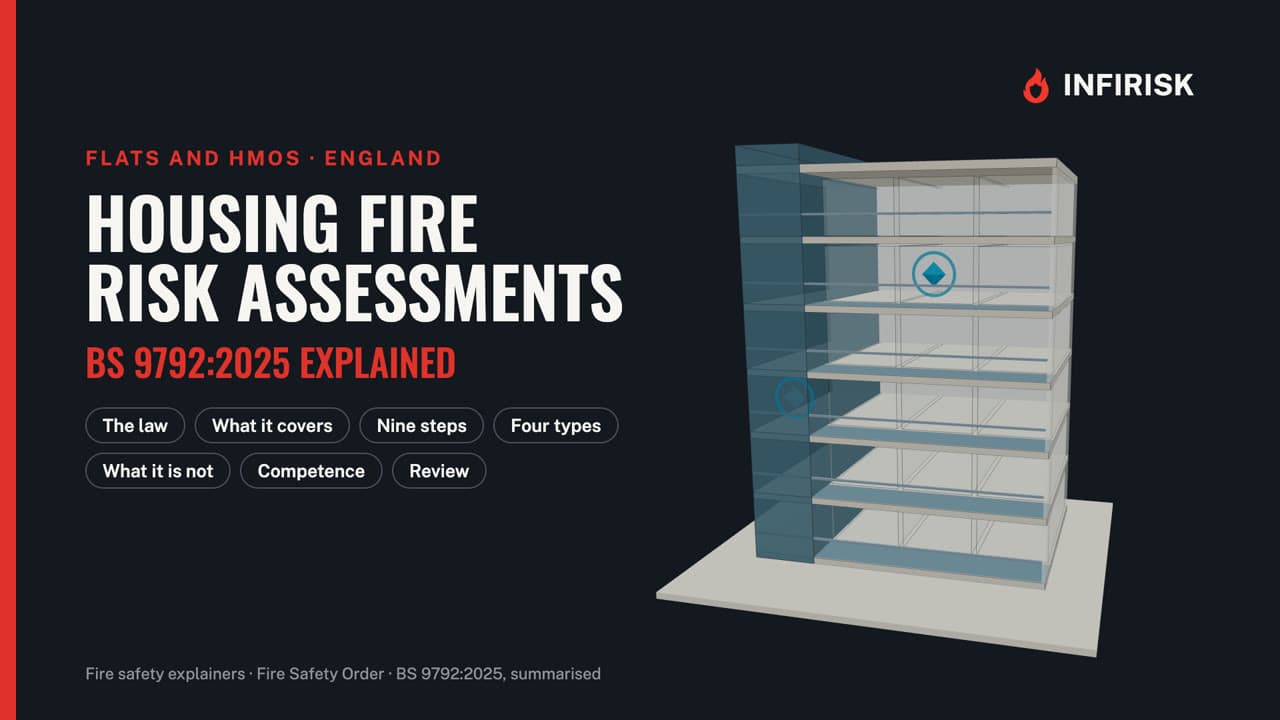
Housing fire risk assessments explained: BS 9792:2025 for flats and HMOs
The code of practice that replaced PAS 79-2: what it covers, its nine steps, the four types of assessment, competence, and how often to review an assessment.