Awaab's Law and fire hazards: repair deadlines for social homes from November 2026
Published 23 October 2026Last reviewed 23 October 2026
From 30 November 2026, Awaab's Law puts fire hazards inside social homes on fixed repair deadlines. A missing smoke alarm, a blocked exit, a sparking socket: the clock starts when you find out. In this guide, we'll cover what the law is, which homes it covers, what counts as a fire hazard, the deadlines, what sits outside it, and how to get ready.
What Awaab's Law is
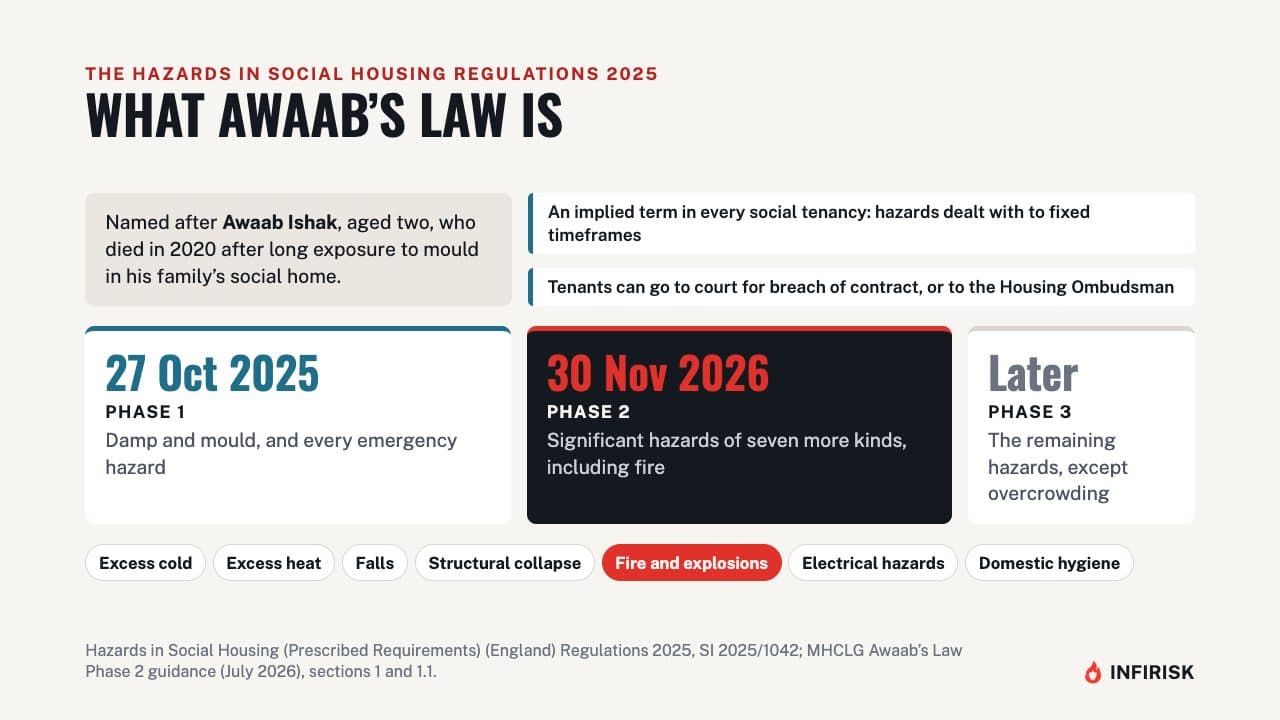
Awaab's Law is named after Awaab Ishak, a two-year-old who died in 2020 after long exposure to mould in his family's social home. The regulations came into force on 27 October 2025, and they write a term into every social tenancy: hazards must be dealt with to fixed timeframes. A tenant can take the landlord to court, or complain to the Housing Ombudsman.
Phase 1 covered damp and mould, and every emergency hazard. Phase 2, from 30 November 2026, adds fire and explosions, along with cold, heat, falls, structural collapse, electrical hazards and hygiene.
Which homes it covers
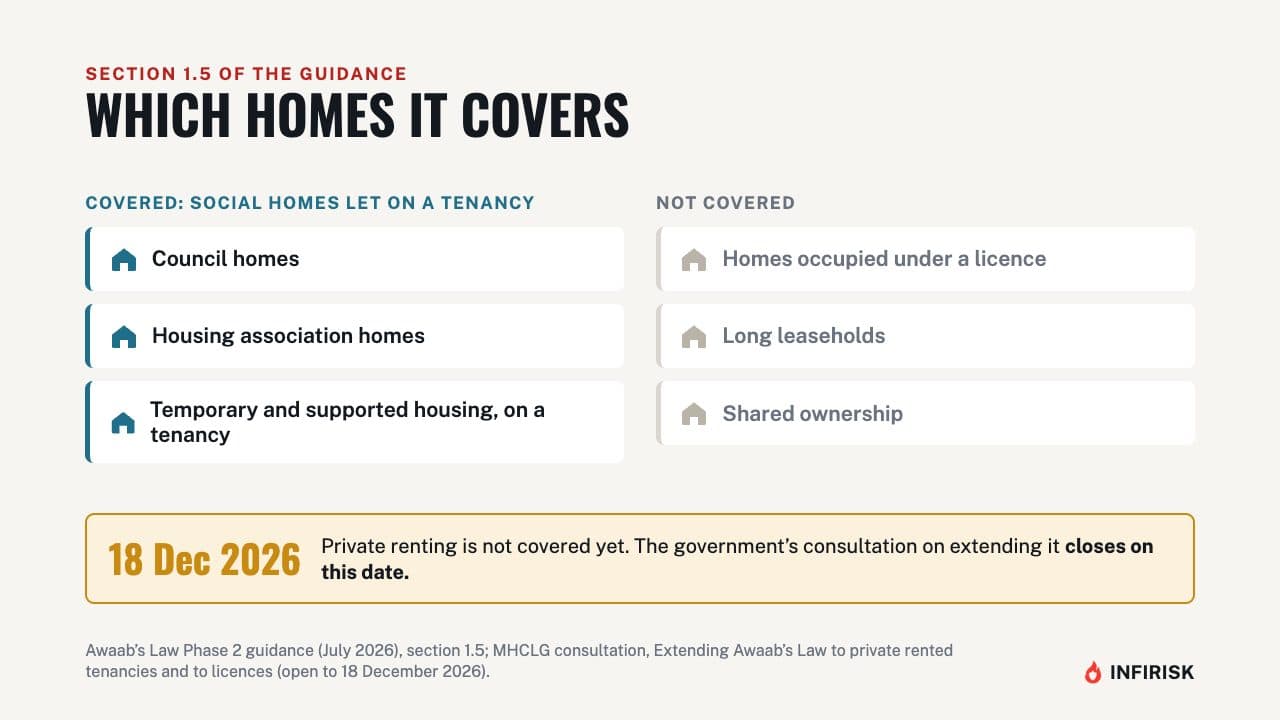
It covers almost all social housing let on a tenancy by a registered provider: councils and housing associations, including temporary and supported housing let on a tenancy. It does not cover homes occupied under a licence, long leaseholds or shared ownership. Private landlords are not covered yet, but the government is consulting on extending it to private renting until 18 December 2026.
What counts as a fire hazard
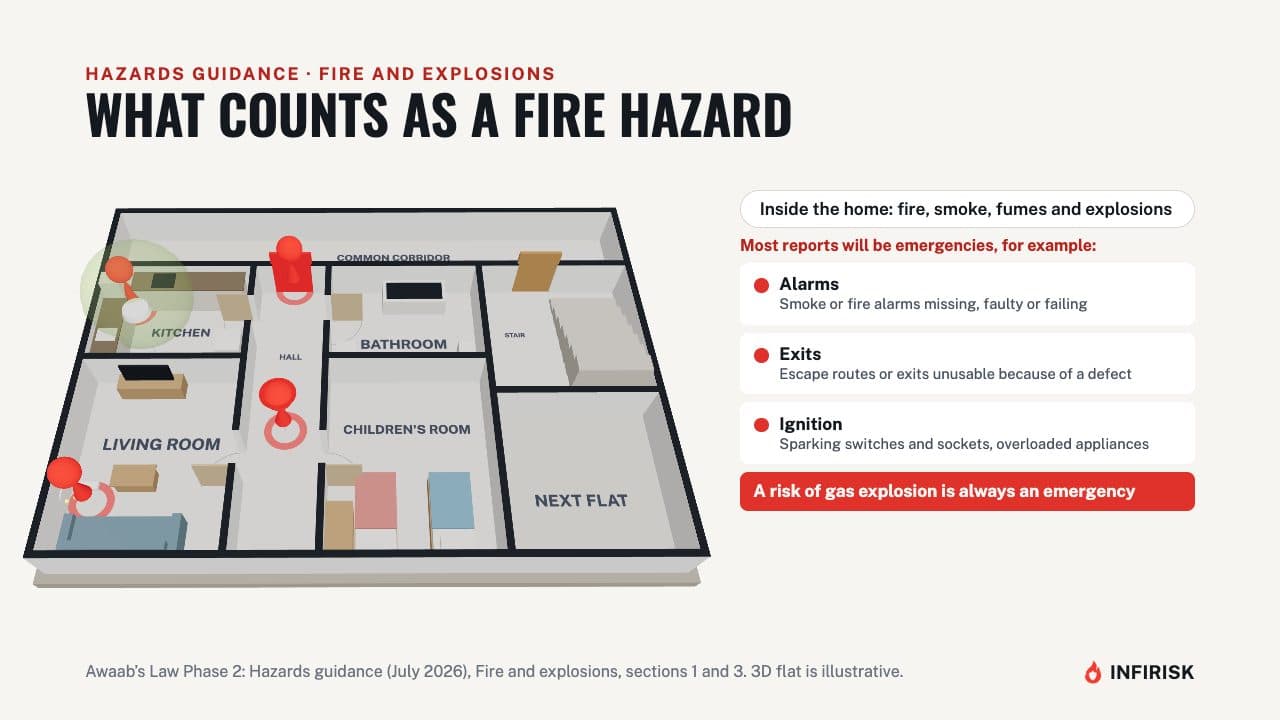
The fire hazard covers uncontrolled fire, smoke and fumes inside the home, and explosions, for example from a failing boiler. The government expects most fire reports to be emergencies. Its examples are smoke or fire alarms in the home that are missing, faulty or failing, and escape routes or exits that can't be used because of a defect.
Then there are uncontrolled ignition sources, like sparking switches and sockets, or overloaded appliances. A risk of gas explosion is always an emergency.
The two clocks
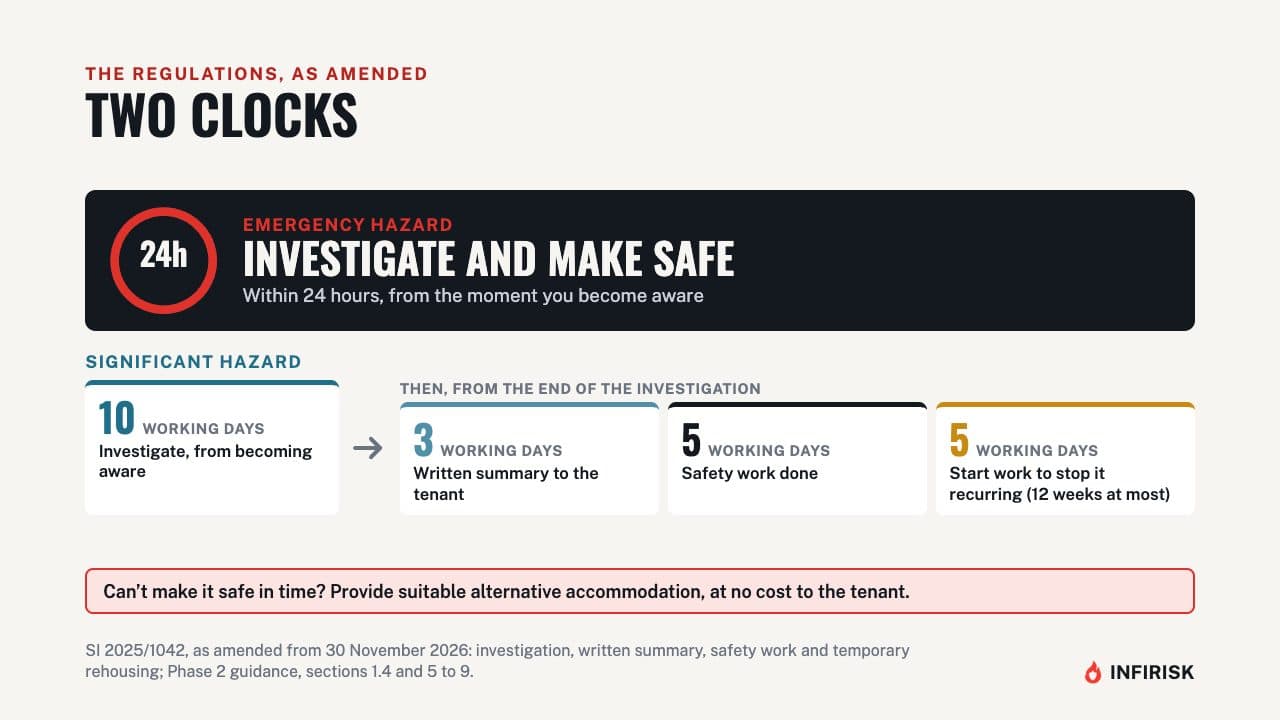
There are two clocks. For an emergency hazard, investigate and make the home safe within 24 hours, from the moment you become aware. For a significant hazard, investigate within 10 working days.
Once the investigation ends, give the tenant a written summary within 3 working days, and complete the safety work within 5 working days. Work to stop it coming back must start within those 5 working days, or as soon as reasonably practicable and within 12 weeks. If you can't make the home safe in time, you must provide suitable alternative accommodation, at no cost to the tenant.
The government's example

Here is the government's own example. A routine inspection finds no working smoke alarm in a flat where a couple live with two young children. With no early warning, especially at night, the risk to life is high, and the guidance says this would likely be an emergency whoever lived there.
So it is made safe within 24 hours. Separately, the smoke alarm regulations already require at least one smoke alarm on every storey with living accommodation.
Where Awaab's Law stops
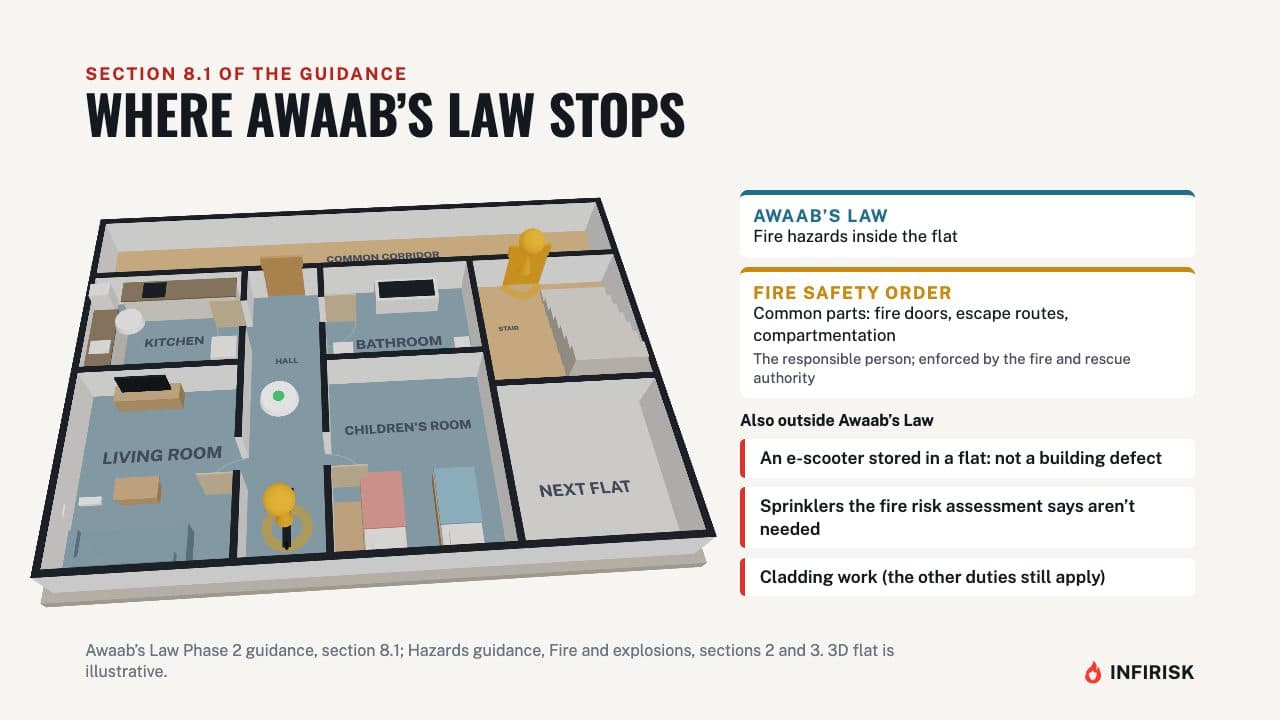
Awaab's Law stops at the front door of the flat. Fire hazards in the common parts of a block, like damaged fire doors, blocked escape routes or gaps in compartmentation, stay with the responsible person under the Fire Safety Order. Those are enforced by the fire and rescue authority.
It also leaves out hazards that aren't defects in the building, like an e-scooter stored in a flat. And it doesn't cover sprinklers the fire risk assessment says aren't needed, or cladding work, though the other duties still apply.
How to get ready
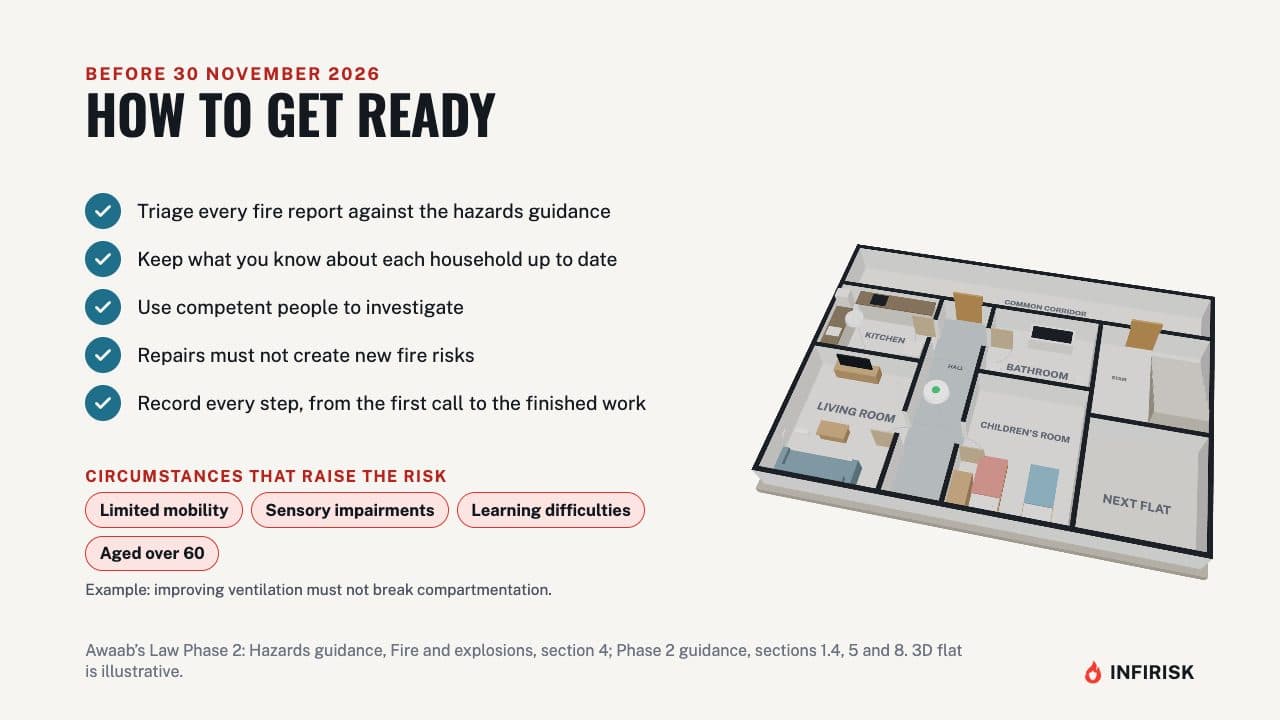
To get ready, triage every fire report against the guidance, and keep what you know about each household up to date. Limited mobility, sensory impairments, learning difficulties and age over 60 can all raise the risk. Use competent people to investigate.
Check that repairs don't create new fire risks: improving ventilation must not break compartmentation. And keep a record of every step, from the first call to the finished work.
Frequently asked questions
When do fire hazards come under Awaab's Law?
From 30 November 2026, when Phase 2 adds fire and explosions, along with cold, heat, falls, structural collapse, electrical hazards and hygiene. Phase 1, in force since 27 October 2025, covered damp and mould and every emergency hazard.
What are the deadlines for a fire hazard in a social home?
For an emergency hazard, investigate and make the home safe within 24 hours of becoming aware. For a significant hazard, investigate within 10 working days, then give the tenant a written summary within 3 working days and complete the safety work within 5 working days. The government expects most fire reports to be emergencies.
Does Awaab's Law apply to private landlords?
Not yet. It covers almost all social housing let on a tenancy by a registered provider, such as councils and housing associations. The government is consulting on extending it to private renting until 18 December 2026.
Does Awaab's Law cover fire doors and corridors in a block of flats?
No. It stops at the front door of the flat. Hazards in the common parts, such as damaged fire doors, blocked escape routes or gaps in compartmentation, stay with the responsible person under the Fire Safety Order, enforced by the fire and rescue authority.
Is a missing smoke alarm an emergency under Awaab's Law?
In the government's own example, a flat with no working smoke alarm, home to a couple with two young children, would likely be an emergency whoever lived there, so it is made safe within 24 hours. Separately, the smoke alarm regulations require at least one smoke alarm on every storey with living accommodation.
Sources
Written against
More from Fire Safety Law for Business
 6:48Video and guide
Fire risk assessments explained: who needs one, what it covers, and what the law says
The Fire Safety Order in plain English: what a fire risk assessment is, who must have one, what it looks at, what to record, and what happens if it is missing.
 5:54Video and guide
E-bike and e-scooter battery fires: buying, charging and the warning signs
Thermal runaway in plain English, what makes a fire more likely, buying and charging safely, the warning signs, and the law for sellers and shared buildings.
- 6 min readINFIRISK guideWritten guide
Fire extinguishers explained: types, colours, how many you need and servicing
What the law requires, the classes of fire, extinguisher types and colours, how many and where, kitchens, electrics and batteries, checks, servicing and training.
- 4 min readINFIRISK guideWritten guide
The Fire Safety (England) Regulations 2022 explained: every duty for blocks of flats
Which buildings and parts are covered, the three height tiers, and each duty: residents, fire door checks, signs, the information box, plans, external walls and monthly checks.
Related guides
 4:41Video and guide
BS 5839-6 explained for landlords: smoke alarm rules for rented homes in England
The legal minimum for landlords in England, what the BS 5839-6 grades and categories mean, and what to aim for in a rented home.
 7:41Video and guide
Housing fire risk assessments explained: BS 9792:2025 for flats and HMOs
The code of practice that replaced PAS 79-2: what it covers, its nine steps, the four types of assessment, competence, and how often to review an assessment.