Do I Need a Fire Risk Assessment?
Published 16 June 2026Last reviewed 16 June 2026
If you run a business, manage a building, or are responsible for any premises other than a single private home, you almost certainly need a fire risk assessment. The Regulatory Reform (Fire Safety) Order 2005 places a legal duty on the responsible person to carry one out and to keep it up to date. This guide explains who the law applies to, who counts as the responsible person, and when the assessment must be reviewed.
Who needs a fire risk assessment
The Regulatory Reform (Fire Safety) Order 2005 applies to virtually all non-domestic premises in England and Wales, including workplaces, shops, offices, factories, care homes, hotels, and the common parts of blocks of flats and houses in multiple occupation. If your premises fall into any of these categories, a fire risk assessment is a legal requirement, not an optional extra.
Single private dwellings are outside the scope of the Order, although the common parts of a building that contains multiple homes are covered. Scotland and Northern Ireland have their own equivalent legislation, the Fire (Scotland) Act 2005 and the Fire and Rescue Services (Northern Ireland) Order 2006, which impose broadly similar duties.
Who is the responsible person
The duty falls on the responsible person, which in a workplace is usually the employer, and in other premises is the person who has control of the building, such as the owner, landlord, or managing agent. In a building with several occupiers there can be more than one responsible person, and they have a legal duty to cooperate and coordinate their fire safety arrangements.
The responsible person does not have to carry out the assessment personally, but they remain accountable for making sure it is done by someone competent and that the findings are acted on. Appointing a qualified assessor does not transfer the legal duty, it discharges it.
When to review the assessment
A fire risk assessment is not a one-off document. The law requires it to be reviewed regularly and whenever there is reason to believe it is no longer valid, for example after building work, a change of use, a significant change in the number of occupants, or a fire or near miss. In practice most duty-holders review annually and carry out a full reassessment every one to five years depending on the level of risk.
Failing to have a suitable and sufficient assessment is a criminal offence and can lead to enforcement notices, prohibition of use, unlimited fines, and in serious cases imprisonment. It can also invalidate buildings insurance, so keeping the assessment current is both a legal and a commercial necessity.
Frequently asked questions
Is a fire risk assessment a legal requirement?
Yes. For all non-domestic premises and the common parts of multi-occupied residential buildings, the Regulatory Reform (Fire Safety) Order 2005 makes a fire risk assessment a legal requirement.
Does my small office need a fire risk assessment?
Yes. The size of the premises does not change the duty. Any workplace, including a small office, requires a suitable and sufficient fire risk assessment, although a low-risk premises will need a simpler one.
Who is responsible for the fire risk assessment?
The responsible person, usually the employer, building owner, landlord, or managing agent. They remain legally accountable even if they appoint a competent assessor to carry out the work.
How often should a fire risk assessment be reviewed?
It should be reviewed regularly and whenever it may no longer be valid, such as after building changes or an incident. Most duty-holders review annually and carry out a full reassessment every one to five years.
Sources
Written against
- The Regulatory Reform (Fire Safety) Order 2005, SI 2005/1541 as amended (Articles 3, 6 and 9)
More from Fire Safety Law for Business
 6:48Video and guide
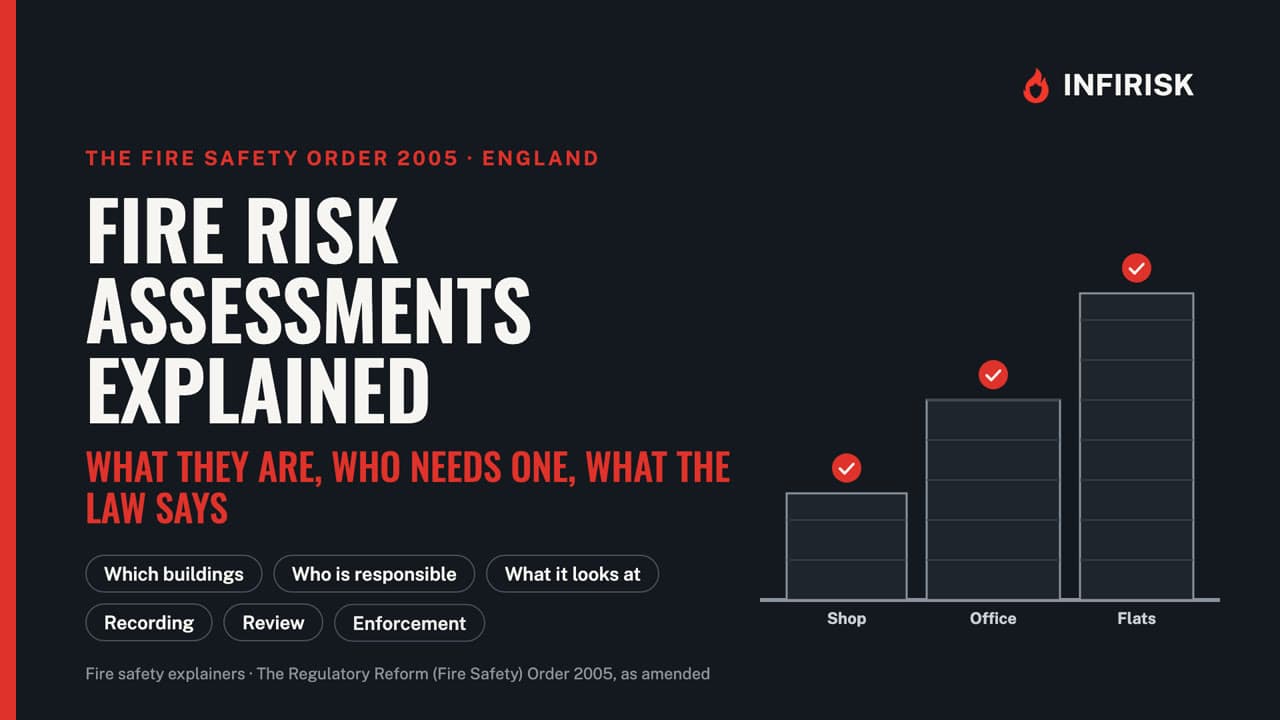
Fire risk assessments explained: who needs one, what it covers, and what the law says
The Fire Safety Order in plain English: what a fire risk assessment is, who must have one, what it looks at, what to record, and what happens if it is missing.
- 3 min readINFIRISK guideWritten guide
Awaab's Law and fire hazards: repair deadlines for social homes from November 2026
Which social homes Awaab's Law covers, what counts as a fire hazard, the emergency and significant hazard deadlines, and where the Fire Safety Order takes over.
 5:54Video and guide
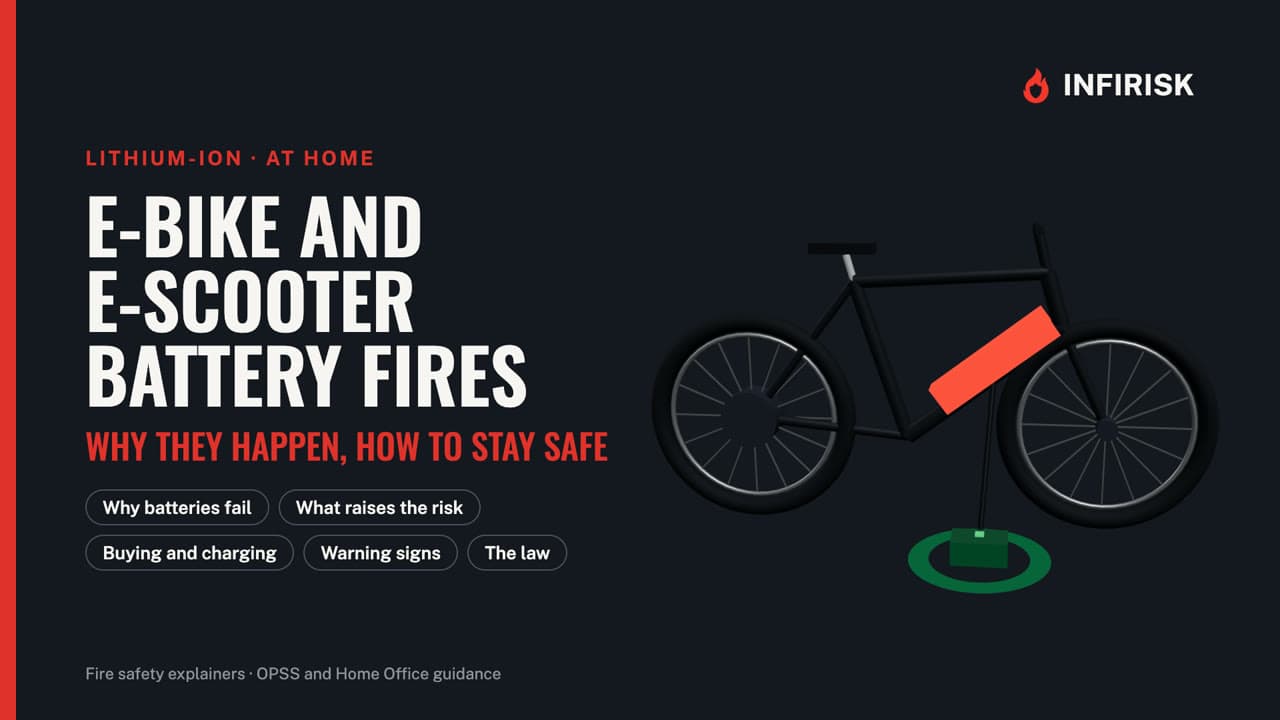
E-bike and e-scooter battery fires: buying, charging and the warning signs
Thermal runaway in plain English, what makes a fire more likely, buying and charging safely, the warning signs, and the law for sellers and shared buildings.
- 6 min readINFIRISK guideWritten guide
Fire extinguishers explained: types, colours, how many you need and servicing
What the law requires, the classes of fire, extinguisher types and colours, how many and where, kitchens, electrics and batteries, checks, servicing and training.
Related guides
 7:41Video and guide
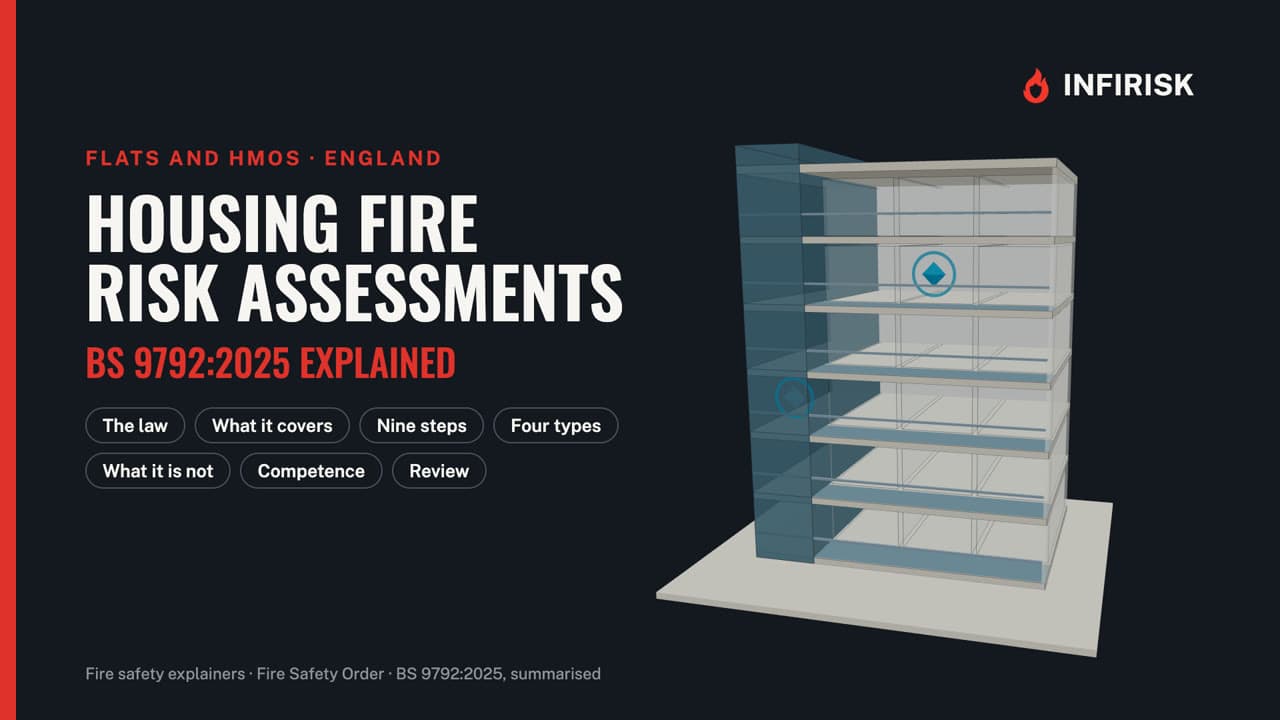
Housing fire risk assessments explained: BS 9792:2025 for flats and HMOs
The code of practice that replaced PAS 79-2: what it covers, its nine steps, the four types of assessment, competence, and how often to review an assessment.
 18:09Case study · 1987 · Transport
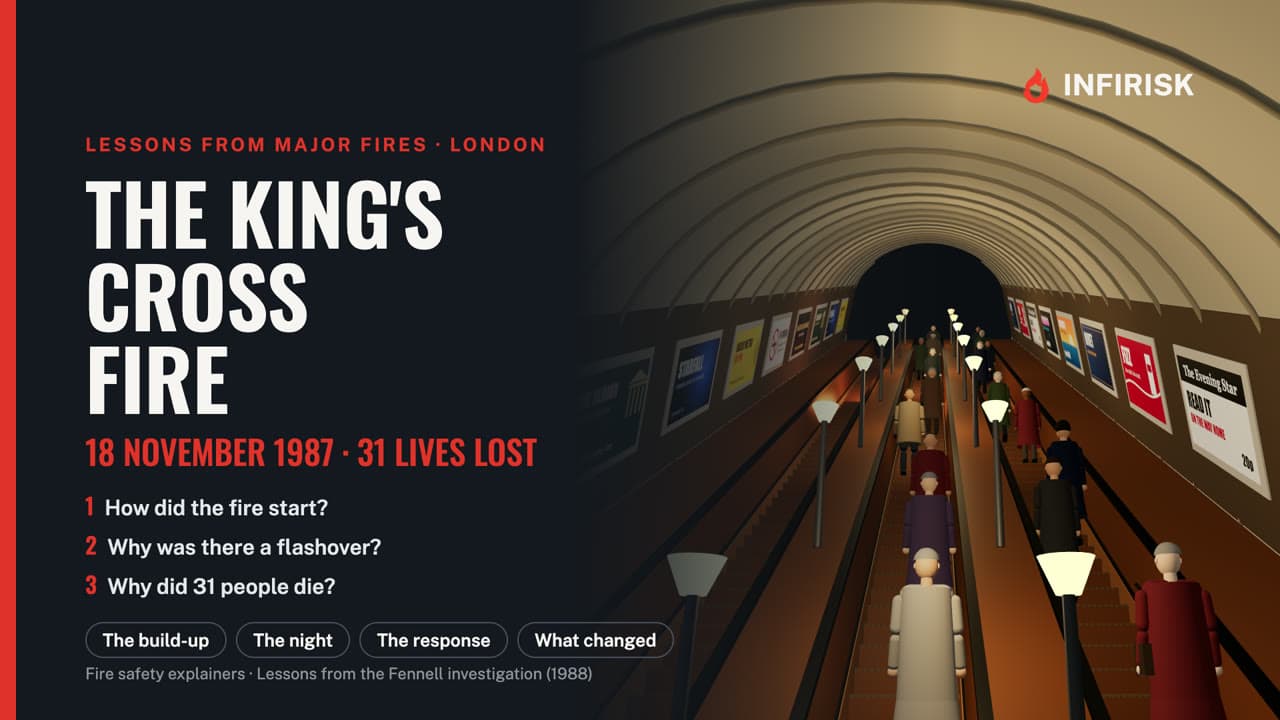
The King's Cross fire 1987 explained: the trench effect, the flashover and the Fennell investigation
How a lit match under a wooden escalator became the flashover that killed 31 people at King's Cross in 1987, why the trench effect drove it into the ticket hall, and what the Fennell investigation changed.
31 deaths, including 1 firefighter
- 2 min readINFIRISK guideWritten guide
How Much Does a Fire Risk Assessment Cost?
Typical UK prices by building and assessment type, what drives the fee, and how to buy the right scope.