How fire safety standards for blocks of flats developed
Historical: the older codes it traces are not current guidance.
Published 15 November 2026Last reviewed 15 November 2026
Older blocks of flats were generally built to the standards of their day. This guide traces how the national codes for the fire safety of blocks of flats developed, from CP 3 in 1962, the first designed for residents staying put, to Approved Document B, with the sources each paragraph rests on. The codes it names from before Approved Document B are historical: none of them is current guidance.
Find a fire risk assessor near you
The 1962 code
CP 3 Chapter IV Part 1 (1962) covered blocks of flats with a floor more than 80 ft up, beyond the reach of a fire service ladder from outside. It was the first national code to design for residents staying in their own flats above a fire, what is now called stay put.
- StandardCP 3 Chapter IV Part 1 (1962), Fire precautions in flats and maisonnettes over 80 ft in height, superseded (historical), Introduction
- GuidanceFire safety in purpose-built blocks of flats, Appendix 1, paras A1.27, A1.28, A1.45, A1.47 and A1.49
The 1971 code
Its 1971 replacement covered flats and maisonettes in blocks over two storeys. With the compartmentation between flats, fire and smoke spreading from one flat to another was unusual, so residents should be safe where they are, while anyone wishing to leave could do so unaided by protected routes inside the building. A 1978 amendment replaced the code’s advice to residents with a fire brigades’ working group’s advice that, with a fire elsewhere, they will normally be safe to stay in their flat.
- StandardCP 3 Chapter IV Part 1 (1971), Flats and maisonettes (in blocks over two storeys), superseded (historical), Foreword and 1.1
- GuidanceFire safety in purpose-built blocks of flats, Appendix 1, paras A1.27, A1.28, A1.45, A1.47 and A1.49
From 1985: functional regulations, then Approved Document B
From 1985 the Building Regulations set functional requirements; in blocks of three or more storeys, means of escape had to follow mandatory rules that pointed to the 1971 code until 1992. In 1990 that code was replaced by BS 5588-1, and since the 1991 Regulations came into force in 1992 Approved Document B has given the guidance on all the fire safety requirements. In 2011 the LGA guide expected blocks designed to the 1991 and later regulations not to need further work, provided their fire precautions stayed in place and were properly maintained; an assessment today still looks at how a block was actually built and has been altered.
- GuidanceFire safety in purpose-built blocks of flats, Appendix 1, paras A1.62 to A1.70
- StandardBS 9792 Fire risk assessment. Housing. Code of practice, clause 15.7, commentary a), and 15.7.1 to 15.7.3
Older codes and today’s guidance
These codes explain why an older block is built as it is; they are not today’s guidance. A fire risk assessor should understand the standards a block was built to, and asks whether each departure from today’s standards creates an unacceptable risk: an older standard is not unsafe because it is older, and not meeting today’s guidance does not by itself call for upgrading.
- StandardBS 9792 Fire risk assessment. Housing. Code of practice, clause 9, commentary, 9.1 and 9.2, and Figure 4
The duties today
Meeting the standard of its day settles how a block was built, not what its responsible person must do now: the duties of the Fire Safety Order apply to every block in use, however old.
- Ongoing dutyFire Safety Order 2005, Article 8(1)(b)
- Ongoing dutyFire Safety Order 2005, Article 9(1), (3), (6) and (7)
Written against
- CP 3 Chapter IV Part 1 (1962), Fire precautions in flats and maisonnettes over 80 ft in height, superseded (historical), CP 3 Chapter IV Part 1:1962
- Fire safety in purpose-built blocks of flats, 2011
- CP 3 Chapter IV Part 1 (1971), Flats and maisonettes (in blocks over two storeys), superseded (historical), CP 3 Chapter IV Part 1:1971 (amended to 1978)
- BS 9792 Fire risk assessment. Housing. Code of practice, BS 9792:2025
- The Regulatory Reform (Fire Safety) Order 2005, SI 2005/1541 as amended
More from Fire Safety Law for Business
 6:48Video and guide
Fire risk assessments explained: who needs one, what it covers, and what the law says
The Fire Safety Order in plain English: what a fire risk assessment is, who must have one, what it looks at, what to record, and what happens if it is missing.
 5:54Video and guide
E-bike and e-scooter battery fires: buying, charging and the warning signs
Thermal runaway in plain English, what makes a fire more likely, buying and charging safely, the warning signs, and the law for sellers and shared buildings.
- 6 min readINFIRISK guideWritten guide
Fire extinguishers explained: types, colours, how many you need and servicing
What the law requires, the classes of fire, extinguisher types and colours, how many and where, kitchens, electrics and batteries, checks, servicing and training.
- 4 min readINFIRISK guideWritten guide
The Fire Safety (England) Regulations 2022 explained: every duty for blocks of flats
Which buildings and parts are covered, the three height tiers, and each duty: residents, fire door checks, signs, the information box, plans, external walls and monthly checks.
Related guides
 7:41Video and guide
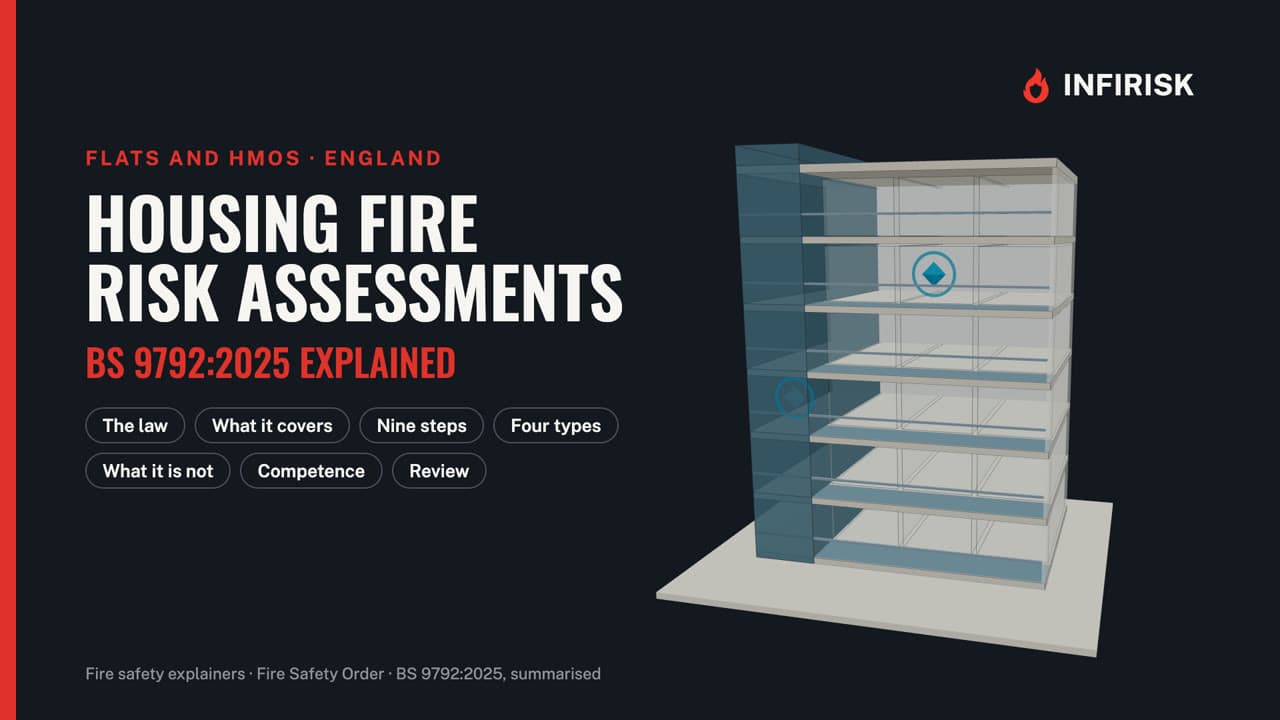
Housing fire risk assessments explained: BS 9792:2025 for flats and HMOs
The code of practice that replaced PAS 79-2: what it covers, its nine steps, the four types of assessment, competence, and how often to review an assessment.
- 2 min readINFIRISK guideWritten guide
How Much Does a Fire Risk Assessment Cost?
Typical UK prices by building and assessment type, what drives the fee, and how to buy the right scope.
- 2 min readINFIRISK guideWritten guide
Do I Need a Fire Risk Assessment?
Whether the law requires an assessment for your premises, who the responsible person is, and review timing.
- 2 min readINFIRISK guideWritten guide
How the fire safety documents work together
The law, Approved Document B, British Standards and sector guidance: what each one is, and where a fire risk assessment fits.
