How the fire safety documents work together
Published 15 November 2026Last reviewed 15 November 2026
Fire safety in a block of flats in England rests on several kinds of document: the law, Approved Document B, British Standards and sector guidance. This guide sets out what each one is and how they relate, with the sources each paragraph rests on. It was written alongside the INFIRISK 3D model of a low-rise block of flats.
Find a fire risk assessor near you
The law
The law sets the duties. The Building Regulations apply to building work and changes of use when they are done; they do not reach back to bring a standing building up to date. Once people live in a block, the Fire Safety Order puts duties on its responsible person, whenever the block was built, and in a building with two or more flats it reaches the structure, the external walls, the common parts and the flat entrance doors.
- LawBuilding Regulations 2010, Regulations 3, 4, 5 and 6
- Ongoing dutyFire Safety Order 2005, Article 8(1)(b)
- Ongoing dutyFire Safety Order 2005, Article 6(1A) and (1B)
Approved Document B
Approved Document B is guidance on one way, in ordinary circumstances, of meeting the Building Regulations in building work; there may be other ways. It guides building work and does not by itself require an existing block to be upgraded, and guidance written for assessing existing buildings is often less onerous than the guidance for new work.
- GuidanceADB Vol 1, introduction and para 0.9
- LawBuilding Regulations 2010, Regulations 3, 4, 5 and 6
British Standards
British Standards such as BS 9792 and BS 9991 are codes of practice: recommendations, not law. BS 9792 sets out how fire risk assessments of housing are made, and treats codes and published guidance as benchmarks, applied with flexibility and in proportion to the risk, so an action plan may ask for more or less than a code recommends.
- StandardBS 9792 Fire risk assessment. Housing. Code of practice, Foreword (Use of this document), clause 8, commentary, and 8.1 to 8.3
- StandardBS 9991, Foreword (Use of this document)
Sector guidance
Sector guidance, such as the LGA guide to fire safety in purpose-built blocks of flats, explains how the law and the standards apply to running existing blocks. It is guidance, not law: it introduces no new standards or regulations, and its criteria are benchmarks. The guide’s cover note says that, written in 2011, it is no longer comprehensive.
- GuidanceFire safety in purpose-built blocks of flats, paras 2.1 to 2.4 and 3.1
- GuidanceFire safety in purpose-built blocks of flats, cover note
The fire risk assessment
Whether an existing block is safe enough is judged in its fire risk assessment, made by a competent person, with an action plan in proportion to the risk that says which actions the law requires and which go further.
- Ongoing dutyFire Safety Order 2005, Article 9(1), (3), (6) and (7)
- StandardBS 9792 Fire risk assessment. Housing. Code of practice, clauses 7.1 to 7.3
- StandardBS 9792 Fire risk assessment. Housing. Code of practice, clause 19, commentary, and 19.4, 19.7 and 19.9
Written against
- The Building Regulations 2010, Schedule 1, Part B (fire safety), SI 2010/2214 as amended
- The Regulatory Reform (Fire Safety) Order 2005, SI 2005/1541 as amended
- Approved Document B (fire safety), volumes 1 and 2, 2019 edition incorporating 2020, 2022, 2025 and 2026 amendments
- BS 9792 Fire risk assessment. Housing. Code of practice, BS 9792:2025
- BS 9991 Fire safety in the design, management and use of residential buildings. Code of practice, BS 9991:2024
- Fire safety in purpose-built blocks of flats, 2011
More from Fire Safety Law for Business
 6:48Video and guide
Fire risk assessments explained: who needs one, what it covers, and what the law says
The Fire Safety Order in plain English: what a fire risk assessment is, who must have one, what it looks at, what to record, and what happens if it is missing.
 5:54Video and guide
E-bike and e-scooter battery fires: buying, charging and the warning signs
Thermal runaway in plain English, what makes a fire more likely, buying and charging safely, the warning signs, and the law for sellers and shared buildings.
- 6 min readINFIRISK guideWritten guide
Fire extinguishers explained: types, colours, how many you need and servicing
What the law requires, the classes of fire, extinguisher types and colours, how many and where, kitchens, electrics and batteries, checks, servicing and training.
- 4 min readINFIRISK guideWritten guide
The Fire Safety (England) Regulations 2022 explained: every duty for blocks of flats
Which buildings and parts are covered, the three height tiers, and each duty: residents, fire door checks, signs, the information box, plans, external walls and monthly checks.
Related guides
 7:41Video and guide
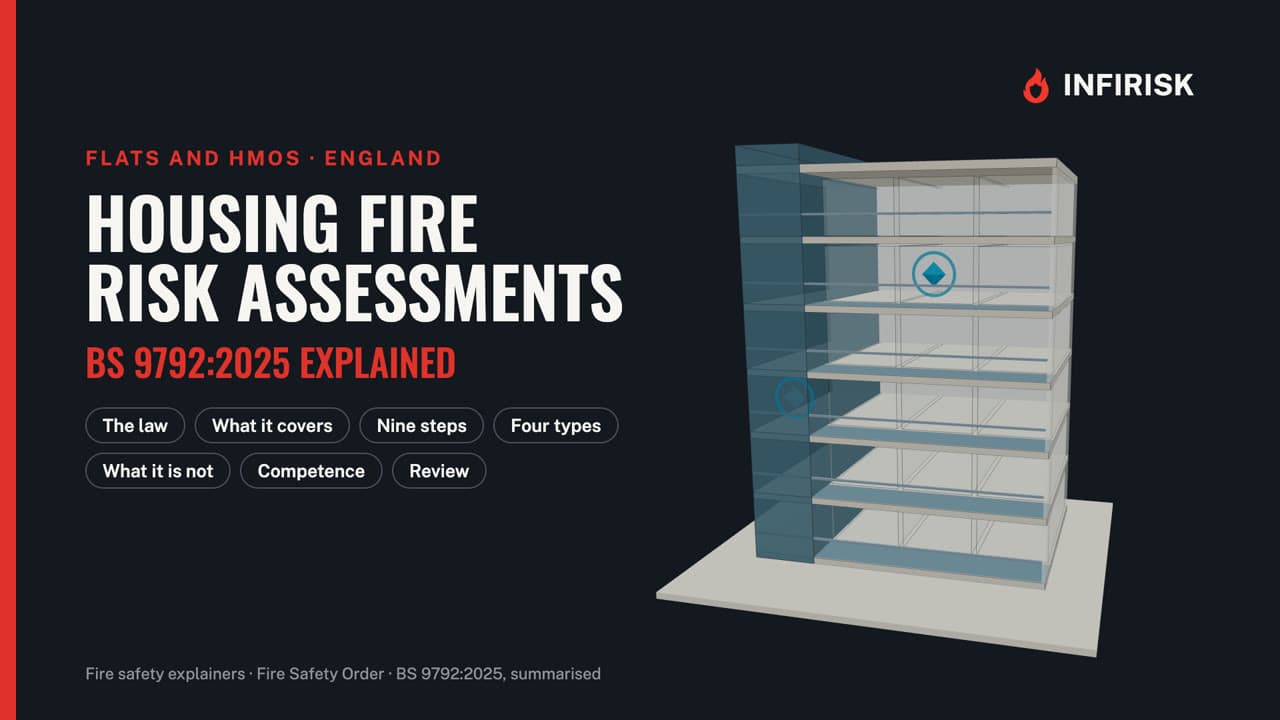
Housing fire risk assessments explained: BS 9792:2025 for flats and HMOs
The code of practice that replaced PAS 79-2: what it covers, its nine steps, the four types of assessment, competence, and how often to review an assessment.
- 2 min readINFIRISK guideWritten guide
How Much Does a Fire Risk Assessment Cost?
Typical UK prices by building and assessment type, what drives the fee, and how to buy the right scope.
- 2 min readINFIRISK guideWritten guide
Do I Need a Fire Risk Assessment?
Whether the law requires an assessment for your premises, who the responsible person is, and review timing.
- 2 min readINFIRISK guideWritten guide
How fire safety standards for blocks of flats developed
The history of the codes older blocks of flats were built to, from CP 3 in 1962 to Approved Document B, and why an assessor needs them.
