How Often Should a Fire Alarm Be Serviced?
Published 16 June 2026Last reviewed 16 June 2026
A commercial fire alarm system in the UK must be tested and serviced on a defined schedule set out in BS 5839-1. The responsible person under the Regulatory Reform (Fire Safety) Order 2005 has a legal duty to keep the system in good working order, which means a weekly user test, regular servicing by a competent contractor, and proper record keeping. This guide explains the schedule in plain terms.
The BS 5839-1 servicing schedule
There are three layers to keeping a fire alarm system maintained. The first is a weekly test, carried out by the occupier, in which a different manual call point is operated each week to confirm the panel and sounders respond. This takes a few minutes and must be recorded in the fire safety logbook.
The second layer is periodic servicing by a competent contractor. BS 5839-1 recommends inspection and servicing at intervals not exceeding six months, so most buildings are visited twice a year, with larger or higher-risk systems serviced more frequently. The third layer is an annual inspection and test of the whole system, which the same servicing contractor usually folds into the schedule of visits across the year.
Who is allowed to service a fire alarm
Weekly user tests can be done by a trained member of staff. Servicing, however, must be carried out by a competent person, which in practice means a specialist fire alarm contractor. BAFE SP203-1 is the recognised third-party certification scheme covering the design, installation, commissioning, and maintenance of fire detection and alarm systems, and many insurers and public-sector clients now expect it.
Whoever carries out the work should leave a clear service record and a certificate. A building with a maintenance contract but a weak paper trail can still fail an inspection, because the responsible person must be able to demonstrate that the system has been properly maintained.
Records and false alarms
Every test, service, fault, and false alarm should be logged. Good records are not just a compliance formality, they help the servicing engineer spot recurring problems, such as a detector in a kitchen or plant room that triggers frequent false alarms and erodes confidence in the system.
If your building suffers repeated false alarms, raise it at the next service visit. The fix is often a change of detector type or position rather than a wholesale system replacement, and reducing unwanted alarms is part of keeping the system effective.
Frequently asked questions
How often does a commercial fire alarm need servicing?
BS 5839-1 recommends servicing at intervals not exceeding six months, so most premises have their fire alarm serviced twice a year by a competent contractor, alongside a weekly user test and an annual inspection of the whole system.
Who can service a fire alarm system?
Servicing must be done by a competent person, in practice a specialist contractor. BAFE SP203-1 registration is the recognised mark of competence for fire alarm design, installation, commissioning, and maintenance.
Do I need to test the fire alarm every week?
Yes. BS 5839-1 calls for a weekly test in which a different manual call point is operated each week to confirm the system responds. The test should be recorded in the fire safety logbook.
What happens if I do not maintain my fire alarm?
The responsible person has a legal duty under the Regulatory Reform (Fire Safety) Order 2005 to keep fire safety equipment in working order. A poorly maintained system can lead to enforcement action and invalidate insurance, as well as putting people at risk.
Sources
Written against
- The Regulatory Reform (Fire Safety) Order 2005, SI 2005/1541 as amended (Article 17)
- BS 5839-1 Fire detection and fire alarm systems for buildings. Code of practice for non-domestic premises, BS 5839-1:2025
More from British Standards Explained
 4:41Video and guide
BS 5839-6 explained for landlords: smoke alarm rules for rented homes in England
The legal minimum for landlords in England, what the BS 5839-6 grades and categories mean, and what to aim for in a rented home.
 9:38Video and guide
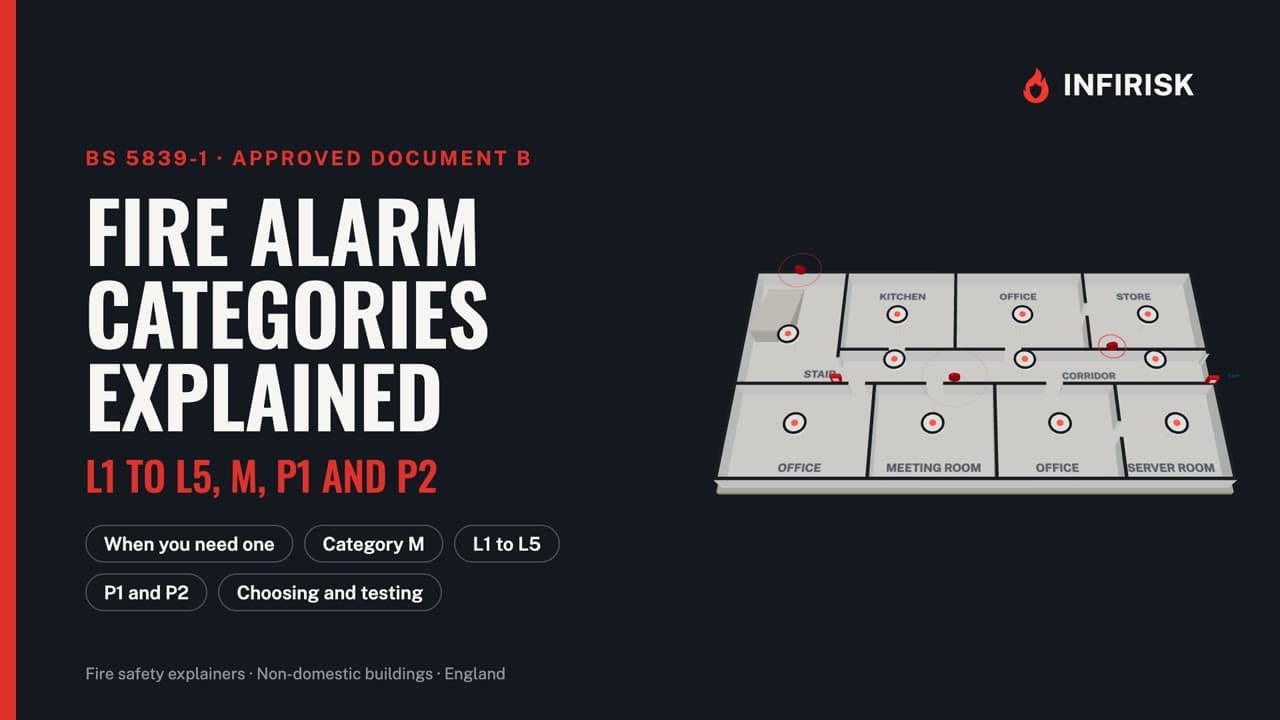
Fire alarm categories explained: BS 5839-1 L1 to L5, M, P1 and P2
What each BS 5839-1 fire alarm category covers, what changed in 2025, where call points go, how loud the alarm must be, and how to test and maintain a system.
 9:54Video and guide
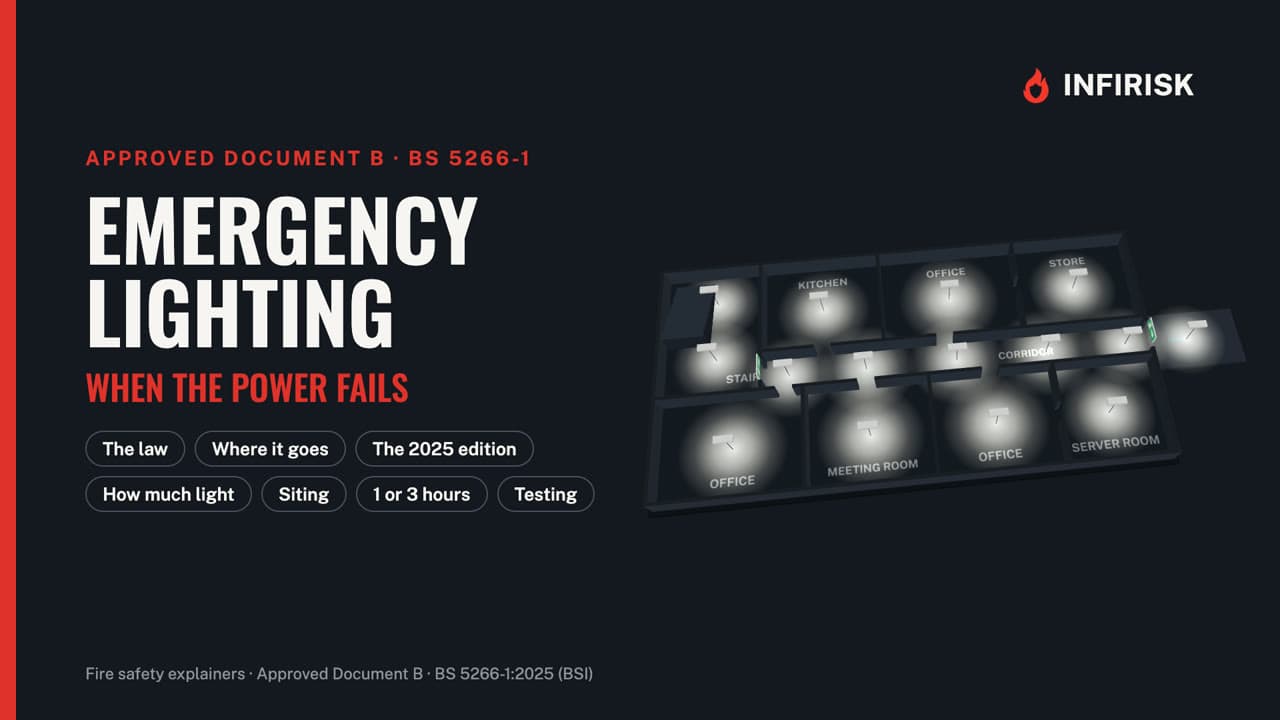
Emergency lighting explained: where it's needed, how much light, and testing
What emergency lighting is, when the law requires it, where Approved Document B expects it, the 2025 edition of BS 5266-1, light levels, siting, duration and testing.
- 6 min readINFIRISK guideWritten guide
Fire extinguishers explained: types, colours, how many you need and servicing
What the law requires, the classes of fire, extinguisher types and colours, how many and where, kitchens, electrics and batteries, checks, servicing and training.